
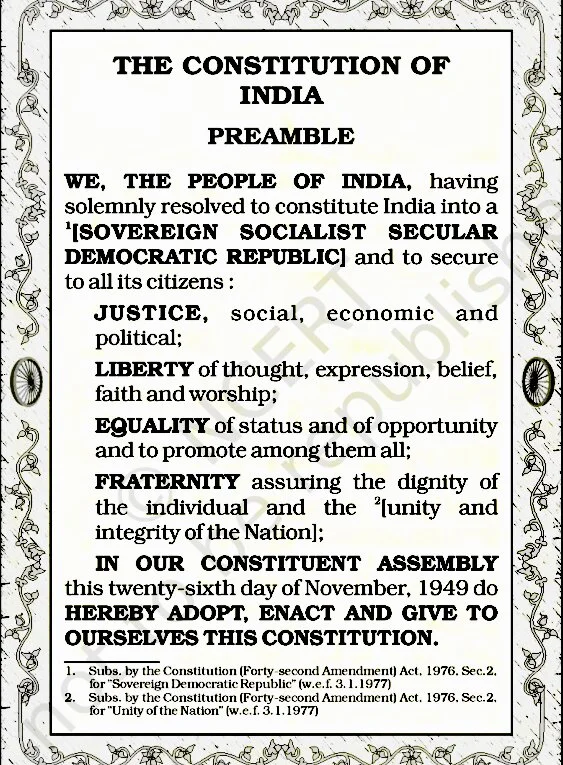
The Preamble to the Indian Constitution is a brief introductory statement that reflects the philosophy, values, and aspirations on which the Constitution is founded. It works like the preface of the Constitution, encapsulating its essence and guiding spirit. It declares India to be a Sovereign, Socialist, Secular, Democratic Republic committed to Justice, Liberty, Equality and Fraternity.
Though the Preamble does not confer enforceable rights, it acts as a guiding light in interpreting the Constitution and understanding the intention of its framers.
What is a Preamble?
A preamble is the opening statement of a document that:
- explains its aims and underlying philosophy
- reflects the intent of the framers
- serves as an interpretative aid when provisions are ambiguous
In constitutional law, the preamble expresses the ideals, goals, and guiding principles of the nation.
Inspiration and Evolution of the Preamble
The inspiration for the Indian Preamble came from Jawaharlal Nehru’s Objectives Resolution, moved on 13 December 1946 and adopted on 22 January 1947 in the Constituent Assembly.
The Objectives Resolution declared that:
- India would be an independent sovereign republic
- power would rest with the people
- the Constitution would guarantee justice, equality, liberty
- adequate safeguards would exist for minorities and backward communities
Later, B.N. Rau prepared an initial draft, after extensive debate in the Assembly the final text was adopted on 26 November 1949 and enforced from 26 January 1950.
What The Preamble Reads?
WE, THE PEOPLE OF INDIA, having solemnly resolved to constitute India into a SOVEREIGN SOCIALIST SECULAR DEMOCRATIC REPUBLIC and to secure to all its citizens:
JUSTICE, social, economic and political
LIBERTY of thought, expression, belief, faith and worship
EQUALITY of status and opportunity
and to promote among them all
FRATERNITY assuring the dignity of the individual and the unity and integrity of the NationIN OUR CONSTITUENT ASSEMBLY, this twenty-sixth day of November, 1949, do HEREBY ADOPT, ENACT AND GIVE TO OURSELVES THIS CONSTITUTION.
What the Preamble Indicates?
The Preamble conveys four core elements:
- Source of authority – “We the People”
- Nature of the polity – Sovereign, Socialist, Secular, Democratic, Republic
- Objectives – Justice, Liberty, Equality, Fraternity
- Date of adoption – 26 November 1949
What is the Nature of the Indian State?
1. Sovereign
India is internally and externally independent:
- not a dominion of any power
- free in decision-making in domestic and foreign affairs
- UN or Commonwealth membership does not dilute sovereignty
2. Socialist
Added by the 42nd Constitutional Amendment, 1976
India follows democratic socialism:
- mixed economy (public + private sectors)
- focus on reducing inequalities
- reflected in Directive Principles of State Policy
3. Secular
Also added by 42nd Amendment, 1976
Features of Indian secularism:
- equal respect for all religions
- freedom of conscience
- no state religion
- Articles 25–28 guarantee religious freedom
4. Democratic
India has:
- representative parliamentary democracy
- universal adult franchise
- periodic elections
- rule of law
- political equality
5. Republic
- elected head of state (President)
- no hereditary ruler
- sovereignty ultimately lies with people
Objectives Enshrined in the Preamble:
1. Justice
Inspired partly by the Russian Revolution
Justice has three aspects:
- Social – end of caste, gender, and status discrimination
- Economic – equitable distribution of wealth and resources
- Political – equal political rights and universal adult suffrage
2. Liberty
Borrowed from French Revolution
Liberty means:
- freedom of thought and expression
- freedom of belief, faith, worship
- development of individual personality
Liberty is not absolute; it is regulated by law to protect others’ rights.
3. Equality
Equality ensures:
- absence of privilege
- equal access to opportunities
- equality before law
Dimensions include:
- civic equality – Articles 14–18
- political equality – Articles 325 & 326 (adult suffrage)
- economic equality – Directive Principles
4. Fraternity
Fraternity means:
- sense of brotherhood
- unity and integrity of the nation
- dignity of the individual
The term “integrity” was added by the 42nd Amendment.
Relationship Between Liberty, Equality, and Fraternity
These ideals form a trinity and cannot be separated:
- Liberty without equality → dominance of elite
- Equality without liberty → suppression of individuality
- Without fraternity → both liberty & equality are fragile
Is the Preamble a Part of the Constitution?
The Supreme Court’s interpretation evolved over time:
Berubari Union Case (1960)
- Preamble is a key to the Constitution’s spirit
- but not a part of the Constitution
Kesavananda Bharati Case (1973)
- Preamble is a part of the Constitution
- it reflects basic structure
- helps interpretation of constitutional provisions
LIC of India Case (1995)
- reaffirmed Preamble as an integral part
- but not directly enforceable in court
Can the Preamble Be Amended?
Yes — but basic structure cannot be altered
- clarified in Kesavananda Bharati (1973)
- amended only once through 42nd Amendment Act, 1976
Changes made by 42nd Amendment:
Added words:
- Socialist
- Secular
- Integrity
Changed:
- “Unity of the Nation” → “Unity and Integrity of the Nation”
Significance of the Preamble:
- expresses spirit and philosophy of Constitution
- acts as interpretative aid for courts
- defines constitutional identity
- embodies values of independence movement
- promotes unity in diversity
It is rightly called the soul, essence and preface of the Constitution.
What our Constitutional Framers Said:
- K. M. Munshi: Referred to the Preamble as the “horoscope of the Constitution.”
- Pandit Thakurdas Bhargava: Described the Preamble as the “soul of the Constitution.”
- N. A. Palkhivala: Called the Preamble the “identity card of the Constitution” and its philosophical core.
How is this topic relevant for UPSC?
The Preamble is important for:
- GS Paper-2
- Polity prelims
- Essay
- Ethics (value principles)
- Constitutional law interpretation
Preamble of the Indian Constitution – UPSC PYQs
Mains
Q1. (2016 – GS Paper 2)
Discuss each adjective attached to the word ‘Republic’ in the Preamble. Are they defendable in the present circumstances? – 12.5 Marks
Prelims
Q2. (2020)
The Preamble to the Constitution of India is:
A. A part of the Constitution but has no legal effect
B. Not a part of the Constitution and has no legal effect either
C. Part of the Constitution and has the same legal effect as any other part
D. A part of the Constitution but has no legal effect independently of other parts
Answer: D
Q3. (2017)
The mind of the makers of the Constitution of India is reflected in which of the following?
A. The Preamble
B. The Fundamental Rights
C. The Directive Principles of State Policy
D. The Fundamental Duties
Answer: A
Q4. (2013)
‘Economic Justice’ as one of the objectives of the Indian Constitution has been provided in:
A. The Preamble and the Fundamental Rights
B. The Preamble and the Directive Principles of State Policy
C. The Fundamental Rights and the Directive Principles of State Policy
D. None of the above
Answer: B
Q5. (2020)
Which one of the following objectives is NOT embodied in the Preamble of the Constitution of India?
A. Liberty of thought
B. Economic liberty
C. Liberty of expression
D. Liberty of belief
Answer: B
La Excellence offers you a one-to-one Personal Mentorship. Here you can register :
For more such preparation strategies, you can read here: https://laex.in/category/preparation-strategy/
La Excellence IAS Academy, the best IAS coaching in Hyderabad, known for delivering quality content and conceptual clarity for UPSC 2025 preparation.
FOLLOW US ON:
◉ Youtube : https://www.youtube.com/@CivilsPrepTeam
◉ Facebook: https://www.facebook.com/LaExcellenceIAS
◉ Instagram: https://www.instagram.com/laexcellenceiasacademy/
GET IN TOUCH:
Contact us at info@laex.in, https://laex.in/contact-us/
or Call us @ +91 9052 29 2929, +91 9052 99 2929, +91 9154 24 2140
OUR BRANCHES:
Head Office: H No: 1-10-225A, Beside AEVA Fertility Center, Ashok Nagar Extension, VV Giri Nagar, Ashok Nagar, Hyderabad, 500020
Madhapur: Flat no: 301, survey no 58-60, Guttala begumpet Madhapur metro pillar : 1524, Rangareddy Hyderabad, Telangana 500081
Bangalore: Plot No: 99, 2nd floor, 80 Feet Road, Beside Poorvika Mobiles, Chandra Layout, Attiguppe, Near Vijaya Nagara, Bengaluru, 560040