
Why in News?
A 24-year study reveals a 50% decline in coral cover in Lakshadweep since 1998 due to repeated marine heatwaves intensified by climate change. The findings highlight the role of local conditions in reef resilience and recovery potential.
Description:
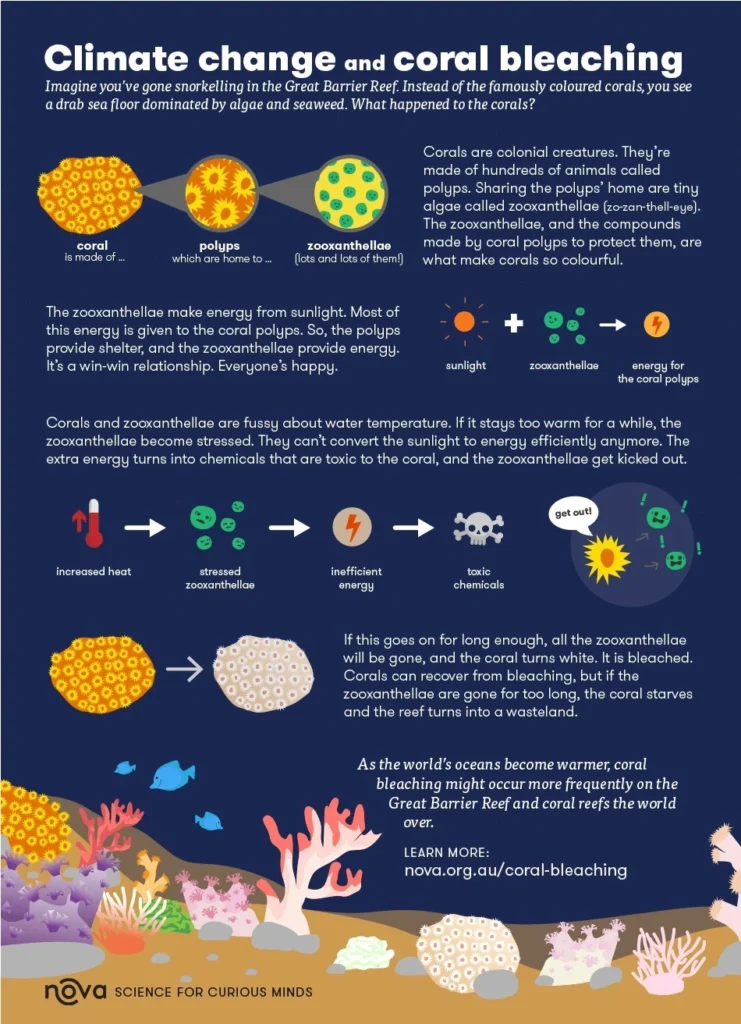
Coral reefs are marine ecosystems formed by colonies of tiny animals called coral polyps, which secrete calcium carbonate to form hard skeletons. These structures support a wide range of marine biodiversity.
- Known as “Rainforests of the Sea“
- Cover <0.1% of the ocean floor, but support ~25% of marine species
- Corals live symbiotically with zooxanthellae algae
Ideal Conditions for Coral Reef Formation:
| Factor | Ideal Range/Requirement |
| Temperature | 23°C to 29°C |
| Depth | Less than 50 meters (for sunlight penetration) |
| Salinity | Stable and high salinity |
| Water | Clear and low nutrient (oligotrophic) |
| Substrate | Hard surface (e.g. volcanic rocks) |
Types of Coral Reefs:
| Type | Description |
| Fringing | Directly attached to the shore (e.g. Gulf of Mannar, Andamans) |
| Barrier | Separated from the land by a lagoon (e.g. Great Barrier Reef) |
| Atolls | Ring-shaped reefs surrounding a lagoon (e.g. Lakshadweep) |
| Patch | Isolated small reefs, often found in lagoons (e.g. Gulf of Kutch) |
Coral Reef Locations (World):
- Coral Triangle: Indonesia, Philippines, Malaysia, PNG, Solomon Islands
- Great Barrier Reef: Australia
- Red Sea Reefs: Egypt, Sudan, Saudi Arabia
- Indian Ocean: Maldives, Seychelles
- Caribbean: Belize, Bahamas
- Pacific: Fiji, Marshall Islands
- Atlantic: Bermuda, Brazil
Coral Reefs in India:
| Region | Type | Features |
| Gulf of Kutch | Fringing | High salinity, tidal fluctuations |
| Gulf of Mannar | Fringing | >3,600 species, Biosphere Reserve |
| Palk Bay | Fringing | High sedimentation, resilient corals |
| Andaman & Nicobar | Fringing, Patch, Barrier | Diverse fauna, clownfish, reef sharks |
| Lakshadweep | Atolls | Coral banks, tuna fisheries, seaweed cultivation |
Importance of Coral Reefs:
Environmental:
- Biodiversity hotspot (25% of marine species)
- Coastal protection (reduce wave energy up to 97%)
- Carbon sink & ecosystem balance
Economic:
- Fisheries: ~500 million people depend on them
- Tourism: ~$36 billion/year globally
- Jobs: Fishing, diving, boat tours, etc.
Scientific/Medicinal:
- Marine organisms yield anti-cancer, HIV, and anti-inflammatory drugs
Cultural/Heritage:
- Integral to Pacific island cultures
- Reefs preserve shipwrecks and artefacts
Threats to Coral Reefs:
Climate Change:
- Bleaching due to ocean warming (e.g. 2016 El Niño → 29% of GBR bleached)
- Ocean Acidification weakens coral skeletons
- Sea-level rise → sedimentation
- Increased storm frequency
Pollution:
- Marine debris (plastics, oil, toxins)
- Fertilizer runoff → algal blooms
- Wastewater discharge
Overfishing:
- Disrupts food chains
- Destructive practices: blast fishing, cyanide fishing
Coastal Development:
- Sedimentation and habitat loss
- Dredging, tourism infrastructure
Human Activities:
- Unsustainable tourism
- Coral mining
- Recreational diving damage
Conservation Efforts:
Global Initiatives:
- ICRI: International Coral Reef Initiative
- CTI: Coral Triangle Initiative
- GCRMN: Global Coral Reef Monitoring Network
- Aichi Target 10: Minimize climate-related coral damage
- UNESCO WHS: Protects key reef sites
Indian Initiatives:
- Wildlife Protection Act, 1972: Hard corals in Schedule I
- Environment Protection Act, 1986: Pollution control
- CRZ Notification 1991/2011: Bans coral mining
- Island Protection Zone (IPZ)
- Marine Protected Areas (MPAs)
- Coral Reef Research Centre: Andaman & Nicobar
Way Forward:
- Stricter enforcement of environmental laws
- Restoration: Coral gardening, Biorock Technology
- Carbon mitigation: Reduce emissions
- Community awareness
- International cooperation on marine conservation
La Excellence IAS Academy, the best IAS coaching in Hyderabad, known for delivering quality content and conceptual clarity for UPSC 2025 preparation.
FOLLOW US ON:
◉ YouTube : https://www.youtube.com/@CivilsPrepTeam
◉ Facebook: https://www.facebook.com/LaExcellenceIAS
◉ Instagram: https://www.instagram.com/laexcellenceiasacademy/
GET IN TOUCH:
Contact us at info@laex.in, https://laex.in/contact-us/
or Call us @ +91 9052 29 2929, +91 9052 99 2929, +91 9154 24 2140
OUR BRANCHES:
Head Office: H No: 1-10-225A, Beside AEVA Fertility Center, Ashok Nagar Extension, VV Giri Nagar, Ashok Nagar, Hyderabad, 500020
Madhapur: Flat no: 301, survey no 58-60, Guttala begumpet Madhapur metro pillar: 1524, Rangareddy Hyderabad, Telangana 500081
Bangalore: Plot No: 99, 2nd floor, 80 Feet Road, Beside Poorvika Mobiles, Chandra Layout, Attiguppe, Near Vijaya Nagara, Bengaluru, 560040