
Context
Recent archaeological discoveries have renewed interest in the Silk Road. Evidence of 4,000-year-old sericulture in Uzbekistan and exploration of a submerged medieval settlement in Kyrgyzstan’s Lake Issyk-Kul highlight Central Asia’s early role in Eurasian trade and cultural exchange.
Background
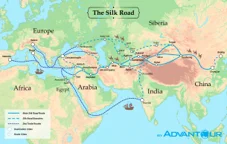
- The Silk Road was a network of land and maritime trade routes, not a single road, connecting East, Central, South and West Asia.
- It became especially important from around the 2nd century BCE, when China’s Han dynasty expanded contacts with Central Asia.
- Chinese silk was a major traded commodity, alongside horses, spices, metals, textiles and other goods.
- The routes connected China, Central Asia, India, Persia and the Mediterranean region.
- They facilitated the spread of Buddhism from India to Central Asia and China, along with Christianity, Manichaeism and Islam.
- Papermaking, art, medicine, astronomy and musical traditions also travelled across these networks.
- Its relative importance declined as Indian Ocean maritime trade became cheaper and safer.
La Excellence IAS Academy, the best IAS coaching in Hyderabad, known for delivering quality content and conceptual clarity for UPSC 2026 preparation.
FOLLOW US ON:
◉ YouTube : https://www.youtube.com/@CivilsPrepTeam
◉ Facebook: https://www.facebook.com/LaExcellenceIAS
◉ Instagram: https://www.instagram.com/laexcellenceiasacademy/
GET IN TOUCH:
Contact us at info@laex.in, https://laex.in/contact-us/
or Call us @ +91 9052 29 2929, +91 9052 99 2929, +91 9154 24 2140
OUR BRANCHES:
Head Office: H No: 1-10-225A, Beside AEVA Fertility Center, Ashok Nagar Extension, VV Giri Nagar, Ashok Nagar, Hyderabad, 500020
Madhapur: Flat no: 301, survey no 58-60, Guttala begumpet Madhapur metro pillar: 1524, Rangareddy Hyderabad, Telangana 500081
Bangalore: Plot No: 99, 2nd floor, 80 Feet Road, Beside Poorvika Mobiles, Chandra Layout, Attiguppe, Near Vijaya Nagara, Bengaluru, 560040