
Paper: GS – III, Subject: Environment and Ecology, Topic: Biodiversity and its Conservation, Issue: Human – Animal Conflict.
Context:
India continues to witness frequent elephant deaths due to train collisions, most recently in Assam’s Hojai district, where a passenger train rammed into a herd, killing several elephants.
Key Takeaways:
Key Facts & Background:
- India hosts over 52,000 Asian elephants (largest global population).
- Train collisions are a leading cause of elephant mortality.
- 2010–2020:
- 1,160 elephants died due to non-natural causes.
- Electrocution is the second-largest killer (741 deaths).
The Problem: Elephant Deaths in Train Hits:
- High Mortality Rate: Train collisions are a major cause of elephant deaths in India. Between 2010 and 2020, 186 elephants were killed by trains, making it the second-largest cause of non-natural elephant deaths after electrocution.
- Impact of Linear Transport Infrastructure (LTI): Railways, roads, and canals fragment elephant habitats, restrict their access to resources, and increase the risk of collisions.
- Collisions occur more frequently:
- At night
- During harvest season
- In forest–agriculture interface zones
- Railways often pass through elephant corridors, fragmenting habitats.
| Project Elephant: Centrally Sponsored Scheme (launched in 1992). Unlike the NTCA, the Steering Committee is an administrative oversight body. Objective: Protection of elephants, their habitats, and corridors; addressing human-elephant conflict. Key Updates SAIEE 2021-25 Results: First-ever DNA-based Synchronous All India Elephant Estimation. Regional Stronghold: The Western Ghats landscape hosts the largest population (11,934). DNA Profiling: Progress reviewed on the DNA profiling of captive elephants to improve welfare and prevent illegal trade. |

- Invasive Species: Management of invasive flora (like Lantana) in tiger and elephant habitats was flagged as a major threat to prey/forage availability.
Initiative for Protecting Elephants:
- MIKE Programme: CITES-mandated initiative (since 2003) to monitor illegal elephant killings and strengthen management and enforcement in elephant range states.
- Haathi Mere Saathi: MoEF–WTI awareness campaign launched in 2011 under Elephant-8 to promote human–elephant coexistence.
- Project RE-HAB: KVIC bee-fence initiative (2021) using beehives to deter elephants, reducing human–elephant conflict by over 70%.
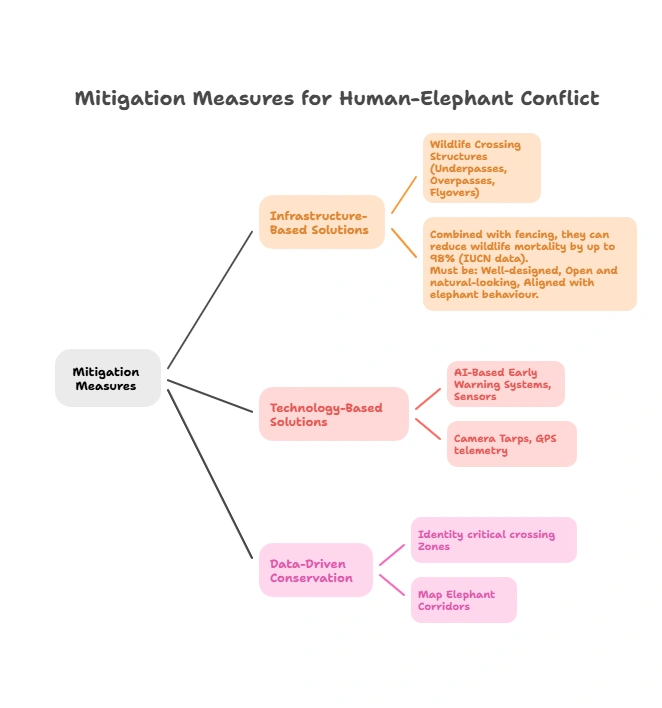
Preventing elephant deaths on railway tracks requires a blended strategy ecologically sensitive infrastructure, intelligent technology, and data-driven planning. Conservation must be embedded into development, not treated as an afterthought.
https://indianexpress.com/article/explained/how-elephants-can-be-protected-from-train-hits-10431606
La Excellence IAS Academy, the best IAS coaching in Hyderabad, known for delivering quality content and conceptual clarity for UPSC 2025 preparation.
FOLLOW US ON:
◉ YouTube : https://www.youtube.com/@CivilsPrepTeam
◉ Facebook: https://www.facebook.com/LaExcellenceIAS
◉ Instagram: https://www.instagram.com/laexcellenceiasacademy/
GET IN TOUCH:
Contact us at info@laex.in, https://laex.in/contact-us/
or Call us @ +91 9052 29 2929, +91 9052 99 2929, +91 9154 24 2140
OUR BRANCHES:
Head Office: H No: 1-10-225A, Beside AEVA Fertility Center, Ashok Nagar Extension, VV Giri Nagar, Ashok Nagar, Hyderabad, 500020
Madhapur: Flat no: 301, survey no 58-60, Guttala begumpet Madhapur metro pillar: 1524, Rangareddy Hyderabad, Telangana 500081
Bangalore: Plot No: 99, 2nd floor, 80 Feet Road, Beside Poorvika Mobiles, Chandra Layout, Attiguppe, Near Vijaya Nagara, Bengaluru, 560040