
Paper: GS-III, Subject: Economy, Topic: Taxation, Issue: Health Tax on Foods High in Fat, Sugar and Salt (HFSS foods)
Context:
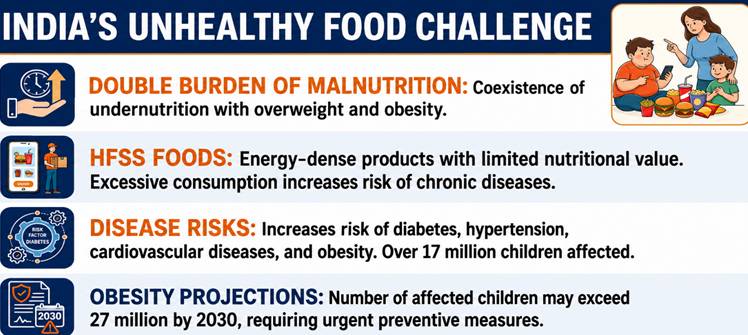
Recently, a Parliamentary Standing Committee recommended mandatory front-of-pack nutrition labelling for packaged foods. A national nutrition consortium also proposed a health tax and stricter advertising rules for foods high in fat, sugar and salt (HFSS foods) to address rising obesity and diet-related diseases.
Explanation
Major Recommendations
- Introduce a health tax to make unhealthy food relatively expensive and discourage excessive consumption.
- Mandate clear front-of-pack nutrition labels indicating high sugar, salt or fat content.
- Include the sugar content of baby foods within food-labelling requirements.
- Regulate advertisements and marketing of unhealthy foods, particularly those targeting children.
- Create healthier school food environments by restricting the sale and promotion of HFSS products.
Significance
- A health tax can encourage consumers to choose healthier alternatives.
- It can reduce long-term expenditure on treating non-communicable diseases.
- Tax revenue may support nutrition education and preventive healthcare programmes.
- Since 2017, at least 133 countries have introduced or increased health-related taxes.
Challenges
- Food companies may pass the tax burden entirely to consumers.
- Defining and classifying HFSS foods can be technically difficult.
- Weak monitoring may permit misleading labels and advertisements.
- Taxation alone may disproportionately affect lower-income households without affordable healthy alternatives.
Way Forward
- The Food Safety and Standards Authority of India should establish science-based nutrient thresholds and simple warning labels.
- Taxation must be combined with awareness campaigns, healthier school meals and strict advertising controls.
- Independent monitoring should assess changes in consumption, obesity and industry practices.
Conclusion
A health tax can serve as an effective public-health nudge, but it cannot operate in isolation. India requires an integrated strategy combining fiscal policy, transparent labelling, nutrition education and access to affordable healthy food.
Source: (The Hindu)
La Excellence IAS Academy, the best IAS coaching in Hyderabad, known for delivering quality content and conceptual clarity for UPSC 2026 preparation.
FOLLOW US ON:
◉ YouTube : https://www.youtube.com/@CivilsPrepTeam
◉ Facebook: https://www.facebook.com/LaExcellenceIAS
◉ Instagram: https://www.instagram.com/laexcellenceiasacademy/
GET IN TOUCH:
Contact us at info@laex.in, https://laex.in/contact-us/
or Call us @ +91 9052 29 2929, +91 9052 99 2929, +91 9154 24 2140
OUR BRANCHES:
Head Office: H No: 1-10-225A, Beside AEVA Fertility Center, Ashok Nagar Extension, VV Giri Nagar, Ashok Nagar, Hyderabad, 500020
Madhapur: Flat no: 301, survey no 58-60, Guttala begumpet Madhapur metro pillar: 1524, Rangareddy Hyderabad, Telangana 500081
Bangalore: Plot No: 99, 2nd floor, 80 Feet Road, Beside Poorvika Mobiles, Chandra Layout, Attiguppe, Near Vijaya Nagara, Bengaluru, 560040