
Paper: GS-III | Subject: Economy (E) | Topic: Agriculture – Inputs (E23) | Issue: Hydrocarbon dependence and food-to-fuel diversion
Context
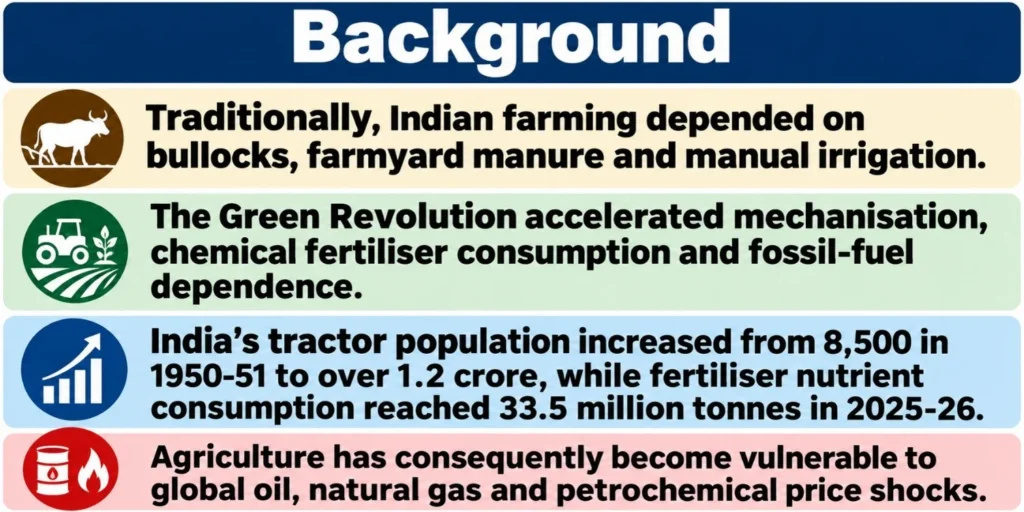
Conflicts in West Asia and the Black Sea region, coupled with the possibility of a strong El Niño, are exposing Indian agriculture to a “double bind”: growing dependence on fossil fuels for cultivation (fossilisation) and increasing diversion of food crops towards biofuel production (fuelisation).
Explanation
1. Fossilisation of Farming: The Input-Side Squeeze
Fossilisation refers to agriculture’s growing dependence on hydrocarbons for producing crops.
- Machinery: Tractors, harvesters and irrigation pumps require diesel or electricity, increasing exposure to energy prices.
- Fertilisers: Natural gas is a major feedstock for manufacturing urea, while sulphur from petroleum refining is essential for phosphatic fertilisers such as DAP.
- Pesticides: Insecticides, herbicides and fungicides depend on petrochemical derivatives such as benzene, toluene and naphtha.
- Geopolitical impact: West Asian and Black Sea conflicts have raised LNG prices from approximately $11 to $30 per million British thermal units and sulphur prices to $1,000-1,100 per tonne.
Consequently, distant energy conflicts translate into higher cultivation costs, fertiliser subsidies and import bills.
2. Fuelisation of Food: The Output-Side Squeeze
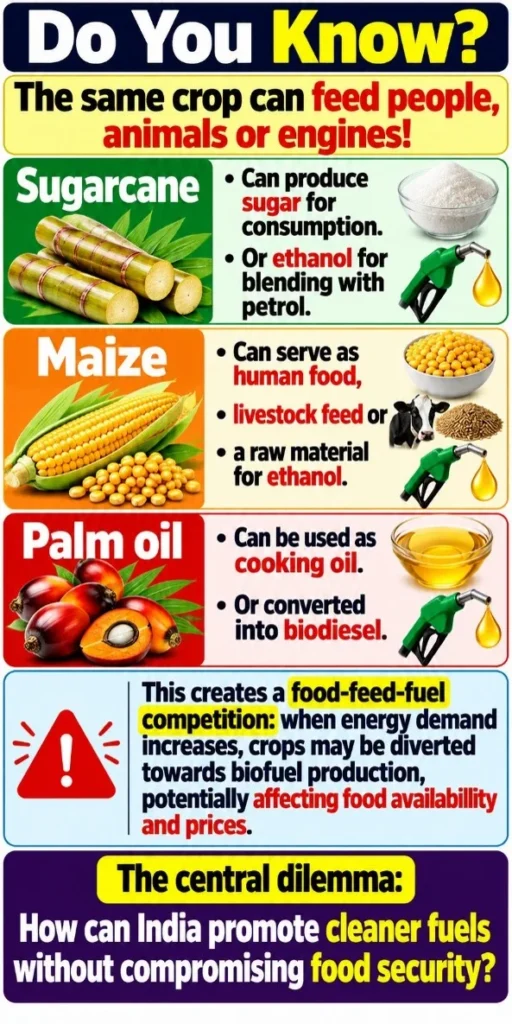
Fuelisation refers to the diversion of agricultural produce from food markets towards biofuel production.
- Ethanol: India uses sugarcane, maize and grains to produce ethanol for blending with petrol.
- Biodiesel: Vegetable oils, including palm and soybean oils, can be converted into biodiesel.
- Global example: Indonesia’s 50% palm oil-based biodiesel blending mandate increases competition for edible oils.
- Food versus fuel: Higher crude prices encourage crop diversion, potentially increasing food prices and reducing availability.
However, biofuel demand can also benefit farmers through additional markets and better prices. The problem arises when energy demand competes with food security during shortages.
3. El Niño: The Compounding Climate Threat
- El Niño may weaken monsoon rainfall, reduce crop yields and increase irrigation requirements.
- Lower production combined with continued biofuel demand could intensify food inflation.
- In 1979-80, simultaneous energy and climate shocks coincided with a 12.8% contraction in agricultural output.
4. Way Forward
- Promote balanced fertilisers, biostimulants and improved nutrient-use efficiency.
- Expand solar irrigation pumps and drip irrigation.
- Diversify farm incomes through horticulture, dairy and allied activities.
- Regulate food-crop diversion during shortages, prioritising food security.
Conclusion
India’s agricultural resilience increasingly depends on its energy security and climate preparedness. Reducing hydrocarbon dependence while balancing biofuel ambitions with food requirements is essential for protecting farmers’ incomes, controlling inflation and ensuring long-term food security.
Source: (The Indian Express)
La Excellence IAS Academy, the best IAS coaching in Hyderabad, known for delivering quality content and conceptual clarity for UPSC 2026 preparation.
FOLLOW US ON:
◉ YouTube: https://www.youtube.com/@CivilsPrepTeam
◉ Facebook: https://www.facebook.com/LaExcellenceIAS
◉ Instagram: https://www.instagram.com/laexcellenceiasacademy/
GET IN TOUCH:
Contact us at info@laex.in, https://laex.in/contact-us/
or Call us @ +91 9052 29 2929, +91 9052 99 2929, +91 9154 24 2140
OUR BRANCHES:
Head Office: H No: 1-10-225A, Beside AEVA Fertility Center, Ashok Nagar Extension, VV Giri Nagar, Ashok Nagar, Hyderabad, 500020
Madhapur: Flat no: 301, survey no 58-60, Guttala begumpet Madhapur metro pillar: 1524, Rangareddy Hyderabad, Telangana 500081
Bangalore: Plot No: 99, 2nd floor, 80 Feet Road, Beside Poorvika Mobiles, Chandra Layout, Attiguppe, Near Vijaya Nagara, Bengaluru, 560040