
Paper: GS-III, Subject: Economy, Topic: Agricultural Inputs and Fertiliser Subsidies, Issue: Soil Health Crisis, NPK Imbalance and Fertiliser Subsidy Reforms
Context
Recently, the Union Agriculture Minister launched Khet Bachao Abhiyan, a nationwide campaign under the slogan “Save the Soil, Save Farming, Save Farmers.” The campaign promotes balanced fertiliser use and sustainable agriculture to protect soil health. It also highlights growing nutrient imbalances linked to India’s fertiliser subsidy policies.
Explanation
Why Has Fertiliser Use Become Imbalanced?
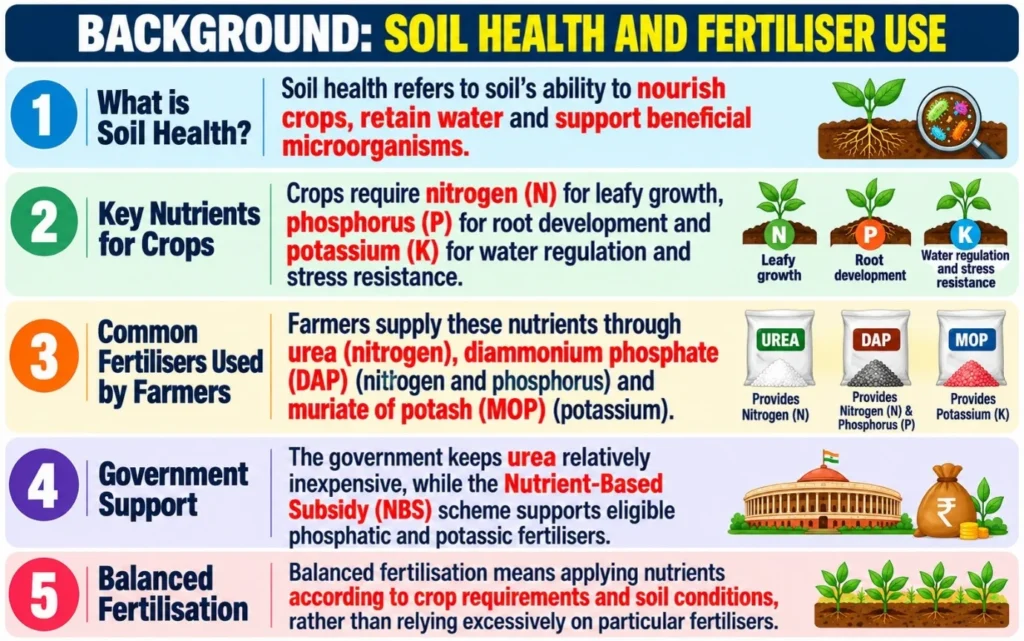
- Cheap urea encourages farmers to apply excessive nitrogen while neglecting phosphorus and potassium requirements.
- A study covering 20 states found an actual nitrogen–phosphorus–potassium (N:P:K) ratio of 10.5:4.1:1, against a recommended 2.8:1.5:1.
- This means farmers applied 10.5 units of nitrogen and 4.1 units of phosphorus for every unit of potassium.
- The comparison reveals disproportionate nitrogen use, although specific nutrient requirements vary across crops and soils.
- Subsidised electricity and assured rice–wheat procurement further encourage input-intensive cultivation, particularly in Punjab and Haryana.
Consequences for Agriculture and the Environment
- Reduced Crop Productivity: Excess nitrogen cannot compensate for phosphorus and potassium deficiencies, which weaken root development, drought resistance and crop yields.
- Deteriorating Soil Health: Continuous nutrient depletion reduces soil fertility, while low soil organic carbon weakens water and nutrient retention.
- Groundwater Pollution and Climate Change: Unused nitrogen can contaminate groundwater as nitrate or escape as nitrous oxide, a powerful greenhouse gas.
- Nutritional Insecurity: Soil micronutrient deficiencies, particularly zinc, can reduce crop nutritional quality and contribute to hidden hunger (vitamin and mineral deficiencies).
- Fiscal Burden: Heavy fertiliser subsidies strain government finances, with ₹1.71 lakh crore budgeted for 2026–27, while encouraging inefficient nutrient use.
Four Reforms to Restore Soil Health
- Reform subsidies: Shift towards direct per-hectare financial assistance, enabling farmers to choose appropriate nutrients while protecting small and tenant farmers.
- Strengthen PM-PRANAM: Effectively implement the Prime Minister’s Programme for Restoration, Awareness Generation, Nourishment and Amelioration of Mother Earth, rewarding states for reducing excessive chemical fertiliser consumption.
- Improve efficiency: Promote drip irrigation, fertigation (fertiliser application through irrigation water), customised fertilisers and biofertilisers to reduce nutrient losses.
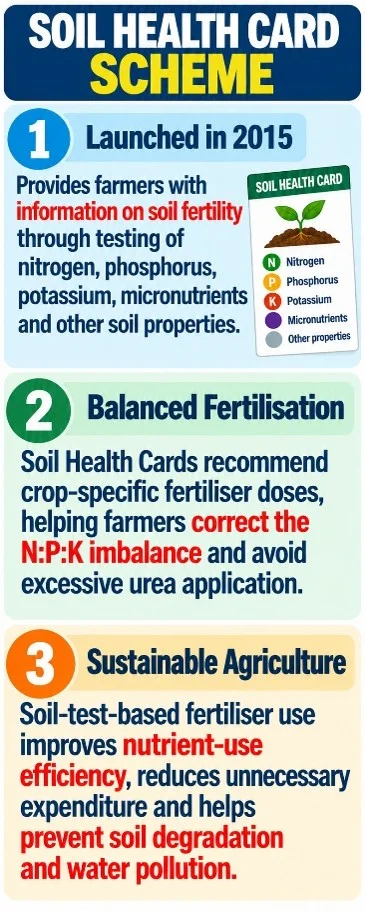
- Follow the 4Rs: Apply the right nutrient source, rate, time and place, guided by Soil Health Cards and crop rotation with pulses.
Conclusion
Restoring soil health requires correcting subsidy incentives and promoting balanced nutrient management. Better fertiliser policies and efficient farming practices can improve productivity, reduce pollution and safeguard India’s long-term food security.
Source: (The Indian Express)
La Excellence IAS Academy, the best IAS coaching in Hyderabad, known for delivering quality content and conceptual clarity for UPSC 2026 preparation.
FOLLOW US ON:
◉ YouTube: https://www.youtube.com/@CivilsPrepTeam
◉ Facebook: https://www.facebook.com/LaExcellenceIAS
◉ Instagram: https://www.instagram.com/laexcellenceiasacademy/
GET IN TOUCH:
Contact us at info@laex.in, https://laex.in/contact-us/
or Call us @ +91 9052 29 2929, +91 9052 99 2929, +91 9154 24 2140
OUR BRANCHES:
Head Office: H No: 1-10-225A, Beside AEVA Fertility Center, Ashok Nagar Extension, VV Giri Nagar, Ashok Nagar, Hyderabad, 500020
Madhapur: Flat no: 301, survey no 58-60, Guttala begumpet Madhapur metro pillar: 1524, Rangareddy Hyderabad, Telangana 500081
Bangalore: Plot No: 99, 2nd floor, 80 Feet Road, Beside Poorvika Mobiles, Chandra Layout, Attiguppe, Near Vijaya Nagara, Bengaluru, 560040