
Paper: GS – III, Subject: Environment and Ecology, Topic: Environmental Impact Assessment, Issue: Supreme Court on Retrospective Environmental Clearances.
Context:
Recently, the Supreme Court quashed the Environment Ministry’s July 2021 Office Memorandum permitting retrospective environmental clearances. However, it allowed a limited, time-bound amnesty in exceptional cases involving genuine public interest.
Key Takeaways:
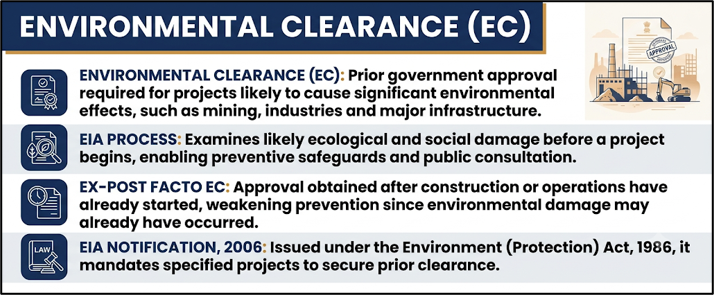
Explanation:
Key Developments and Implications:
- The July 2021 mechanism allowed projects operating without prior EC to apply for environmental approval after beginning their activities.
- The Supreme Court held that a permanent regularisation mechanism could encourage developers to construct first and obtain permission later.
- It distinguished this mechanism from the March 2017 notification, which offered violators a one-time, six-month compliance window.
- The judgment allows the government to address exceptional cases through a narrowly framed statutory notification issued under the Environment (Protection) Act.
- Clearances already granted remain protected because the ruling operates prospectively, preventing sudden disruption of existing projects and public services.
Balancing Environmental Protection and Public Interest:
- The Court rejected both blanket regularisation of violations and automatic closure of every non-compliant project.
- Closure may affect essential services, workers, dependent communities and substantially completed public infrastructure in certain exceptional situations.
- However, private investment, employment generation or economic benefits cannot alone establish the compelling public interest needed for relief.
- Authorities must consider the project’s purpose, environmental damage, nature of violation and possibility of restoring the affected ecosystem.
- This approach distinguishes the illegality of starting without clearance from the appropriate remedy after a violation has occurred.
Way Forward:
- Any future amnesty must remain exceptional, time-bound and narrowly defined, with relief restricted to compelling public-interest circumstances.
- Project proponents should bear assessment, restoration and compensation costs under the polluter pays principle.
- Independent experts must evaluate ecological damage, restoration plans and whether continued operation is environmentally sustainable.
- Public-interest claims and appraisal findings should be disclosed transparently to permit public participation and judicial scrutiny.
Conclusion:
The judgment preserves prior environmental clearance as the governing rule while recognising practical difficulties in exceptional cases. India must prevent limited relief from becoming routine regularisation by strengthening deterrence, transparent appraisal and ecological restoration.
La Excellence IAS Academy, the best IAS coaching in Hyderabad, known for delivering quality content and conceptual clarity for UPSC 2026 preparation.
FOLLOW US ON:
◉ YouTube : https://www.youtube.com/@CivilsPrepTeam
◉ Facebook: https://www.facebook.com/LaExcellenceIAS
◉ Instagram: https://www.instagram.com/laexcellenceiasacademy/
GET IN TOUCH:
Contact us at info@laex.in, https://laex.in/contact-us/
or Call us @ +91 9052 29 2929, +91 9052 99 2929, +91 9154 24 2140
OUR BRANCHES:
Head Office: H No: 1-10-225A, Beside AEVA Fertility Center, Ashok Nagar Extension, VV Giri Nagar, Ashok Nagar, Hyderabad, 500020
Madhapur: Flat no: 301, survey no 58-60, Guttala begumpet Madhapur metro pillar: 1524, Rangareddy Hyderabad, Telangana 500081
Bangalore: Plot No: 99, 2nd floor, 80 Feet Road, Beside Poorvika Mobiles, Chandra Layout, Attiguppe, Near Vijaya Nagara, Bengaluru, 560040