
Paper: GS – III, Subject: Indian Economy, Topic: Employment, Issue: Gig Economy and Social Security for Platform Workers.
Context:
Recently, India abstained from voting on International Labour Organization (ILO) Convention No. 193 on decent work in the platform economy. This renewed debate over social security, algorithmic control and safeguards for India’s gig workforce.
Key Takeaways:
Explanation:
Why the Convention Matters?
- The Convention provides minimum protections regardless of whether platforms call workers employees, partners or independent contractors.
- It supports minimum and timely payments, occupational safety, social security and effective grievance redressal.
- It requires explanations and human review of automated decisions, including account deactivation.
- Worker status must reflect conditions, including platform control, monitoring, pricing powers and economic dependence.
Importance for India:
- India had about 7.7 million gig workers in 2020–21, projected to reach 2.35 crore by 2029–30.
- These workers support transport, deliveries, logistics and digital commerce.
- However, long hours, fuel expenses, unstable earnings and limited social security reduce their income.
- Rajasthan enacted a platform-based gig workers’ law, while Karnataka and Telangana proposed welfare-board mechanisms.
Challenges:
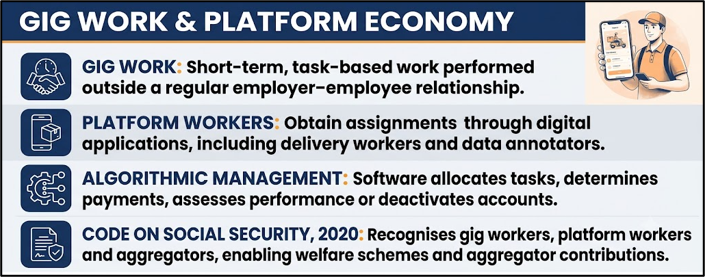
- Recognition under the Code on Social Security, 2020 has not yet produced clear, accessible and enforceable benefits.
- Contractual labels may hide employer-like control and exclude workers from overtime and employment safeguards.
- Opaque algorithms can reduce incentives, restrict assignments or deactivate accounts without reasons or effective appeals.
- Labour belongs to the Concurrent List, making Union–State coordination essential for protection.
Way Forward:
- India should operationalise welfare schemes, register workers and collect contributions from aggregators.
- A national framework should ensure fair payments, accident insurance, algorithmic transparency and grievance redressal.
- Governments, platforms and workers should design portable benefits usable across platforms and States.
Conclusion:
Gig work creates flexibility and employment but can transfer business risks to workers. India must balance digital innovation with enforceable safeguards. Effective domestic implementation and gradual alignment with international standards can create a fairer platform economy.
Source: (The Hindu)
La Excellence IAS Academy, the best IAS coaching in Hyderabad, known for delivering quality content and conceptual clarity for UPSC 2026 preparation.
FOLLOW US ON:
◉ YouTube : https://www.youtube.com/@CivilsPrepTeam
◉ Facebook: https://www.facebook.com/LaExcellenceIAS
◉ Instagram: https://www.instagram.com/laexcellenceiasacademy/
GET IN TOUCH:
Contact us at info@laex.in, https://laex.in/contact-us/
or Call us @ +91 9052 29 2929, +91 9052 99 2929, +91 9154 24 2140
OUR BRANCHES:
Head Office: H No: 1-10-225A, Beside AEVA Fertility Center, Ashok Nagar Extension, VV Giri Nagar, Ashok Nagar, Hyderabad, 500020
Madhapur: Flat no: 301, survey no 58-60, Guttala begumpet Madhapur metro pillar: 1524, Rangareddy Hyderabad, Telangana 500081
Bangalore: Plot No: 99, 2nd floor, 80 Feet Road, Beside Poorvika Mobiles, Chandra Layout, Attiguppe, Near Vijaya Nagara, Bengaluru, 560040
Platform Economy Convention