
Paper: GS – III, Subject: Environment and Ecology, Topic: Pollution, Issue: Role of Carbon Capture in Net-Zero.
Context:
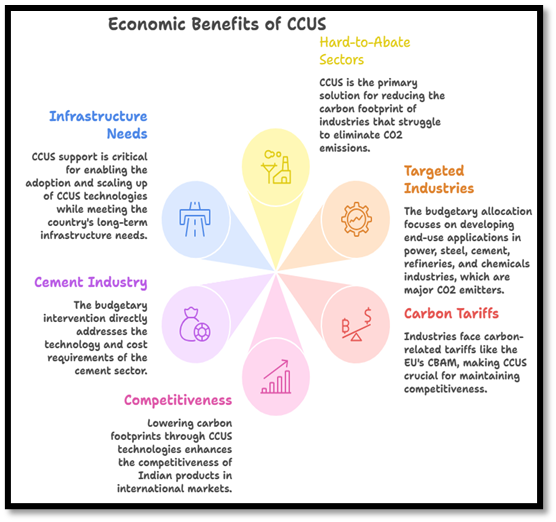
Carbon Capture, Utilisation, and Storage (CCUS) is pivotal for India’s net-zero emissions target by 2070, as highlighted in the recent Budget’s Rs 20,000 crore allocation to develop these technologies for hard-to-abate industries like steel, cement, and power.
Key Takeaways:
What are CCUS Solutions?
- CCUS refers to a suite of technologies designed to capture carbon dioxide (CO2) emissions from industrial processes.
- This captured CO2 can then be either stored permanently, often in underground geological formations, or utilized to create valuable products.
It consists of three stages: capture, transport and storage (or usage) of CO2.
- Carbon Capture, Utilization and Storage (CCUS) Capture: CO2 is captured from large point sources, such as coal-fired power plants or industrial facilities, or from the atmosphere.
- Transport: Once captured, the CO2 is compressed and transported by ship, rail, truck, or pipeline to where it will be utilized or stored.
- Utilization: The CO2 can be used to create valuable products, such as cementitious materials, chemicals, or even fuels.
- Storage: Alternatively, it can be injected deep underground into geological formations, such as depleted oil and gas reservoirs, coal seams, or saline aquifers, for long-term storage.
Relevance to India:
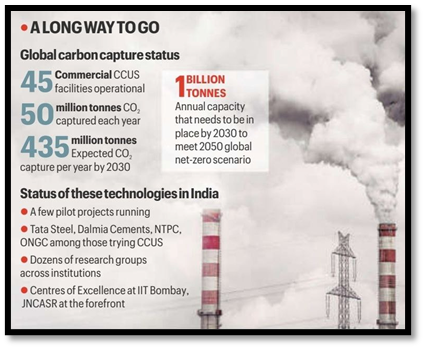
India has been actively promoting the development and deployment of indigenous CCUS technologies tailored to its specific needs.
- India aims to achieve net-zero emissions by 2070.
- Several pilot and demonstration projects are underway in industries like steel, cement, and chemicals.
- Potential sites for large-scale carbon capture and long-term storage have been identified.
Critical for Some Industries:
- CCUS technology is relevant for industries such as steel and cement where CO2 release is an intrinsic part of production.
- In such sectors, just switching from fossil fuels to renewable electricity does not get rid of CO2.
Carbon capture is a critical enabler of India’s net-zero ambitions, especially for hard-to-abate industries, but requires policy support, cost reduction, and rapid scaling.
Source: (The Indian Express)
La Excellence IAS Academy, the best IAS coaching in Hyderabad, known for delivering quality content and conceptual clarity for UPSC 2026 preparation.
FOLLOW US ON:
◉ YouTube : https://www.youtube.com/@CivilsPrepTeam
◉ Facebook: https://www.facebook.com/LaExcellenceIAS
◉ Instagram: https://www.instagram.com/laexcellenceiasacademy/
GET IN TOUCH:
Contact us at info@laex.in, https://laex.in/contact-us/
or Call us @ +91 9052 29 2929, +91 9052 99 2929, +91 9154 24 2140
OUR BRANCHES:
Head Office: H No: 1-10-225A, Beside AEVA Fertility Center, Ashok Nagar Extension, VV Giri Nagar, Ashok Nagar, Hyderabad, 500020
Madhapur: Flat no: 301, survey no 58-60, Guttala begumpet Madhapur metro pillar: 1524, Rangareddy Hyderabad, Telangana 500081
Bangalore: Plot No: 99, 2nd floor, 80 Feet Road, Beside Poorvika Mobiles, Chandra Layout, Attiguppe, Near Vijaya Nagara, Bengaluru, 560040