
Paper: GS – III, Subject: Environment and Ecology, Topic: Indian Initiatives, efforts and Commitments, Issue: Carbon Capture and Utilisation (CCU).
Context:
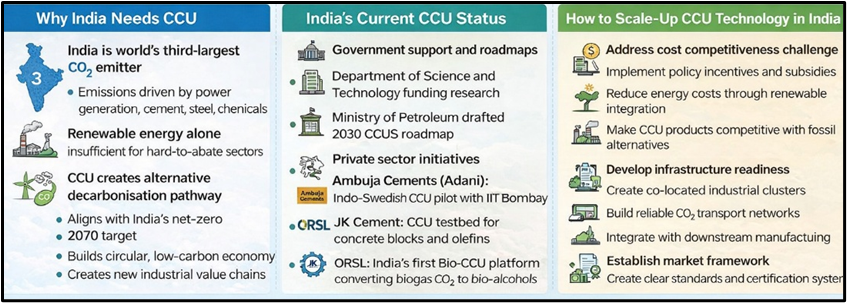
India, the world’s third-largest CO₂ emitter, is exploring Carbon Capture and Utilisation (CCU) to reduce emissions from hard-to-abate sectors like cement, steel, and chemicals.
Key Takeaways:
What is CCU?
- Carbon Capture and Utilisation refer to technologies that capture CO₂ emissions from industrial sources or directly from air, then convert them into useful products like fuels, chemicals, building materials, and polymers.
- Unlike carbon capture and storage (which permanently stores CO₂ underground), CCU reuses captured carbon in the economy.
How CCU Reduces Carbon Dioxide Emissions:
- Removes CO₂ from atmosphere and industrial sources: especially “hard-to-abate” sectors (cement, steel, chemicals).
- Converts captured carbon into economic value: Creates alternative feedstocks for fuels and chemicals
- Supports circular economy principles: Enables sustainable product manufacturing.
EU Bioeconomy Strategy and Circular Economy Action Plan:
- Explicitly supports CCU as sustainability mechanism: Converts CO₂ into feedstocks for chemicals, fuels, materials
- Promotes integrated approach to resource management: Drives innovation in low-carbon industrial processes
Net-Zero 2070:
Key Risks in Scaling CCU:
- Cost competitiveness: Capturing, purifying, converting CO₂ is energy-intensive and expensive and Without incentives, CCU products cannot compete with fossil-based alternatives
- Infrastructure gaps: Uneven development across Indian industrial regions and Lack of integrated CO₂ transport and storage systems
- Market uncertainty: Absence of standards and certification and Limited demand signals for CO₂-derived products
CCU offers India a pragmatic pathway to decarbonise heavy industry while building new value chains. However, without policy incentives, cost reduction, and infrastructure readiness, scaling CCU beyond pilot projects will remain difficult.
Source: (The Hindu)
La Excellence IAS Academy, the best IAS coaching in Hyderabad, known for delivering quality content and conceptual clarity for UPSC 2026 preparation.
FOLLOW US ON:
◉ YouTube : https://www.youtube.com/@CivilsPrepTeam
◉ Facebook: https://www.facebook.com/LaExcellenceIAS
◉ Instagram: https://www.instagram.com/laexcellenceiasacademy/
GET IN TOUCH:
Contact us at info@laex.in, https://laex.in/contact-us/
or Call us @ +91 9052 29 2929, +91 9052 99 2929, +91 9154 24 2140
OUR BRANCHES:
Head Office: H No: 1-10-225A, Beside AEVA Fertility Center, Ashok Nagar Extension, VV Giri Nagar, Ashok Nagar, Hyderabad, 500020
Madhapur: Flat no: 301, survey no 58-60, Guttala begumpet Madhapur metro pillar: 1524, Rangareddy Hyderabad, Telangana 500081
Bangalore: Plot No: 99, 2nd floor, 80 Feet Road, Beside Poorvika Mobiles, Chandra Layout, Attiguppe, Near Vijaya Nagara, Bengaluru, 560040