
Paper: GS – III, Subject: Science & Technology, Topic: Basics of Science and Technology, Issue: Induction vs Infrared cooktops.
Context:
Rising LPG costs and supply uncertainties have accelerated the shift towards electric cooking technologies such as induction and infrared cooktops, raising concerns about increasing electricity demand and potential stress on India’s power grid.
Key Takeaways:
Background:
- India’s electricity demand is steadily rising, with peak demand expected to reach approximately 270 GW during summer months.
- Electric cooking is gaining popularity due to convenience, efficiency, and its perceived environmental benefits.
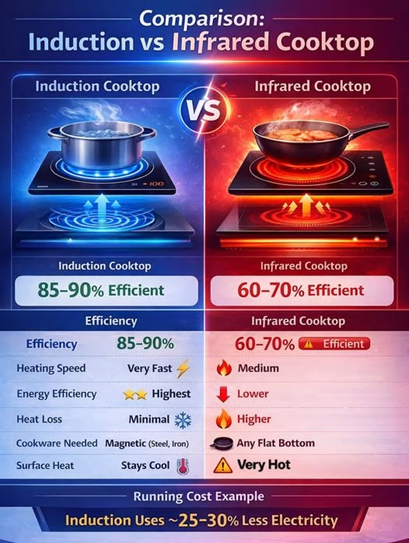
- Induction cooktops operate on electromagnetic induction, whereas infrared cooktops rely on radiant heat generated by heating elements.
Explanation:
- Induction cooktops are more energy-efficient (around 85–90%) as they directly heat the vessel, while infrared cooktops have lower efficiency (around 70–80%) due to heat loss.
- The growing adoption of electric cooking could add an estimated 13–27 GW to electricity demand, with even a 3–5 GW increase during peak hours posing significant challenges.
- Cooking demand is highly time-concentrated, particularly during morning and evening hours, thereby intensifying peak load pressures on the grid.
- Localised adoption in urban clusters such as apartment complexes and hostels may lead to transformer overloading and distribution-level failures.
- Existing electricity distribution infrastructure is not adequately equipped to handle sudden spikes in demand, necessitating upgrades and investments.
- While electric cooking reduces indoor air pollution and dependence on LPG imports, it may increase reliance on electricity generated from fossil fuels unless supported by renewable energy integration.
- Policy responses should include strengthening distribution infrastructure, promoting energy-efficient appliances such as induction cooktops, implementing smart metering and time-of-use tariffs, and aligning the transition with renewable energy expansion.
Conclusion:
The transition to electric cooking presents both opportunities and challenges, and it must be supported by strategic infrastructure development and demand management to ensure grid stability and sustainable energy use.
Source: (The Indian Express)
La Excellence IAS Academy, the best IAS coaching in Hyderabad, known for delivering quality content and conceptual clarity for UPSC 2026 preparation.
FOLLOW US ON:
◉ YouTube : https://www.youtube.com/@CivilsPrepTeam
◉ Facebook: https://www.facebook.com/LaExcellenceIAS
◉ Instagram: https://www.instagram.com/laexcellenceiasacademy/
GET IN TOUCH:
Contact us at info@laex.in, https://laex.in/contact-us/
or Call us @ +91 9052 29 2929, +91 9052 99 2929, +91 9154 24 2140
OUR BRANCHES:
Head Office: H No: 1-10-225A, Beside AEVA Fertility Center, Ashok Nagar Extension, VV Giri Nagar, Ashok Nagar, Hyderabad, 500020
Madhapur: Flat no: 301, survey no 58-60, Guttala begumpet Madhapur metro pillar: 1524, Rangareddy Hyderabad, Telangana 500081
Bangalore: Plot No: 99, 2nd floor, 80 Feet Road, Beside Poorvika Mobiles, Chandra Layout, Attiguppe, Near Vijaya Nagara, Bengaluru, 560040