
Paper: GS – II, Subject: International Relations, Topic: International institutions, Issue: Strait of Hormuz: Testing UNCLOS and Global Cooperation.
Context:
The Strait of Hormuz has emerged as a major geopolitical flashpoint amid escalating tensions involving Iran, threatening global energy supplies, maritime trade, and the international legal framework governing navigation.
Key Takeaways:
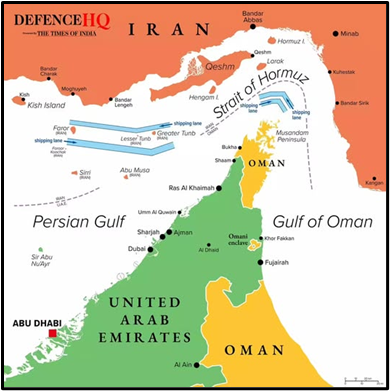
- The Strait of Hormuz is a narrow maritime chokepoint connecting the Persian Gulf to the Gulf of Oman, through which nearly 20% of global oil trade and a significant share of LNG passes.
- Maritime chokepoints are narrow sea routes where global trade is concentrated, making them highly strategic yet vulnerable to disruption.
- Historically, control over such chokepoints has enhanced naval dominance and geopolitical influence.
Impact on Shipping and Global Economy:
- Iran’s deployment of coastal missile systems, naval mines, and drone capabilities has created a deterrence effect on commercial shipping even without a formal blockade.
- Marine insurance premiums have surged sharply (approximately 400% – 600% increase), indicating heightened risk perception in global shipping markets.
- Reports of Iran demanding “security tolls” on oil transit are viewed as coercive and extortionate, further complicating global trade flows.
Legal Framework under UNCLOS (1982):
- The United Nations Convention on the Law of the Sea (UNCLOS) governs maritime rights and establishes a balance between coastal state sovereignty and freedom of navigation.
- Although the Strait of Hormuz lies within the territorial waters of Iran and Oman, it qualifies as an international strait, invoking special legal protections for navigation.
Key Legal Regimes of Passage under UNCLOS:
- Innocent Passage (Articles 17–32):
- It allows foreign vessels to pass through territorial waters, provided the passage is continuous, expeditious, and non-threatening to the coastal state.
- The coastal state retains the power to regulate or suspend passage on security grounds.
- Transit Passage (Articles 37–44):
- It applies specifically to international straits like Hormuz and guarantees uninterrupted navigation for ships and aircraft.
- Coastal states cannot suspend or impede transit passage, even during conflict situations.
Issue of Tolls and Legal Prohibitions:
- UNCLOS explicitly prohibits the imposition of general tolls or transit taxes on vessels merely passing through territorial waters.
- Charges are permissible only for specific services rendered, such as pilotage or emergency assistance, and must be applied without discrimination.
Legal vs Geopolitical Contradiction:
- Iran has signed but not ratified UNCLOS and argues that transit passage obligations are not binding, especially for non-member states.
- However, most of the international community, including India, considers freedom of navigation and the prohibition of tolls as customary international law, binding on all states.
- This creates a conflict between legal norms and strategic leverage, where control over chokepoints is used as a geopolitical tool.
Conclusion:
The Strait of Hormuz exemplifies the tension between international law and power politics, where legal guarantees of free navigation coexist with strategic coercion. Ensuring stability requires strict adherence to UNCLOS norms, diplomatic engagement, and cooperative security mechanisms to safeguard global trade and energy flows.
Source: (The Indian Express)
La Excellence IAS Academy, the best IAS coaching in Hyderabad, known for delivering quality content and conceptual clarity for UPSC 2026 preparation.
FOLLOW US ON:
◉ YouTube : https://www.youtube.com/@CivilsPrepTeam
◉ Facebook: https://www.facebook.com/LaExcellenceIAS
◉ Instagram: https://www.instagram.com/laexcellenceiasacademy/
GET IN TOUCH:
Contact us at info@laex.in, https://laex.in/contact-us/
or Call us @ +91 9052 29 2929, +91 9052 99 2929, +91 9154 24 2140
OUR BRANCHES:
Head Office: H No: 1-10-225A, Beside AEVA Fertility Center, Ashok Nagar Extension, VV Giri Nagar, Ashok Nagar, Hyderabad, 500020
Madhapur: Flat no: 301, survey no 58-60, Guttala begumpet Madhapur metro pillar: 1524, Rangareddy Hyderabad, Telangana 500081
Bangalore: Plot No: 99, 2nd floor, 80 Feet Road, Beside Poorvika Mobiles, Chandra Layout, Attiguppe, Near Vijaya Nagara, Bengaluru, 560040