
Paper: GS – III, Subject: Economy, Topic: Trade and External sector, Issue: India Sugar Export Ban.
Context:
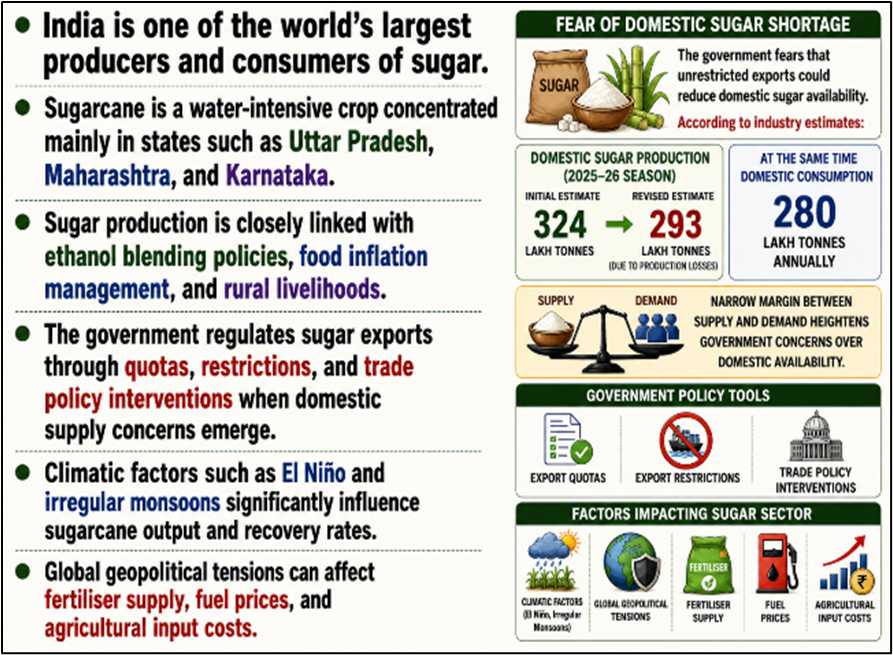
The Government of India has prohibited the export of raw, white, and refined sugar until September 2026, while allowing limited exports to the United States and the European Union under quota commitments, due to concerns over domestic availability, food inflation, and uncertain agricultural conditions.
Key Takeaways:
Background:
Explanation:
Problems and Challenges:
Why did the Government Ban Sugar Exports?
- The government fears a possible shortage of sugar in the domestic market due to lower-than-expected production.
- Policymakers also want to avoid a rise in sugar prices, which could worsen food inflation.
- India is already facing concerns related to fuel prices, fertiliser costs, and broader inflationary pressures.
Role of El Niño:
- El Niño is a climatic phenomenon involving abnormal warming of Pacific Ocean waters.
- It often weakens the Indian monsoon and causes irregular rainfall.
- Sugarcane is a water-intensive crop and highly dependent on adequate rainfall and irrigation.
- Poor monsoon conditions can reduce cane productivity and sugar recovery rates.
Impact of the Iran Conflict:
- The Iran-related tensions in West Asia threaten the Strait of Hormuz, a critical global oil route.
- Rising crude oil prices increase fertiliser, transport, and irrigation costs for agriculture.
- Fertiliser production itself depends heavily on natural gas and energy imports.
- Higher input costs can reduce profitability and efficiency in sugar production.
Decline in Sugar Stocks:
- India’s sugar closing stocks have reportedly fallen to multi-year lows.
- Lower stocks reduce the government’s ability to stabilise prices during shortages.
- The government therefore prioritised domestic supply over export earnings.
Ethanol Diversion Factor:
- A portion of sugarcane and sugar is diverted for ethanol production.
- Ethanol blending helps reduce crude oil imports and supports green energy goals.
- However, diversion reduces sugar availability for domestic consumption and exports.
- Balancing food security and energy security has become a major policy challenge.
Why are U.S. and EU Exports Allowed?
- India has international quota commitments with the United States and European Union.
- These exports occur under preferential tariff arrangements such as Tariff-Rate Quotas (TRQs) and CXL concessions (often related to quota concessions under WTO).
- Limited exports are therefore permitted to maintain trade obligations and diplomatic credibility.
Way Forward:
- Ensure Balanced Sugar Management: The government should maintain a balance between exports, domestic consumption, and ethanol blending targets.
- Strengthen Climate-Resilient Agriculture: Promotion of drought-resistant sugarcane varieties, micro-irrigation, and efficient water management is necessary.
- Improve Crop Diversification: Farmers should be encouraged to shift towards less water-intensive crops in ecologically stressed regions.
- Develop Stable Export Policies: Predictable trade policies can improve long-term planning for sugar mills, exporters, and farmers.
- Enhance Strategic Buffer Stocks: Maintaining adequate sugar reserves can help stabilise prices during production shortfalls.
- Rationalise Ethanol Diversion: Ethanol blending policies should be aligned with domestic food security and sugar availability conditions.
- Strengthen Agricultural Forecasting: Better weather forecasting, crop monitoring, and supply assessment can improve timely policy decisions.
Conclusion:
India’s sugar sector lies at the intersection of food security, farmer welfare, energy policy, and climate resilience. Sustainable management of sugar production and exports requires balanced policymaking that protects consumers while ensuring long-term stability for farmers and the agricultural economy.
Source: (The Indian Express, The Hindu)
La Excellence IAS Academy, the best IAS coaching in Hyderabad, known for delivering quality content and conceptual clarity for UPSC 2026 preparation.
FOLLOW US ON:
◉ YouTube : https://www.youtube.com/@CivilsPrepTeam
◉ Facebook: https://www.facebook.com/LaExcellenceIAS
◉ Instagram: https://www.instagram.com/laexcellenceiasacademy/
GET IN TOUCH:
Contact us at info@laex.in, https://laex.in/contact-us/
or Call us @ +91 9052 29 2929, +91 9052 99 2929, +91 9154 24 2140
OUR BRANCHES:
Head Office: H No: 1-10-225A, Beside AEVA Fertility Center, Ashok Nagar Extension, VV Giri Nagar, Ashok Nagar, Hyderabad, 500020
Madhapur: Flat no: 301, survey no 58-60, Guttala begumpet Madhapur metro pillar: 1524, Rangareddy Hyderabad, Telangana 500081
Bangalore: Plot No: 99, 2nd floor, 80 Feet Road, Beside Poorvika Mobiles, Chandra Layout, Attiguppe, Near Vijaya Nagara, Bengaluru, 560040