
Paper: GS – II, Subject: Governance, Topic: Government Policies, Issue: Medical Education in India.
Context:
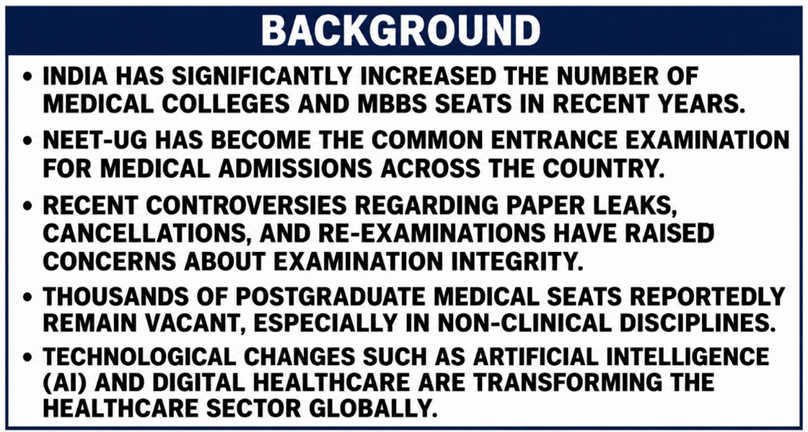
Medical education in India is undergoing rapid expansion with a sharp increase in medical colleges and MBBS seats. However, concerns are growing regarding the quality of education, shortage of faculty, examination-related issues, and the ability of the system to produce competent and future-ready doctors.
Key Takeaways:
Major Challenges in Medical Education:
1. Excessive Focus on Quantity over Quality:
- Expansion in seats and institutions has not always ensured quality medical training.
- Many institutions face infrastructure and teaching deficiencies.
- The system often emphasises numbers rather than learning outcomes and competence.
2. Faculty Shortage:
- Many medical colleges face shortage of qualified faculty, particularly in pre-clinical and para-clinical subjects.
- Rapid expansion of colleges has increased pressure on existing teaching staff.
- Regulatory requirements regarding faculty standards are difficult to meet uniformly.
3. Problems in Entrance Examination System:
- NEET has reduced multiple entrance examinations and standardised admissions.
- However, repeated paper leak incidents and exam cancellations have reduced trust in the system.
- Excessive dependence on rote learning and coaching culture affects conceptual understanding and clinical reasoning.
4. Weak Research Culture:
- Medical research in many institutions lacks innovation and practical relevance.
- Research output often focuses on publications rather than solving healthcare challenges.
- Undergraduate students receive limited exposure to research-based learning.
5. Need for Curriculum Modernisation:
- Medical education must adapt to AI, digital diagnostics, telemedicine, and modern healthcare technologies.
- Traditional teaching methods may not adequately prepare students for future healthcare systems.
- Greater emphasis is needed on clinical reasoning, communication skills, ethics, and patient-centred care.
Way Forward:
- Shift focus from expansion of seats to quality medical education and competency-based outcomes.
- Strengthen faculty recruitment, training, and infrastructure development.
- Reform assessment systems to test analytical and clinical skills instead of rote memorisation.
- Promote meaningful medical research and early research exposure for students.
- Integrate AI, digital health technologies, and modern diagnostic tools into medical curriculum.
Conclusion:
India has made major progress in expanding medical education capacity, but the next phase of reform must prioritise quality, professionalism, research, and technological readiness. Producing competent, ethical, and future-ready doctors is essential for strengthening India’s healthcare system and meeting the country’s long-term public health needs.
Source: (The Hindu)
La Excellence IAS Academy, the best IAS coaching in Hyderabad, known for delivering quality content and conceptual clarity for UPSC 2026 preparation.
FOLLOW US ON:
◉ YouTube : https://www.youtube.com/@CivilsPrepTeam
◉ Facebook: https://www.facebook.com/LaExcellenceIAS
◉ Instagram: https://www.instagram.com/laexcellenceiasacademy/
GET IN TOUCH:
Contact us at info@laex.in, https://laex.in/contact-us/
or Call us @ +91 9052 29 2929, +91 9052 99 2929, +91 9154 24 2140
OUR BRANCHES:
Head Office: H No: 1-10-225A, Beside AEVA Fertility Center, Ashok Nagar Extension, VV Giri Nagar, Ashok Nagar, Hyderabad, 500020
Madhapur: Flat no: 301, survey no 58-60, Guttala begumpet Madhapur metro pillar: 1524, Rangareddy Hyderabad, Telangana 500081
Bangalore: Plot No: 99, 2nd floor, 80 Feet Road, Beside Poorvika Mobiles, Chandra Layout, Attiguppe, Near Vijaya Nagara, Bengaluru, 560040