
Paper: GS – I/II, Subject: Society and Social Justice, Topic: Diversity of India, Issue: Vande Mataram and Multicultural Nationalism.
Context:
The debate around Vande Mataram has intensified after recent Union Government decisions regarding its official use and legal protection. In 2026, the Union Cabinet approved a proposal to amend the Prevention of Insults to National Honour Act, 1971 to make intentional insult or obstruction during the singing of Vande Mataram a punishable offence, similar to protections available for the National Anthem. The government also issued guidelines encouraging the singing of the full six stanzas at selected official events.
Key Takeaways:
Why is the Song Controversial?
Religious Imagery:
- The later stanzas portray the motherland using imagery associated with Hindu goddesses such as Durga.
- Critics argue that this gives the song a distinctly Hindu religious tone.
Concerns of Minority Communities:
- Some Muslim organisations historically opposed compulsory singing of the full version because Islamic monotheism discourages devotional expressions directed toward figures other than God.
- Therefore, mandatory singing has often been viewed as conflicting with religious freedom.
Debate over Secularism:
- India is constitutionally secular and culturally diverse.
- Critics argue that linking patriotism with a culturally specific religious symbol may weaken inclusive nationalism.
Historical Accommodation:
Congress Position (1937):
- To address concerns, the Indian National Congress decided that only the first two stanzas would be officially used.
- These stanzas mainly praise the motherland and avoid strong religious imagery.
Constituent Assembly Decision:
- During Constitution-making debates:
- Jana Gana Mana was adopted as the National Anthem.
- Vande Mataram received the status of National Song.
- This compromise balanced historical significance with pluralistic concerns.
Recent Developments:
Legal Changes:
The proposed amendment to the Prevention of Insults to National Honour Act seeks to:
- Extend statutory protection to Vande Mataram
- Punish intentional disruption or insult during its rendition
- Place it closer to the legal status of the National Anthem (Drishti IAS)
Political Debate:
- Recent controversies in Tamil Nadu and Puducherry over whether Tamil Thai Vaazhthu or Vande Mataram should be played first at official ceremonies revived discussions on regional identity, federalism, and cultural nationalism.
Multicultural Nationalism in India:
Indian nationalism traditionally emphasises:
- Religious pluralism
- Linguistic diversity
- Constitutional secularism
- “Unity in Diversity”
Therefore, many scholars argue that national symbols should remain inclusive and voluntary rather than culturally majoritarian.
Conclusion:
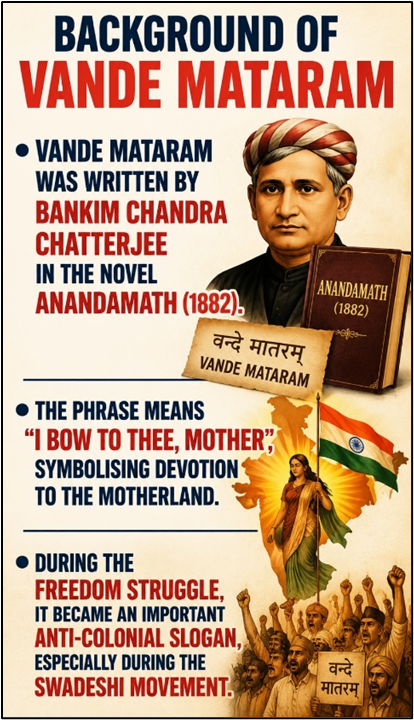
The Vande Mataram debate reflects the continuing tension between cultural nationalism and constitutional pluralism in India. While the song remains an important symbol of the freedom struggle, its official enforcement raises broader questions about secularism, minority rights, and the inclusive character of Indian nationalism.
Source: (The Hindu)
La Excellence IAS Academy, the best IAS coaching in Hyderabad, known for delivering quality content and conceptual clarity for UPSC 2026 preparation.
FOLLOW US ON:
◉ YouTube : https://www.youtube.com/@CivilsPrepTeam
◉ Facebook: https://www.facebook.com/LaExcellenceIAS
◉ Instagram: https://www.instagram.com/laexcellenceiasacademy/
GET IN TOUCH:
Contact us at info@laex.in, https://laex.in/contact-us/
or Call us @ +91 9052 29 2929, +91 9052 99 2929, +91 9154 24 2140
OUR BRANCHES:
Head Office: H No: 1-10-225A, Beside AEVA Fertility Center, Ashok Nagar Extension, VV Giri Nagar, Ashok Nagar, Hyderabad, 500020
Madhapur: Flat no: 301, survey no 58-60, Guttala begumpet Madhapur metro pillar: 1524, Rangareddy Hyderabad, Telangana 500081
Bangalore: Plot No: 99, 2nd floor, 80 Feet Road, Beside Poorvika Mobiles, Chandra Layout, Attiguppe, Near Vijaya Nagara, Bengaluru, 560040