
Paper: GS – II, Subject: International Relations, Topic: Agreements involving India and/or affecting India’s interests, Issue: India–Pakistan Indus Waters Treaty Dispute.
Context:
India has intensified the development of hydropower and water infrastructure projects on the western rivers of the Indus system after keeping the Indus Waters Treaty (IWT) “in abeyance” following the Pahalgam terror attack. Simultaneously, Pakistan has attempted to internationalise the issue through forums such as the United Nations, the World Bank and international legal mechanisms.
Key Takeaways:
Background:
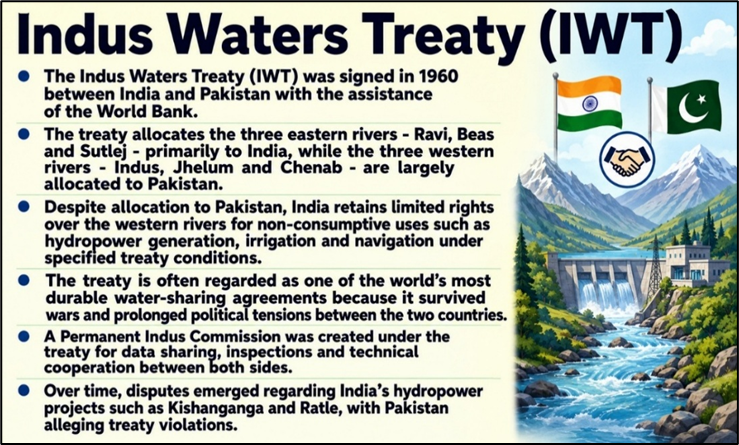
Explanation:
India’s Decision to Keep the Treaty “In Abeyance”
- India decided to suspend normal treaty engagement mechanisms after the Pahalgam terror attack, arguing that continued cross-border terrorism undermines bilateral cooperation.
Pakistan’s Concerns:
- Pakistan is a lower riparian country and depends heavily on the Indus river system for irrigation, agriculture and food security.
- Nearly 70% of Pakistan’s irrigation requirements are linked to the Indus basin.
- Pakistan fears that rapid Indian infrastructure expansion could affect water flows, especially during crucial agricultural seasons.
- Consequently, Pakistan has attempted to raise the issue at international forums including the UNSC, International Court of Justice (ICJ) and World Bank-linked mechanisms.
India’s Infrastructure Push:
- India is now focusing on completing long-delayed hydropower and storage projects on the western rivers.
- India argues that these projects remain within treaty limits because they involve run-of-the-river hydropower and limited storage permitted under the IWT.
- The government also believes climate change, glacier melting, altered river flows and rising developmental needs require reinterpretation or renegotiation of certain treaty provisions.
Strategic and Security Dimensions:
- Water security has increasingly become linked with national security in South Asia.
- Pakistan frames the issue as a regional peace and humanitarian concern, while India maintains that the treaty is fundamentally a bilateral arrangement.
- The dispute also reflects the broader India – Pakistan geopolitical rivalry where infrastructure, water and terrorism have become interconnected strategic issues.
Conclusion:
The Indus Waters Treaty remains a significant pillar of South Asian water diplomacy, but growing geopolitical tensions and changing environmental realities are testing its sustainability. The present dispute highlights the complex relationship between water sharing, national security, climate change and regional stability.
Source: (The Indian Express)
La Excellence IAS Academy, the best IAS coaching in Hyderabad, known for delivering quality content and conceptual clarity for UPSC 2026 preparation.
FOLLOW US ON:
◉ YouTube : https://www.youtube.com/@CivilsPrepTeam
◉ Facebook: https://www.facebook.com/LaExcellenceIAS
◉ Instagram: https://www.instagram.com/laexcellenceiasacademy/
GET IN TOUCH:
Contact us at info@laex.in, https://laex.in/contact-us/
or Call us @ +91 9052 29 2929, +91 9052 99 2929, +91 9154 24 2140
OUR BRANCHES:
Head Office: H No: 1-10-225A, Beside AEVA Fertility Center, Ashok Nagar Extension, VV Giri Nagar, Ashok Nagar, Hyderabad, 500020
Madhapur: Flat no: 301, survey no 58-60, Guttala begumpet Madhapur metro pillar: 1524, Rangareddy Hyderabad, Telangana 500081
Bangalore: Plot No: 99, 2nd floor, 80 Feet Road, Beside Poorvika Mobiles, Chandra Layout, Attiguppe, Near Vijaya Nagara, Bengaluru, 560040