
Paper: GS – III, Subject: Environment and Ecology, Topic: Pollution, Issue: Delhi’s new Summer’s Air Pollution Crisis.
Context:
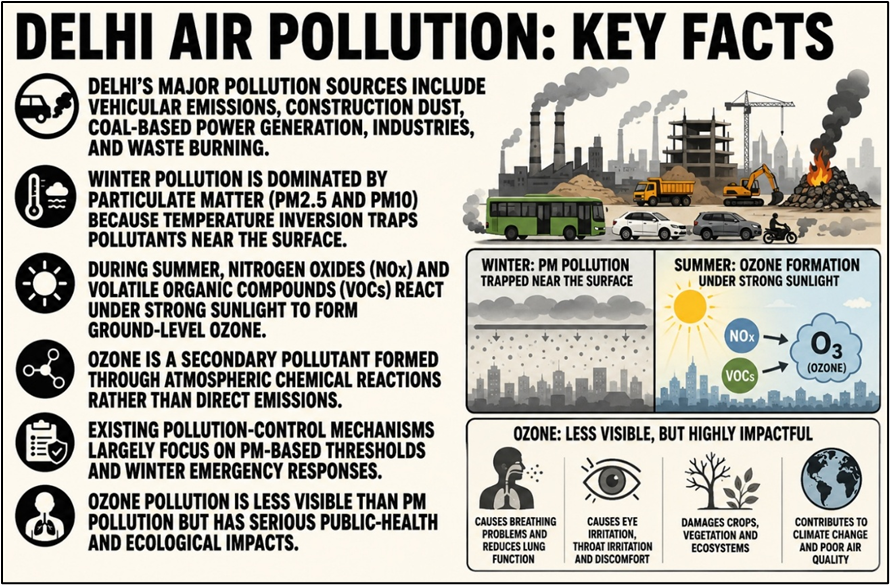
Air pollution in Delhi has traditionally been associated with winter smog and particulate matter (PM) pollution. However, recent assessments indicate that air pollution is increasingly becoming an all-season problem, with ozone pollution emerging significantly during summer months due to atmospheric and chemical interactions.
Key Takeaways:
Background:
Explanation:
Major Concerns and Challenges:
Seasonal Variation in Pollution:
- Different pollutants dominate in different seasons, requiring distinct policy responses.
- Winter conditions favour PM accumulation, while summer conditions accelerate ozone formation.
Increasing Ground-Level Ozone Pollution:
- Ground-level ozone causes respiratory irritation, asthma aggravation, and long-term lung damage.
- Ozone also affects crops, vegetation, and urban ecosystems.
Narrow Regulatory Focus:
- Pollution-control frameworks primarily target particulate matter and visible smog.
- Limited attention is given to precursor pollutants such as NOx and VOCs.
Vehicular and Industrial Emissions:
- Vehicular exhaust and thermal power plants remain major contributors to NOx emissions.
- VOC emissions originate from fuels, solvents, waste burning, and industrial activities.
Weak Monitoring Mechanisms:
- VOC emissions are difficult to measure because they arise from multiple dispersed sources.
- Monitoring systems remain inadequate for real-time ozone management.
Urbanisation and Energy Dependence:
- Rising vehicle ownership and dependence on fossil fuels continue to increase emission loads.
- Coal-based energy generation contributes substantially to urban pollution.
Public Health Risks:
- Air pollution has become a continuous public-health concern rather than a seasonal issue.
- Vulnerable groups such as children and the elderly face greater health risks.
Way Forward:
- Adopt a multi-pollutant and all-season air-quality management strategy.
- Strengthen public transport and promote cleaner mobility systems.
- Tighten fuel-quality standards and reduce coal dependence through renewable energy expansion.
- Improve monitoring of NOx, VOCs, and ozone alongside particulate matter.
Conclusion:
Delhi’s air pollution challenge extends beyond winter smog and particulate matter. Effective pollution control now requires an integrated, year-round strategy that addresses changing atmospheric conditions, multiple pollutants, and long-term structural sources of emissions.
Source: (The Indian Express)
La Excellence IAS Academy, the best IAS coaching in Hyderabad, known for delivering quality content and conceptual clarity for UPSC 2026 preparation.
FOLLOW US ON:
◉ YouTube : https://www.youtube.com/@CivilsPrepTeam
◉ Facebook: https://www.facebook.com/LaExcellenceIAS
◉ Instagram: https://www.instagram.com/laexcellenceiasacademy/
GET IN TOUCH:
Contact us at info@laex.in, https://laex.in/contact-us/
or Call us @ +91 9052 29 2929, +91 9052 99 2929, +91 9154 24 2140
OUR BRANCHES:
Head Office: H No: 1-10-225A, Beside AEVA Fertility Center, Ashok Nagar Extension, VV Giri Nagar, Ashok Nagar, Hyderabad, 500020
Madhapur: Flat no: 301, survey no 58-60, Guttala begumpet Madhapur metro pillar: 1524, Rangareddy Hyderabad, Telangana 500081
Bangalore: Plot No: 99, 2nd floor, 80 Feet Road, Beside Poorvika Mobiles, Chandra Layout, Attiguppe, Near Vijaya Nagara, Bengaluru, 560040