
Paper: GS – III, Subject: Science and Technology, Topic: Space Technology, Issue: Dual-Use Satellites and the Militarisation of Outer Space.
Context:
The growing reliance on satellites for civilian and military purposes has blurred the distinction between peaceful and hostile uses of outer space. This transformation is reshaping the nature of conflict, making space an increasingly contested and ambiguous domain.
Key Takeaways:
Background:
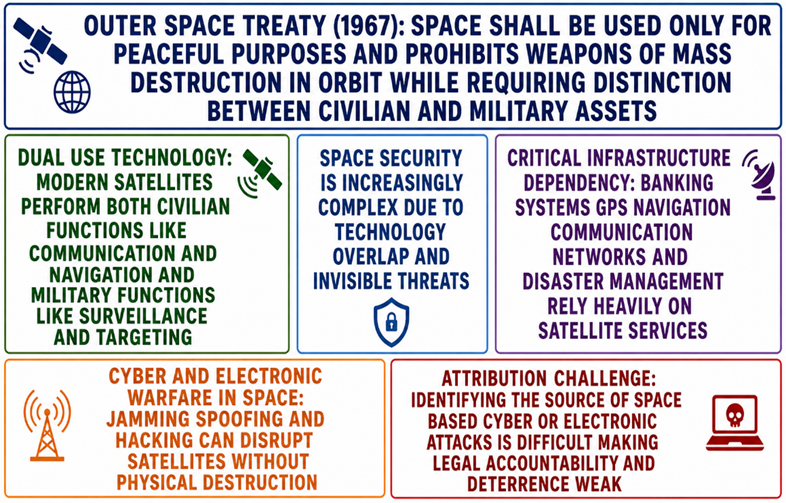
Explanation:
1. Changing Nature of Space Warfare:
- Modern space conflict is increasingly non-kinetic, characterized by signal interference, cyber intrusions, and system manipulation rather than physical destruction.
- Initial phases of conflict may involve disabling communication networks or navigation systems, thereby affecting both military operations and civilian life.
- Example: A cyberattack disabling satellite internet can disrupt military coordination without any missile strike.
2. Dual-Use Satellites and Blurred Boundaries:
- Satellites used for civilian purposes, such as GPS and broadband services, are often leveraged for military applications like intelligence gathering and drone operations.
- This dual-use nature complicates the legal distinction between civilian and military targets, increasing the risk of unintended escalation.
- Example: GPS used for navigation in cars can also guide precision missiles.
3. Vulnerability of Civilian Infrastructure:
- Since essential services depend on satellites, disruptions in space systems can cascade into failures in energy, banking, transportation, and emergency response systems on Earth.
- Cyberattacks on satellite networks can paralyze societies without a single physical strike.
- Example: Jamming satellite signals can disrupt aircraft navigation systems.
4. Legal and Normative Gaps:
- Existing international frameworks struggle to address cyber and electronic operations in space, particularly regarding what constitutes “use of force.”
- The ambiguity in legal interpretation allows states to operate in grey zones below the threshold of open conflict.
- Example: Signal spoofing may not clearly qualify as an “armed attack” under current law.
5. Attribution and Deterrence Challenges:
- Difficulty in identifying perpetrators reduces the effectiveness of deterrence, as states can act through proxies or conceal their involvement.
- This encourages low-intensity, persistent disruptions that undermine stability without triggering direct retaliation.
6. Emergence of Persistent Low-Level Conflict:
- Space is evolving into a domain of continuous competition, where states engage in constant surveillance, disruption, and signaling activities.
- The objective is shifting from destruction of assets to degradation of systems and erosion of adversary capabilities.
- Example: Repeated temporary jamming of communication satellites during tensions.
7. Need for Secure-by-Design Systems:
- There is a growing emphasis on integrating cybersecurity at every stage of satellite development and operation.
- Strengthening cooperative mechanisms for attribution and establishing enforceable norms are essential to maintain stability.
Conclusion:
The increasing integration of civilian and military functions in space systems has transformed space into a domain of silent yet pervasive conflict. Addressing legal ambiguities and enhancing resilience through technological and institutional measures is essential to ensure stability and prevent escalation in this critical frontier.
Source: (The Hindu)
La Excellence IAS Academy, the best IAS coaching in Hyderabad, known for delivering quality content and conceptual clarity for UPSC 2026 preparation.
FOLLOW US ON:
◉ YouTube : https://www.youtube.com/@CivilsPrepTeam
◉ Facebook: https://www.facebook.com/LaExcellenceIAS
◉ Instagram: https://www.instagram.com/laexcellenceiasacademy/
GET IN TOUCH:
Contact us at info@laex.in, https://laex.in/contact-us/
or Call us @ +91 9052 29 2929, +91 9052 99 2929, +91 9154 24 2140
OUR BRANCHES:
Head Office: H No: 1-10-225A, Beside AEVA Fertility Center, Ashok Nagar Extension, VV Giri Nagar, Ashok Nagar, Hyderabad, 500020
Madhapur: Flat no: 301, survey no 58-60, Guttala begumpet Madhapur metro pillar: 1524, Rangareddy Hyderabad, Telangana 500081
Bangalore: Plot No: 99, 2nd floor, 80 Feet Road, Beside Poorvika Mobiles, Chandra Layout, Attiguppe, Near Vijaya Nagara, Bengaluru, 560040