
Paper: GS – II, Subject: Governance, Topic: Government Policies – Health, Issue: PM-JAY Scheme– Bridging India’s Healthcare Divide.
Context:
The latest Household Social Consumption (Health) Survey by NSO highlights that while health insurance coverage has expanded significantly after PM-JAY Scheme, actual access to healthcare and financial protection remains uneven, especially for serious illnesses.
Key Takeaways:
Background:
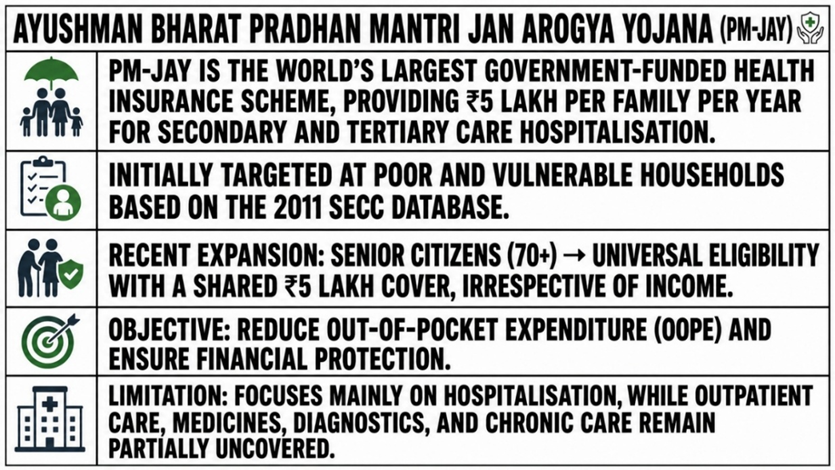
Explanation:
1. Insurance Expansion vs Limited Access:
Insurance coverage has increased sharply post-PM-JAY, improving financial protection.
However, hospitalisation rates remain below 2014 levels, showing that coverage ≠ access.
Barriers persist due to limited facilities, hidden costs, and uneven service availability.
2. Public Financing, Private Provision:
PM-JAY and state schemes now finance a larger share of hospital care.
But low reimbursement rates lead private hospitals to:
Charge for diagnostics, medicines, and ancillary services separately
Result: Public insurance often subsidises private healthcare without full price regulation.
3. Changing Disease Burden:
Increase in reported illness reflects better healthcare-seeking behaviour.
Shift observed:
Decline in infectious diseases
Rise in non-communicable diseases (NCDs)
Requires stronger systems for long-term and chronic care, not just hospitalisation.
4. OOPE Trends: Mixed Outcomes:
Median OOPE has declined (~₹11,285 per hospitalisation) and is minimal in public outpatient care.
Public sector and schemes like AAM reduce routine costs.
However, high-cost treatments (surgeries, chronic diseases) still cause catastrophic expenditure.
5. Structural Weakness in Health System:
Public sector effectively supports primary and secondary care.
But:
Underfunding for chronic disease management
Private dominance in tertiary care
Outcome:
Poor → nominal coverage but limited real benefit
Middle class → high financial burden in serious illness
6. Core Issue:
India has improved:
Insurance coverage
Basic affordability
But lacks:
Adequate public hospital capacity, especially for advanced care
Thus, access inequality persists despite coverage expansion.
7. Way Forward:
Strengthen public sector hospital capacity, particularly tertiary care
Reduce dependence on private providers
Ensure actual service delivery matches insurance coverage
Conclusion:
India’s health reforms have expanded insurance and improved affordability at basic levels, but true universal healthcare requires strong public hospitals. Without this, financial protection remains incomplete and inequalities persist.
Source: (The Hindu)
La Excellence IAS Academy, the best IAS coaching in Hyderabad, known for delivering quality content and conceptual clarity for UPSC 2026 preparation.
FOLLOW US ON:
◉ YouTube : https://www.youtube.com/@CivilsPrepTeam
◉ Facebook: https://www.facebook.com/LaExcellenceIAS
◉ Instagram: https://www.instagram.com/laexcellenceiasacademy/
GET IN TOUCH:
Contact us at info@laex.in, https://laex.in/contact-us/
or Call us @ +91 9052 29 2929, +91 9052 99 2929, +91 9154 24 2140
OUR BRANCHES:
Head Office: H No: 1-10-225A, Beside AEVA Fertility Center, Ashok Nagar Extension, VV Giri Nagar, Ashok Nagar, Hyderabad, 500020
Madhapur: Flat no: 301, survey no 58-60, Guttala begumpet Madhapur metro pillar: 1524, Rangareddy Hyderabad, Telangana 500081
Bangalore: Plot No: 99, 2nd floor, 80 Feet Road, Beside Poorvika Mobiles, Chandra Layout, Attiguppe, Near Vijaya Nagara, Bengaluru, 560040