
Paper: GS – II, Subject: Governance, Topic: government Policies, Issue: Right to Education (RTE) Act and Social Inclusion.
Context:
In a recent judgment (2026), the Supreme Court reaffirmed the importance of Section 12(1)(c) of the Right to Education (RTE) Act, 2009, which mandates 25% reservation for disadvantaged children in private schools. The ruling emphasizes social inclusion as a constitutional goal of education policy.
Key Takeaways:
Background:
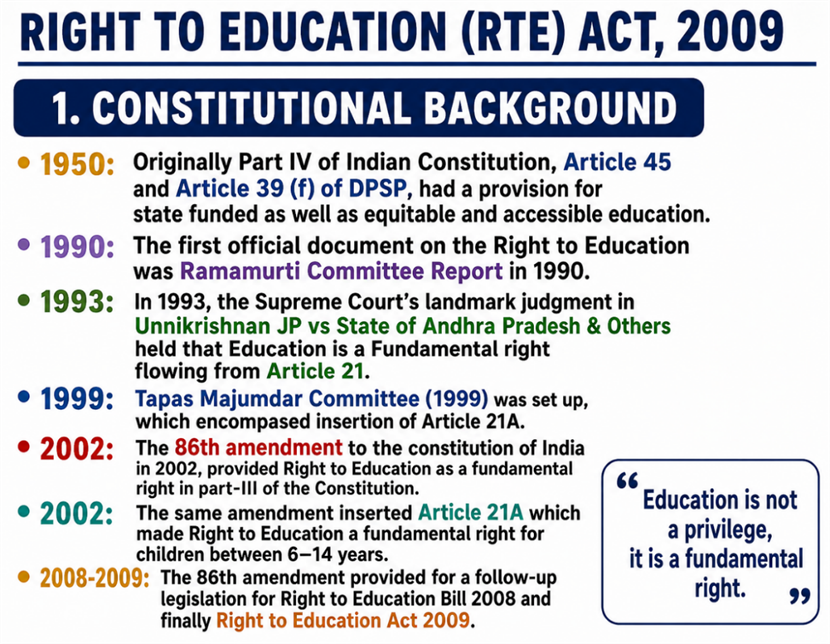
RTE Act: Core Provision for inclusive Education
- Section 12(1)(c) of the RTE Act mandates that private schools reserve 25% of their seats for children from economically weaker sections (EWS) and disadvantaged groups.
- This provision is designed to ensure that children from diverse backgrounds can learn together, thereby promoting social integration.
- By facilitating access to quality education for marginalized communities, the RTE Act aims to create a more inclusive educational environment that reflects the diversity of Indian society.
RTE Act: Shared Responsibility in Education
- Since the implementation of the RTE Act, over five million children have gained access to educational opportunities that were previously out of reach.
- Retention rates in these blended classrooms have averaged over 90%, indicating a positive impact on student engagement and success.
- Research, including studies like the Annual Status of Education Report (ASER), shows that mixed classrooms foster increased generosity, reduced discrimination, and enhanced pro-social behavior among students.
- These environments not only improve academic outcomes but also broaden aspirations and worldviews for children from disadvantaged backgrounds.
Challenges:
Despite the positive impact of the RTE Act, several challenges persist.
- Some private schools resist full inclusion, often imposing hidden costs for uniforms, books, and materials that can deter families from utilizing the provision.
- Implementation of Section 12(1)(c) remains uneven across states, with gaps in transparency, grievance redress mechanisms, and last-mile outreach.
- These challenges highlight the need for clear, enforceable rules to ensure that the benefits of the RTE Act reach all intended beneficiaries.
Supreme Court View:
- The Supreme Court’s reaffirmation of Section 12(1)(c) is significant as it reinforces the idea that the RTE Act is not a retreat from public education but a commitment to social integration.
- This judgment aligns with earlier cases, such as the Society for Unaided Private Schools of Rajasthan v. Union of India (2012), which emphasized the importance of balancing private and public educational responsibilities.
- The Court’s stance underscores the necessity of operationalizing the constitutional promise of equality in education.
Way Forward:
- To realize the full potential of the RTE Act, several administrative reforms are needed. States must ensure timely reimbursements to private schools for the reserved seats, eliminate hidden costs imposed by these institutions, and strengthen grievance redress mechanisms.
- Improved monitoring and accountability measures, particularly through digital admission systems, can enhance transparency and ensure that inclusion norms are enforced effectively.
Conclusion:
The RTE Act represents a significant step towards achieving social integration and equality of opportunity in education. Its success depends on strengthening implementation, addressing financial and administrative gaps, and ensuring that inclusion translates into meaningful equality in classrooms.
Source: (The Hindu)
La Excellence IAS Academy, the best IAS coaching in Hyderabad, known for delivering quality content and conceptual clarity for UPSC 2026 preparation.
FOLLOW US ON:
◉ YouTube : https://www.youtube.com/@CivilsPrepTeam
◉ Facebook: https://www.facebook.com/LaExcellenceIAS
◉ Instagram: https://www.instagram.com/laexcellenceiasacademy/
GET IN TOUCH:
Contact us at info@laex.in, https://laex.in/contact-us/
or Call us @ +91 9052 29 2929, +91 9052 99 2929, +91 9154 24 2140
OUR BRANCHES:
Head Office: H No: 1-10-225A, Beside AEVA Fertility Center, Ashok Nagar Extension, VV Giri Nagar, Ashok Nagar, Hyderabad, 500020
Madhapur: Flat no: 301, survey no 58-60, Guttala begumpet Madhapur metro pillar: 1524, Rangareddy Hyderabad, Telangana 500081
Bangalore: Plot No: 99, 2nd floor, 80 Feet Road, Beside Poorvika Mobiles, Chandra Layout, Attiguppe, Near Vijaya Nagara, Bengaluru, 560040