
Paper: GS – III, Subject: Environment and Ecology, Topic: Forest Conservation, Issue: Saranda Forests: Ecological Importance.
Context:
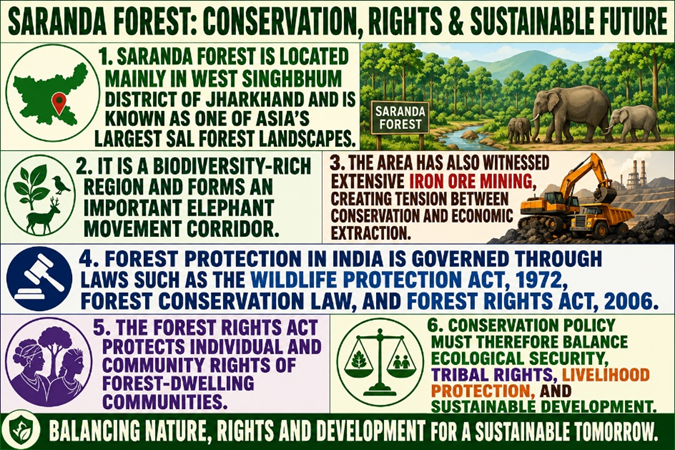
The Saranda forests of Jharkhand are ecologically significant sal forests and an important elephant corridor. The present issue concerns the delay in giving stronger legal protection to this forest landscape despite judicial directions, rising mining pressure, and increasing ecological damage.
Key Takeaways:
Explanation:
1. Problem: Delay in Forest Protection:
- The major concern is the delay in notifying Saranda as a protected wildlife area despite its ecological importance.
- Delay weakens conservation efforts and allows continued degradation of the forest ecosystem.
2. Mining Pressure and Ecological Damage:
- Mining has disturbed forest continuity, damaged habitats, and affected wildlife movement.
- Fragmentation of forests reduces biodiversity and makes ecosystems more vulnerable to long-term decline.
3. Elephant Corridors and Human–Animal Conflict:
- Saranda is important for elephant migration.
- When forest corridors are disturbed, elephants are forced to move through villages and agricultural fields.
- This increases crop loss, human casualties, elephant deaths, and social tension.
4. Forest Rights and Conservation Debate:
- A common fear is that protected area status may affect the rights of tribal and forest-dwelling communities.
- However, conservation and community rights need not be treated as opposites.
- The Forest Rights Act recognises individual and community forest rights, and these must be protected even while conserving forests.
5. Weak Environmental Governance:
- The issue also reflects poor implementation of environmental laws and court directions.
- Environmental governance suffers when governments give assurances but delay actual action.
- Such delays reduce public trust in institutions and weaken rule-based governance.
Way Forward:
- The state must complete legal notification and prepare a science-based management plan.
- Mining should be strictly regulated through ecological assessment, “go” and “no-go” zoning, and continuous monitoring.
- Elephant corridors must be restored and protected.
- Gram Sabhas and local communities should be involved in conservation planning.
- Tribal livelihoods, forest rights, compensation, and rehabilitation support must be ensured.
- Conservation should be treated as long-term ecological security, not merely as a restriction on development.
Conclusion:
Saranda represents the larger challenge of balancing environment, minerals, tribal rights, and governance. Protecting the forest is essential not only for wildlife but also for water security, soil conservation, climate resilience, and local livelihoods. A rights-based, community-centred, and scientifically planned conservation model is the most sustainable way forward.
Source: (The Indian Express)
La Excellence IAS Academy, the best IAS coaching in Hyderabad, known for delivering quality content and conceptual clarity for UPSC 2026 preparation.
FOLLOW US ON:
◉ YouTube : https://www.youtube.com/@CivilsPrepTeam
◉ Facebook: https://www.facebook.com/LaExcellenceIAS
◉ Instagram: https://www.instagram.com/laexcellenceiasacademy/
GET IN TOUCH:
Contact us at info@laex.in, https://laex.in/contact-us/
or Call us @ +91 9052 29 2929, +91 9052 99 2929, +91 9154 24 2140
OUR BRANCHES:
Head Office: H No: 1-10-225A, Beside AEVA Fertility Center, Ashok Nagar Extension, VV Giri Nagar, Ashok Nagar, Hyderabad, 500020
Madhapur: Flat no: 301, survey no 58-60, Guttala begumpet Madhapur metro pillar: 1524, Rangareddy Hyderabad, Telangana 500081
Bangalore: Plot No: 99, 2nd floor, 80 Feet Road, Beside Poorvika Mobiles, Chandra Layout, Attiguppe, Near Vijaya Nagara, Bengaluru, 560040