
Paper: GS – III, Subject: Economy, Topic: Trade and External sector, Issue: Challenges in India’s FTAs.
Context:
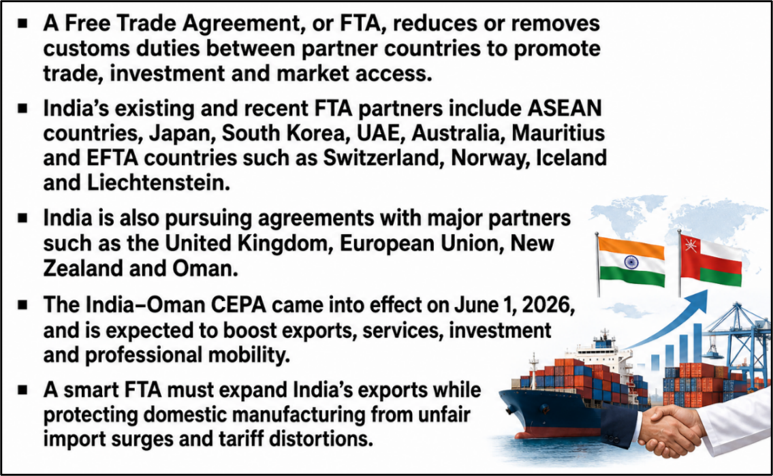
India now has 15 Free Trade Agreements covering 27 countries. Another nine agreements are under negotiation, and once finalised, India’s FTA partners would cover around 69 countries and nearly 75% of India’s exports. This makes FTAs central to India’s trade policy, but India’s past experience shows four major challenges that demand careful attention.
Key Takeaways:
Explanation:
1. Challenge One: Rising Trade Deficit:
- India’s FTA experience shows that imports from partner countries have often increased faster than exports.
- After some agreements, India’s trade deficit with partners such as ASEAN, Japan and South Korea widened significantly.
- This means that tariff reduction alone does not guarantee export growth unless Indian firms are globally competitive.
- The core problem is that partner countries often use India’s large market more effectively than India uses their markets.
- Therefore, India must evaluate whether each FTA will genuinely expand exports or merely increase cheaper imports.
2. Challenge Two: Low Utilisation of FTA Benefits
- Many Indian exporters do not fully use the tariff concessions available under FTAs.
- This happens due to complex paperwork, rules of origin requirements, certification procedures and lack of awareness among exporters.
- Small and medium enterprises often avoid FTA procedures because the compliance burden is higher than the expected tariff benefit.
- As a result, India may negotiate tariff concessions but fail to convert them into actual export gains.
- Better exporter awareness, digital certification, trade facilitation and sector-specific support are necessary.
3. Challenge Three: Inverted Duty Structure
- An inverted duty structure occurs when raw materials or intermediate goods face higher duties than finished products.
- Under such conditions, finished goods from FTA partners enter India at low or zero duty, while Indian manufacturers pay higher input costs.
- This makes domestic manufacturing less competitive.
- Sectors such as chemicals, plastics, metals, electronics and engineering goods can be affected.
- India must align industrial tariffs with FTA commitments to protect domestic value addition.
4. Challenge Four: Relocation of Manufacturing
- If it becomes cheaper to manufacture in partner countries and export duty-free to India, companies may shift production abroad.
- This creates the risk of “Make in ASEAN, sell in India” instead of “Make in India”.
- Third-country firms may also route goods through FTA partners to access India’s market indirectly.
- Strong rules of origin, anti-circumvention checks and domestic production incentives are essential.
- FTAs should support India’s manufacturing base, not weaken it.
India–Oman CEPA as a Smart FTA Example:
- The India–Oman CEPA provides opportunities in textiles, chemicals, engineering goods, pharmaceuticals, food products, services and professional mobility.
- Oman’s strategic location near the Gulf, Arabian Sea and East Africa can help India use it as an export and logistics gateway.
- Ports such as Sohar, Duqm and Salalah can support Indian trade with Gulf and African markets.
Conclusion:
India should pursue FTAs, but with stronger economic strategy and domestic preparedness. Future agreements must correct tariff distortions, improve FTA utilisation, prevent import dependence and strengthen manufacturing. The India–Oman CEPA shows that FTAs can be beneficial when market access is combined with services mobility, logistics advantage and strategic connectivity.
Source: (The Indian Express)
La Excellence IAS Academy, the best IAS coaching in Hyderabad, known for delivering quality content and conceptual clarity for UPSC 2026 preparation.
FOLLOW US ON:
◉ YouTube : https://www.youtube.com/@CivilsPrepTeam
◉ Facebook: https://www.facebook.com/LaExcellenceIAS
◉ Instagram: https://www.instagram.com/laexcellenceiasacademy/
GET IN TOUCH:
Contact us at info@laex.in, https://laex.in/contact-us/
or Call us @ +91 9052 29 2929, +91 9052 99 2929, +91 9154 24 2140
OUR BRANCHES:
Head Office: H No: 1-10-225A, Beside AEVA Fertility Center, Ashok Nagar Extension, VV Giri Nagar, Ashok Nagar, Hyderabad, 500020
Madhapur: Flat no: 301, survey no 58-60, Guttala begumpet Madhapur metro pillar: 1524, Rangareddy Hyderabad, Telangana 500081
Bangalore: Plot No: 99, 2nd floor, 80 Feet Road, Beside Poorvika Mobiles, Chandra Layout, Attiguppe, Near Vijaya Nagara, Bengaluru, 560040
India Oman CEPA: Balancing Trade Gains and Risks