
Paper: GS – I/II, Subject: India Society and Social Justice, Topic: Population and Associated Issues, Issue: Asia’s Ageing Population Challenge.
Context:
Asia is witnessing rapid population ageing, with a sharp rise in the elderly population and age-related diseases. The central issue is whether primary healthcare systems can move beyond basic first-contact treatment and provide sustained, coordinated, long-term care for older persons.
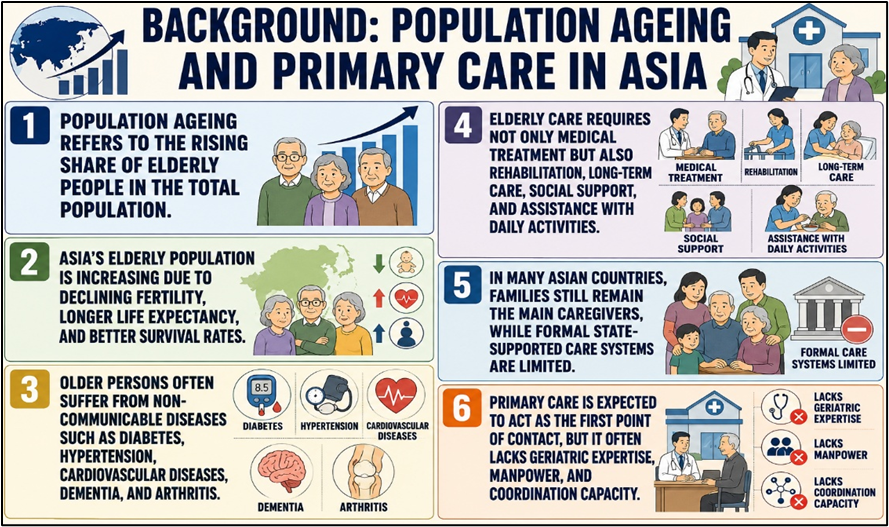
Key Takeaways:
Explanation:
1. Ageing as a Health-System Challenge:
- Ageing is not merely a demographic issue; it is a major public health and governance challenge.
- Older adults require repeated, continuous, and multidimensional care rather than one-time clinical treatment.
- Their needs include disease management, mental health support, physiotherapy, assistive devices, home-based care, and social security.
- Therefore, health systems must shift from episodic treatment to life-cycle-based care.
2. Limits of Present Primary Care:
- Primary healthcare in many countries is still designed mainly for maternal care, child health, immunisation, infectious diseases, and basic outpatient treatment.
- It is often not equipped to manage chronic diseases and long-term elderly care.
- Many centres lack trained geriatric staff, diagnostic support, follow-up systems, and referral coordination.
- As a result, elderly patients often directly approach hospitals, even for problems that could be managed at the primary level.
3. Fragmented Care System:
- Elderly care involves both health and social welfare departments.
- However, these services are often planned separately, leading to duplication, gaps, and weak accountability.
- Hospitals, community health centres, family caregivers, rehabilitation services, and welfare schemes often operate without proper coordination.
- This fragmentation increases household burden and reduces care quality.
4. Burden on Families and Hospitals:
- When formal care systems are weak, families become the default caregivers.
- This creates emotional, financial, and time-related pressure, especially on women.
- Hospitals also become overcrowded because primary care fails to manage long-term conditions.
- This makes healthcare costly, inefficient, and less accessible for the elderly poor.
Way Forward:
- Primary care must be redefined as a continuous care platform, not just a first-contact clinic.
- Geriatric training, community health workers, digital health records, home-based care, telemedicine, and regular screening must be strengthened.
- Health and social welfare systems should be integrated through clear roles and accountability.
- Public financing for elderly care is essential to reduce household expenditure.
Conclusion:
Asia’s ageing population will test the sustainability of healthcare systems. The solution lies in strengthening primary care as a coordinated, long-term, elderly-friendly system. Without this shift, hospitals and families will continue to bear an unsustainable burden.
Source: (The Indian Express)
La Excellence IAS Academy, the best IAS coaching in Hyderabad, known for delivering quality content and conceptual clarity for UPSC 2026 preparation.
FOLLOW US ON:
◉ YouTube : https://www.youtube.com/@CivilsPrepTeam
◉ Facebook: https://www.facebook.com/LaExcellenceIAS
◉ Instagram: https://www.instagram.com/laexcellenceiasacademy/
GET IN TOUCH:
Contact us at info@laex.in, https://laex.in/contact-us/
or Call us @ +91 9052 29 2929, +91 9052 99 2929, +91 9154 24 2140
OUR BRANCHES:
Head Office: H No: 1-10-225A, Beside AEVA Fertility Center, Ashok Nagar Extension, VV Giri Nagar, Ashok Nagar, Hyderabad, 500020
Madhapur: Flat no: 301, survey no 58-60, Guttala begumpet Madhapur metro pillar: 1524, Rangareddy Hyderabad, Telangana 500081
Bangalore: Plot No: 99, 2nd floor, 80 Feet Road, Beside Poorvika Mobiles, Chandra Layout, Attiguppe, Near Vijaya Nagara, Bengaluru, 560040