
Paper: GS-III, Subject: Environment and Ecology, Topic: Renewable Energy, Issue: India’s Renewable Surge: The Energy Storage Challenge
Context:
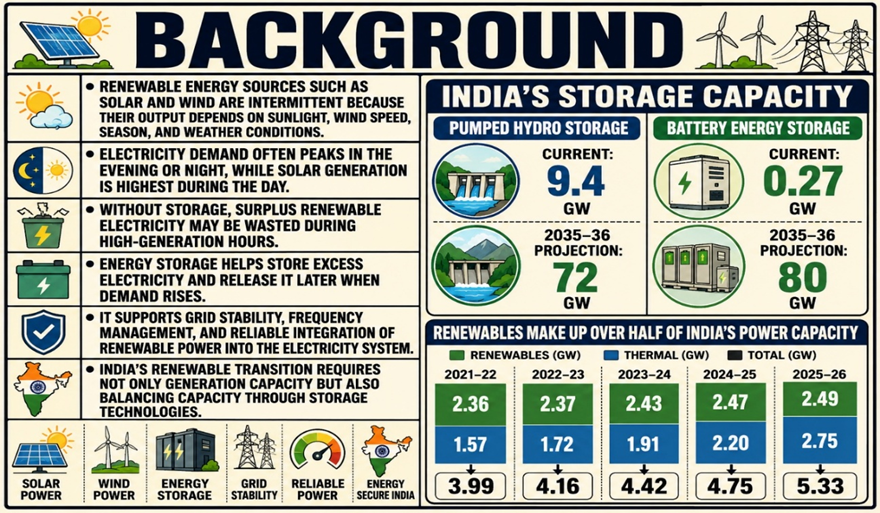
India’s rapid expansion of renewable energy has made electricity storage a critical requirement. Since solar power is unavailable after sunset and wind power varies with weather conditions, storage is needed to supply electricity when generation is low but demand remains high.
Explanation
Why Storage is Essential
- Storage solves the core mismatch between renewable generation and electricity demand.
- Solar energy may produce surplus power in the afternoon, but demand often rises in the evening when solar generation falls sharply.
- Wind power can fluctuate suddenly due to weather changes, creating instability in supply.
- Storage allows excess electricity to be saved during low-demand periods and supplied during peak demand.
- It reduces dependence on coal-based backup power and improves the reliability of clean energy.
- It also helps prevent grid stress, blackouts, and curtailment of renewable power.
Types of Energy Storage
- Pumped Hydro Storage: Surplus electricity pumps water from a lower reservoir to a higher reservoir. During demand peaks, water is released downward through turbines to generate electricity.
- Battery Energy Storage Systems: Electricity is stored chemically in batteries, especially lithium-ion and lithium iron phosphate batteries. These are useful for fast response and short-duration storage.
- Concentrating Solar-Thermal Storage: Mirrors concentrate sunlight to produce heat, which is stored in materials such as molten salt and later used to generate steam and electricity.
- Compressed Air Energy Storage: Excess electricity compresses air into underground caverns or tanks. When needed, the air is released to run turbines.
- Flywheel Energy Storage: Electricity spins a rotor at high speed, and the stored kinetic energy is later converted back into electricity.
- Gravity Energy Storage: Surplus power lifts heavy weights, which are later lowered to generate electricity through gravitational movement.
India’s Key Challenges
- India faces a large gap between projected renewable capacity and available storage capacity.
- Limited storage can create grid instability as renewable energy becomes a larger share of total power supply.
- Battery storage expansion depends heavily on imported lithium-ion cells and critical minerals such as lithium, cobalt, and nickel.
- This creates supply-chain vulnerability, cost risks, and strategic dependence on a few countries.
- Pumped hydro projects face long gestation periods, environmental concerns, land issues, and high upfront investment.
Conclusion
Energy storage is the backbone of India’s renewable energy transition. Without rapid expansion of storage capacity, renewable growth may create reliability challenges; with proper investment, domestic manufacturing, and technology diversification, India can achieve cleaner and more stable power supply.
Source: (The Indian Express)
La Excellence IAS Academy, the best IAS coaching in Hyderabad, known for delivering quality content and conceptual clarity for UPSC 2026 preparation.
FOLLOW US ON:
◉ YouTube : https://www.youtube.com/@CivilsPrepTeam
◉ Facebook: https://www.facebook.com/LaExcellenceIAS
◉ Instagram: https://www.instagram.com/laexcellenceiasacademy/
GET IN TOUCH:
Contact us at info@laex.in, https://laex.in/contact-us/
or Call us @ +91 9052 29 2929, +91 9052 99 2929, +91 9154 24 2140
OUR BRANCHES:
Head Office: H No: 1-10-225A, Beside AEVA Fertility Center, Ashok Nagar Extension, VV Giri Nagar, Ashok Nagar, Hyderabad, 500020
Madhapur: Flat no: 301, survey no 58-60, Guttala begumpet Madhapur metro pillar: 1524, Rangareddy Hyderabad, Telangana 500081
Bangalore: Plot No: 99, 2nd floor, 80 Feet Road, Beside Poorvika Mobiles, Chandra Layout, Attiguppe, Near Vijaya Nagara, Bengaluru, 560040