
Paper: GS – II, Subject: International Relations, Topic: India’s relations with major powers, Issue: India GCC relations.
Context:
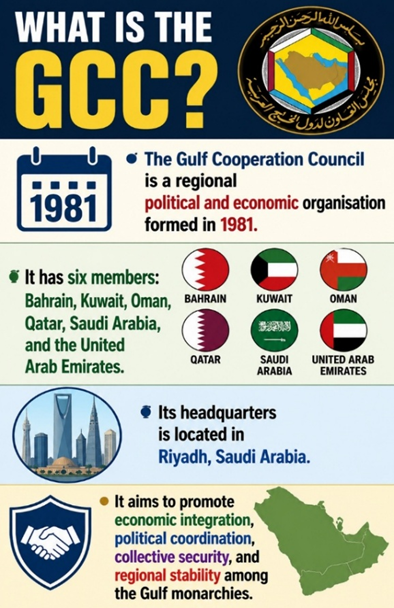
The recent escalation in West Asia has again highlighted the importance of the Gulf Cooperation Council (GCC) for India. The Gulf region is central to India’s energy security, trade, investment flows, maritime stability, and diaspora safety, making India-GCC relations a core pillar of India’s West Asia policy.
Key Takeaways:
Why is the GCC important for India?
1. Energy Security:
- The GCC is one of India’s most important energy partners.
- India depends heavily on Gulf countries for crude oil, liquefied natural gas, and liquefied petroleum gas.
- Any conflict near the Strait of Hormuz can directly affect India’s oil supply, inflation, current account deficit, and overall economic stability.
2. Trade and Investment:
- India-GCC trade reached USD 178.56 billion in FY 2024–25, accounting for 15.42% of India’s global trade.
- The UAE is India’s largest GCC trade partner, followed by Saudi Arabia.
- GCC sovereign wealth funds are important investors in Indian infrastructure, renewable energy, logistics, digital technology, and financial services.
3. Indian Diaspora:
- Around 8.9 million Indians live in GCC countries, forming nearly 66% of non-resident Indians.
- Their remittances support Indian households and the wider economy.
- Therefore, any regional conflict creates a major concern for India regarding evacuation, worker safety, labour rights, and social security.
4. Strategic and Defence Cooperation:
- India-GCC relations have moved beyond oil and trade.
- Cooperation now includes maritime security, defence exercises, counter-terrorism, cyber security, drones, artificial intelligence, and defence production.
- Oman, the UAE, and Saudi Arabia are especially important for India’s maritime and strategic outreach in the western Indian Ocean.
5. Diplomatic Importance:
- India and the GCC share a common interest in regional stability, secure sea lanes, counter-terrorism, and balanced West Asia diplomacy.
- The India-GCC Joint Action Plan 2024–2028 has expanded cooperation into health, trade, energy, security, agriculture, food security, transport, and culture.
6. Challenges in India-GCC Relations:
- India remains highly dependent on GCC energy imports, creating vulnerability during regional crises.
- Trade is still imbalanced because India imports more energy than it exports goods and services.
- Labour welfare issues, including wage delays, harsh working conditions, and localisation policies such as Saudisation and Emiratisation, can affect Indian workers.
- Regional instability involving Iran, Israel, Yemen, and the Red Sea creates diplomatic and energy-security risks.
- China’s growing presence in the Gulf adds a strategic challenge for India.
7. Way Forward:
- India should fast-track the India-GCC Free Trade Agreement to deepen trade and services cooperation.
- India must strengthen labour agreements, grievance redressal systems, and social security portability for Indian workers.
- Defence cooperation should expand into maritime security, drones, counter-drone systems, and joint production.
- India should use GCC partnerships for renewable energy, green hydrogen, artificial intelligence, fintech, logistics, and connectivity projects like the India-Middle East-Europe Economic Corridor.
- A regular India-GCC summit mechanism can institutionalise strategic dialogue.
Conclusion:
India-GCC relations have evolved from a traditional oil-and-remittance relationship into a broader strategic partnership covering energy, trade, investment, defence, technology, and diaspora welfare. For India, the GCC is not merely part of West Asia; it is an essential pillar of India’s extended neighbourhood strategy and economic security architecture.
La Excellence IAS Academy, the best IAS coaching in Hyderabad, known for delivering quality content and conceptual clarity for UPSC 2026 preparation.
FOLLOW US ON:
◉ YouTube : https://www.youtube.com/@CivilsPrepTeam
◉ Facebook: https://www.facebook.com/LaExcellenceIAS
◉ Instagram: https://www.instagram.com/laexcellenceiasacademy/
GET IN TOUCH:
Contact us at info@laex.in, https://laex.in/contact-us/
or Call us @ +91 9052 29 2929, +91 9052 99 2929, +91 9154 24 2140
OUR BRANCHES:
Head Office: H No: 1-10-225A, Beside AEVA Fertility Center, Ashok Nagar Extension, VV Giri Nagar, Ashok Nagar, Hyderabad, 500020
Madhapur: Flat no: 301, survey no 58-60, Guttala begumpet Madhapur metro pillar: 1524, Rangareddy Hyderabad, Telangana 500081
Bangalore: Plot No: 99, 2nd floor, 80 Feet Road, Beside Poorvika Mobiles, Chandra Layout, Attiguppe, Near Vijaya Nagara, Bengaluru, 560040