
Paper: GS – II, Subject: Polity, Topic: Legal issues, Issue: Regulation of Digital Speech and IT Rules Amendments in India.
Context:
The Union Government has proposed amendments to the Information Technology (IT) Rules, 2021, expanding regulatory control over online content and digital platforms. These changes have triggered concerns about freedom of speech, executive overreach, and the balance between regulation and rights in India’s digital public sphere.
Key Takeaways:
Background:
Core Issues Explained:
1. Expansion of Executive Power:
- The proposed amendments significantly increase the role of the executive (government) in regulating online content.
- Platforms may be required to comply with government advisories, directions, and procedures even if they are not backed by formal law.
- This weakens the traditional role of Parliament and the judiciary in setting limits on free speech.
2. Impact on Safe Harbour Protection:
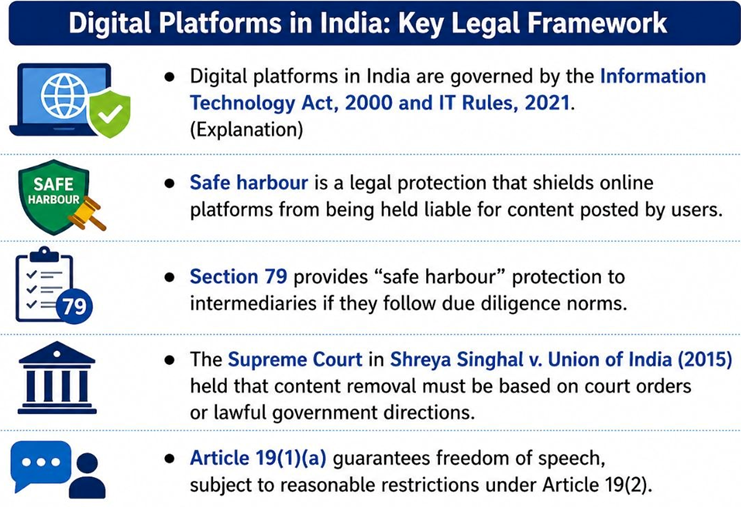
- Under Section 79 of the IT Act, platforms enjoy “safe harbour” protection if they follow due diligence norms.
- The new rules make this protection conditional on compliance with a wide range of government-issued instructions.
- This creates legal pressure on platforms to follow informal directives, encouraging over-compliance and censorship.
3. Conflict with Judicial Precedents:
- The Supreme Court in Shreya Singhal v. Union of India (2015) held that content can only be removed based on court orders or lawful government notifications.
- The new amendments dilute this safeguard by allowing informal executive directions to influence content moderation.
- This undermines established constitutional protections for free speech.
4. Expansion of Oversight Mechanisms:
- The amendments extend government oversight to include ordinary users who post news and current affairs content.
- The Inter-Departmental Committee (IDC), originally meant for grievance redressal, is now empowered to review and recommend blocking content.
- This expands state control beyond traditional publishers to individuals.
5. Undefined and Broad Powers:
- The role and functioning of the IDC remain vaguely defined, creating scope for arbitrary action.
- There is no clear threshold for intervention or guarantee of hearing for affected users.
- This raises concerns about violation of principles of natural justice.
6. Shift from Grievance Redressal to Pre-emptive Control:
- The regulatory framework shifts from resolving complaints to proactively monitoring and controlling content.
- This changes the nature of digital governance from reactive to intrusive.
- It increases the risk of suppressing legitimate expression before any harm occurs.
7. Increased Data Retention and Surveillance Risks:
- Platforms may be required to retain user data, including browsing and communication records, for extended periods.
- Longer data retention increases risks of misuse, data breaches, and surveillance.
- It alters the relationship between citizens and digital platforms, encouraging self-censorship.
8. Chilling Effect on Free Speech:
- Unclear liability and fear of penalties will push platforms to remove content proactively.
- Users may avoid expressing opinions due to fear of monitoring or content removal.
- This leads to a “chilling effect” where free expression is indirectly suppressed.
9. Delegated Legislation and Constitutional Concerns:
- The amendments rely on delegated legislation, which must remain within limits set by Parliament.
- Supreme Court judgments (e.g., Indian Express Newspapers v. Union of India) emphasize that such rules must not create new legal obligations beyond the parent law.
- The current changes risk upsetting the balance between regulation and overreach.
10. Weak Public Consultation Process:
- The consultation period for such significant amendments was short.
- Major policy changes require wider debate, legislative scrutiny, and alignment with constitutional principles.
- Lack of adequate consultation reduces transparency and accountability.
Conclusion:
The proposed amendments reflect a shift towards tighter state control over digital spaces. While regulation of harmful content is necessary, it must be balanced with constitutional safeguards, judicial oversight, and transparency to preserve democratic freedoms.
Source: (The Indian Express, The Hindu, Live Mint)
La Excellence IAS Academy, the best IAS coaching in Hyderabad, known for delivering quality content and conceptual clarity for UPSC 2026 preparation.
FOLLOW US ON:
◉ YouTube : https://www.youtube.com/@CivilsPrepTeam
◉ Facebook: https://www.facebook.com/LaExcellenceIAS
◉ Instagram: https://www.instagram.com/laexcellenceiasacademy/
GET IN TOUCH:
Contact us at info@laex.in, https://laex.in/contact-us/
or Call us @ +91 9052 29 2929, +91 9052 99 2929, +91 9154 24 2140
OUR BRANCHES:
Head Office: H No: 1-10-225A, Beside AEVA Fertility Center, Ashok Nagar Extension, VV Giri Nagar, Ashok Nagar, Hyderabad, 500020
Madhapur: Flat no: 301, survey no 58-60, Guttala begumpet Madhapur metro pillar: 1524, Rangareddy Hyderabad, Telangana 500081
Bangalore: Plot No: 99, 2nd floor, 80 Feet Road, Beside Poorvika Mobiles, Chandra Layout, Attiguppe, Near Vijaya Nagara, Bengaluru, 560040