
Paper: GS – II, Subject: International Relations, Topic: Agreements involving India, Issue: India New Zealand FTA.
Context:
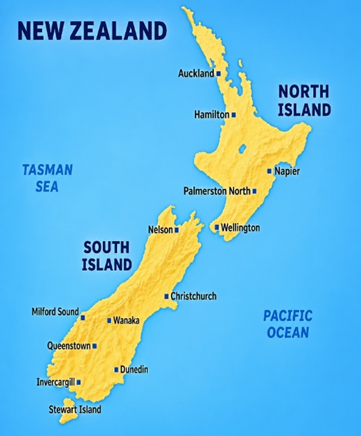
India and New Zealand have signed a “historic” Free Trade Agreement (FTA), aiming to deepen trade, investment, and strategic ties. The deal includes tariff reductions, duty-free access for exports, and an investment commitment of about $20 billion from New Zealand over the next 15 years
Key Takeaways:
Background:
A Free Trade Agreement (FTA) is a pact between countries to reduce or eliminate tariffs and trade barriers.
India has been selectively negotiating FTAs to balance domestic industry protection with global integration.
New Zealand is a developed economy with strengths in agriculture, dairy, and services.
Explanation:
1. Key Provisions of the Agreement:
New Zealand will eliminate tariffs on 100% of goods imported from India.
India will remove or reduce tariffs on about 95% of imports from New Zealand.
Tariff elimination is phased for sensitive sectors such as petroleum products and machinery.
India has excluded critical sectors such as dairy, animal products, and some agricultural goods.
2. Investment and Economic Commitments
New Zealand has committed to invest $20 billion in India over 15 years.
Investment is expected in sectors such as infrastructure, services, and supply chains.
However, past trends show that investment commitments do not always translate into actual flows.
3. Sectoral Impacts:
Positive impacts:
Indian exports such as textiles, pharmaceuticals, and machinery gain better market access.
Services sector (IT, professionals, students) gets mobility opportunities.
Concerns:
Dairy sector fears competition from efficient New Zealand producers.
Apple growers in Himachal Pradesh and Kashmir may face price competition.
4. Trade Liberalisation and Market Access:
India has liberalised tariffs on about 70% of tariff lines, covering 90% of trade value.
Preferential access for products like apples and kiwifruit is included with quota limits.
A fast-track mechanism is proposed to facilitate smoother trade flows.
5. Strategic and Policy Significance:
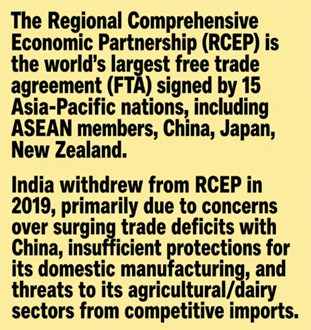
Strengthens India’s global trade integration strategy post-RCEP withdrawal.
Enhances economic ties with a developed, rule-based economy.
Signals India’s willingness to engage in balanced trade agreements.
Conclusion:
The India–New Zealand FTA represents a calibrated approach to trade liberalisation, balancing export promotion with domestic safeguards. Its success will depend on effective implementation, protection of vulnerable sectors, and realisation of promised investments.
Source: (The Hindu)
La Excellence IAS Academy, the best IAS coaching in Hyderabad, known for delivering quality content and conceptual clarity for UPSC 2026 preparation.
FOLLOW US ON:
◉ YouTube : https://www.youtube.com/@CivilsPrepTeam
◉ Facebook: https://www.facebook.com/LaExcellenceIAS
◉ Instagram: https://www.instagram.com/laexcellenceiasacademy/
GET IN TOUCH:
Contact us at info@laex.in, https://laex.in/contact-us/
or Call us @ +91 9052 29 2929, +91 9052 99 2929, +91 9154 24 2140
OUR BRANCHES:
Head Office: H No: 1-10-225A, Beside AEVA Fertility Center, Ashok Nagar Extension, VV Giri Nagar, Ashok Nagar, Hyderabad, 500020
Madhapur: Flat no: 301, survey no 58-60, Guttala begumpet Madhapur metro pillar: 1524, Rangareddy Hyderabad, Telangana 500081
Bangalore: Plot No: 99, 2nd floor, 80 Feet Road, Beside Poorvika Mobiles, Chandra Layout, Attiguppe, Near Vijaya Nagara, Bengaluru, 560040