
Paper: GS – III, Subject: Science and Technology, Topic: Bio-Technology, Issue: Gene Therapy vs GM Crops Debate.
Context:
Modern societies display a clear inconsistency in their attitude towards genetic technologies: while gene therapy in humans is widely accepted and encouraged, genetic modification in crops faces resistance and suspicion, even though both are based on similar scientific principles.
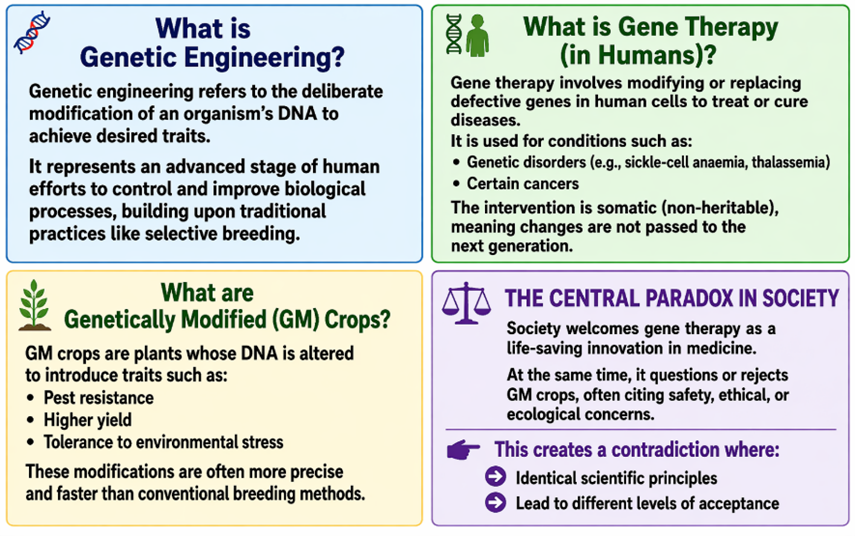
Key Takeaways:
REASONS FOR ACCEPTANCE OF GENE THERAPY:
- Gene therapy is perceived as a direct medical necessity, especially for life-threatening diseases.
- The benefits are immediate and visible, often involving survival or improved quality of life.
- Patients and families actively demand access to such treatments, increasing societal support.
- Ethical justification is strong because it is seen as curing suffering rather than altering nature arbitrarily.
REASONS FOR RESISTANCE TO GM CROPS:
- Concerns persist regarding:
- Environmental impact, including unintended ecological consequences
- Loss of biodiversity
- Corporate control over seeds and agriculture
- There is a perception that GM crops represent unnatural interference in ecosystems.
- Benefits are often indirect or long-term, making them less visible to consumers.
- Public understanding of agricultural biotechnology remains limited, contributing to mistrust.
SCIENTIFIC AND HISTORICAL PERSPECTIVE:
- Human societies have always modified plants and animals through:
- Domestication
- Selective breeding
- Much of today’s food is already the result of centuries of genetic manipulation, albeit slower and less precise.
- Modern genetic engineering is therefore an extension, not a departure, from historical practices.
ROLE AND LIMITATIONS OF REGULATION:
- Regulatory systems today are often:
- Risk-averse and compliance-heavy
- Focused more on preventing harm than enabling innovation
- Excessive regulation can:
- Delay technological adoption
- Discourage scientific experimentation and investment
- At the same time, lack of regulation may create legitimate safety concerns
Hence, there is a need for balanced, evidence-based regulation
GLOBAL VARIATION IN APPROACH:
- Countries such as the United States and Canada have widely adopted GM crops.
- Regions like Europe and India remain more cautious or restrictive.
- These differences arise from:
- Public perception
- Political priorities
- Cultural attitudes towards science and risk
BROADER INSIGHT: INNOVATION AND SOCIETY:
- Societies that encourage innovation and scientific inquiry tend to progress faster.
- Those that over-regulate or fear technological change risk stagnation.
- Historical experiences show that suppression of scientific ideas can limit long-term development.
WAY FORWARD:
- There is a need for risk-based regulation instead of fear-driven approaches, along with greater scientific awareness to address perception biases.
- Policies should ensure safety, environmental protection, and accessibility of innovations, while promoting responsible use of genetic technologies.
- A balanced approach combining science, public trust, and prudent regulation is essential for advancing human well-being and sustainable development.
Source: (The Hindu)
La Excellence IAS Academy, the best IAS coaching in Hyderabad, known for delivering quality content and conceptual clarity for UPSC 2026 preparation.
FOLLOW US ON:
◉ YouTube : https://www.youtube.com/@CivilsPrepTeam
◉ Facebook: https://www.facebook.com/LaExcellenceIAS
◉ Instagram: https://www.instagram.com/laexcellenceiasacademy/
GET IN TOUCH:
Contact us at info@laex.in, https://laex.in/contact-us/
or Call us @ +91 9052 29 2929, +91 9052 99 2929, +91 9154 24 2140
OUR BRANCHES:
Head Office: H No: 1-10-225A, Beside AEVA Fertility Center, Ashok Nagar Extension, VV Giri Nagar, Ashok Nagar, Hyderabad, 500020
Madhapur: Flat no: 301, survey no 58-60, Guttala begumpet Madhapur metro pillar: 1524, Rangareddy Hyderabad, Telangana 500081
Bangalore: Plot No: 99, 2nd floor, 80 Feet Road, Beside Poorvika Mobiles, Chandra Layout, Attiguppe, Near Vijaya Nagara, Bengaluru, 560040