
Paper: GS-I, Subject: History, Topic: Reaction of Society towards colonial rule, Issue: Birsa Munda – Movement and Resistance
Context:
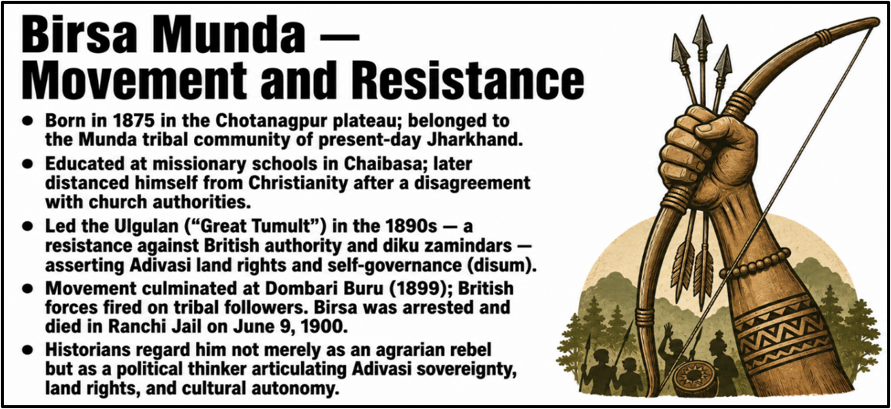
Birsa Munda is one of the most consequential figures in Indian tribal history, revered as “Dharti Aba” across the Chotanagpur plateau. His 19th-century uprising against colonial exploitation produced lasting legal and political legacies that continue to shape debates over Adivasi identity and Scheduled Tribe classification today.
Explanation
Religious Identity and the Birsait Faith
- Birsa founded the Birsait faith — distinct from Sarnaism (traditional tribal faith), Christianity, and Hinduism — rooted in Adivasi cosmology and his own teachings on life and nature.
- His vision was non-exclusionary; he opposed zamindars and missionaries alike as parts of the same exploitative system, not targeting any specific religion.
Legislative and Political Legacy
- The Ulgulan compelled colonial authorities to recognise Khuntkatti rights — the traditional Munda system of collective land ownership by original forest-clearing settlers.
- This led to the Chotanagpur Tenancy (CNT) Act, 1908 — preventing Adivasi land transfer to non-Adivasis and remaining a key tribal land safeguard in Jharkhand.
- His vision of Adivasi self-governance fed into the Jharkhand statehood movement under Jaipal Singh Munda, culminating in Jharkhand’s creation in 2000.
The Delisting Debate
- Current delisting demands — removing tribal converts to Christianity or Islam from the ST list — directly contest the definition of Adivasi identity Birsa’s movement established.
- Religion as a criterion for ST classification threatens to fracture Adivasi communities and dilute constitutional protections built on ancestry and community, not faith.
- This debate sits at the intersection of constitutional law, cultural politics, and electoral mobilisation, with direct implications for land rights and reservation entitlements.
Contemporary Relevance
- Birsa’s descendants argue tribal identity is determined by ancestry and community, making religion an invalid basis for Scheduled Tribe classification.
- His legacy is increasingly invoked across the political spectrum, reflecting the contested nature of Adivasi identity in modern India.
Conclusion:
Birsa Munda’s legacy spans colonial-era land legislation, post-independence state formation, and contemporary constitutional debates. His articulation of Adivasi identity — rooted in land, community, and sovereignty rather than religion — remains the central reference point in tribal rights discourse. Engaging seriously with Adivasi rights today requires reckoning with the framework he established.
Source: (The Indian Express)
La Excellence IAS Academy, the best IAS coaching in Hyderabad, known for delivering quality content and conceptual clarity for UPSC 2026 preparation.
FOLLOW US ON:
◉ YouTube : https://www.youtube.com/@CivilsPrepTeam
◉ Facebook: https://www.facebook.com/LaExcellenceIAS
◉ Instagram: https://www.instagram.com/laexcellenceiasacademy/
GET IN TOUCH:
Contact us at info@laex.in, https://laex.in/contact-us/
or Call us @ +91 9052 29 2929, +91 9052 99 2929, +91 9154 24 2140
OUR BRANCHES:
Head Office: H No: 1-10-225A, Beside AEVA Fertility Center, Ashok Nagar Extension, VV Giri Nagar, Ashok Nagar, Hyderabad, 500020
Madhapur: Flat no: 301, survey no 58-60, Guttala begumpet Madhapur metro pillar: 1524, Rangareddy Hyderabad, Telangana 500081
Bangalore: Plot No: 99, 2nd floor, 80 Feet Road, Beside Poorvika Mobiles, Chandra Layout, Attiguppe, Near Vijaya Nagara, Bengaluru, 560040