
Paper: GS – I, Subject: Society and Social justice, Topic: Urbanization – Problems and remedies, Issue: Urban Water Security and the Circular Water Economy.
Context:
India’s cities are facing a deepening urban water crisis driven by rising heat, growing population, ageing infrastructure and poor wastewater management. The challenge is not only about the shortage of water, but also about the safety, reliability and reuse of available water. A sustainable solution requires cities to reduce losses, prevent contamination and treat wastewater as an economic resource.
Key Takeaways:
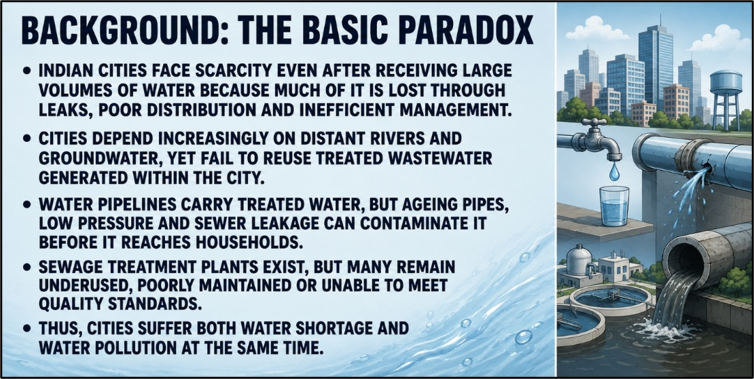
Explanation:
- Rising urban demand: Heatwaves and temperatures above 40°C increase domestic water demand. Cities such as Delhi, Ahmedabad, Jaipur, Bhopal and Narsinghpur reflect the pressure of extreme summer conditions on urban water systems.
- Falling water availability: India’s annual per capita water availability is around 1,500 cubic metres and may fall closer to the water-scarcity threshold of 1,000 cubic metres in the coming decades.
- Dependence on distant sources: Large cities often bring water from far-off rivers and reservoirs. This increases cost, energy use and dependence on upper riparian regions.
- Urban water contamination: In South Delhi’s affluent areas such as Gulmohar Park, Hauz Khas, Sarvodaya Enclave, Green Park, Greater Kailash and Vasant Kunj, residents reported foul smell, discoloured water, high chlorine and turbidity.
- Role of ageing infrastructure: Old pipelines, damaged joints and corroded networks allow contamination to enter drinking water lines, especially when pipelines run close to sewer lines.
- Low pressure and leakages: When water pressure falls, dirty water from drains, sewage lines or surrounding soil can enter the supply network through cracks. This explains why water shortages and contamination often occur together.
- Operational stress on water agencies: Delhi Jal Board’s network is under pressure due to rising demand, uneven supply, old pipes and frequent complaints. Tankers are often used as emergency support during shortages.
- Need for wastewater reuse: Treated used water can be used for agriculture, landscaping, construction, lake rejuvenation, industry and public conveniences instead of wasting freshwater.
- City-specific reuse planning: Delhi can prioritise peri-urban agriculture, Chennai can use treated water for lakes and water bodies, while Thane can use it for construction and industry.
- Improving Sewage Treatment Plants (STPs): Sewage treatment plants require better maintenance, trained personnel, energy supply, quality monitoring and prevention of industrial effluents entering domestic sewage.
- Circular water economy: Cities must shift from “use and dispose” to “treat, reuse and recycle”, supported by private investment, decentralised treatment plants, pricing reforms, behavioural change and local-body capacity.
Conclusion:
Urban water security requires cities to manage water as a complete cycle rather than as a one-time supply service. Reducing leaks, preventing contamination and reusing treated wastewater must become core urban policy. This can make Indian cities more resilient, efficient and climate-ready.
Source: (The Indian Express)
La Excellence IAS Academy, the best IAS coaching in Hyderabad, known for delivering quality content and conceptual clarity for UPSC 2026 preparation.
FOLLOW US ON:
◉ YouTube : https://www.youtube.com/@CivilsPrepTeam
◉ Facebook: https://www.facebook.com/LaExcellenceIAS
◉ Instagram: https://www.instagram.com/laexcellenceiasacademy/
GET IN TOUCH:
Contact us at info@laex.in, https://laex.in/contact-us/
or Call us @ +91 9052 29 2929, +91 9052 99 2929, +91 9154 24 2140
OUR BRANCHES:
Head Office: H No: 1-10-225A, Beside AEVA Fertility Center, Ashok Nagar Extension, VV Giri Nagar, Ashok Nagar, Hyderabad, 500020
Madhapur: Flat no: 301, survey no 58-60, Guttala begumpet Madhapur metro pillar: 1524, Rangareddy Hyderabad, Telangana 500081
Bangalore: Plot No: 99, 2nd floor, 80 Feet Road, Beside Poorvika Mobiles, Chandra Layout, Attiguppe, Near Vijaya Nagara, Bengaluru, 560040