
Context:
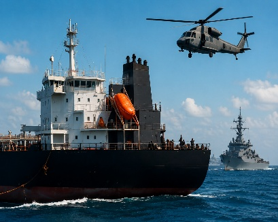
Following U.S. attacks on merchant vessels in the Gulf carrying Indian crew members, concerns have emerged regarding the safety of civilian seafarers in conflict zones. The issue highlights the limitations of international maritime law in protecting commercial shipping and civilian crews during geopolitical conflicts.
Explanation:
- International Maritime Law comprises rules governing navigation, shipping, maritime trade, safety, and conduct at sea.
- The principal legal framework is the United Nations Convention on the Law of the Sea (UNCLOS), 1982, often called the “Constitution of the Oceans.”
- UNCLOS regulates territorial seas, Exclusive Economic Zones (EEZs), high seas, straits, navigation rights, and maritime jurisdiction.
- The International Maritime Organization (IMO), a UN specialized agency, develops global standards for shipping safety, security, and pollution prevention.
- Merchant ships are civilian commercial vessels carrying cargo, energy supplies, and goods across international waters.
- Civilian seafarers are protected under multiple international frameworks – including IHL/Geneva Conventions (prohibiting deliberate targeting of civilians), SOLAS (safety and rescue obligations), the Maritime Labour Convention 2006 (seafarers’ rights and repatriation), and the SUA Convention 1988 (criminalising attacks on ships).
- However, when attacks are carried out by a state actor, none of these conventions provide an effective enforcement mechanism – protection exists normatively, but not operationally.
- Many merchant vessels operate under Flags of Convenience (FOC), being registered in countries different from the owner’s nationality.
- Enforcement of maritime law is challenging because there is no global maritime police force; compliance depends largely on states.
La Excellence IAS Academy, the best IAS coaching in Hyderabad, known for delivering quality content and conceptual clarity for UPSC 2026 preparation.
FOLLOW US ON:
◉ YouTube : https://www.youtube.com/@CivilsPrepTeam
◉ Facebook: https://www.facebook.com/LaExcellenceIAS
◉ Instagram: https://www.instagram.com/laexcellenceiasacademy/
GET IN TOUCH:
Contact us at info@laex.in, https://laex.in/contact-us/
or Call us @ +91 9052 29 2929, +91 9052 99 2929, +91 9154 24 2140
OUR BRANCHES:
Head Office: H No: 1-10-225A, Beside AEVA Fertility Center, Ashok Nagar Extension, VV Giri Nagar, Ashok Nagar, Hyderabad, 500020
Madhapur: Flat no: 301, survey no 58-60, Guttala begumpet Madhapur metro pillar: 1524, Rangareddy Hyderabad, Telangana 500081
Bangalore: Plot No: 99, 2nd floor, 80 Feet Road, Beside Poorvika Mobiles, Chandra Layout, Attiguppe, Near Vijaya Nagara, Bengaluru, 560040