
Paper: GS – II, Subject: Society and Social Justice, Topic: Social Sector – Health, Issue: Regulating Junk-Food Advertising in India.
Context:
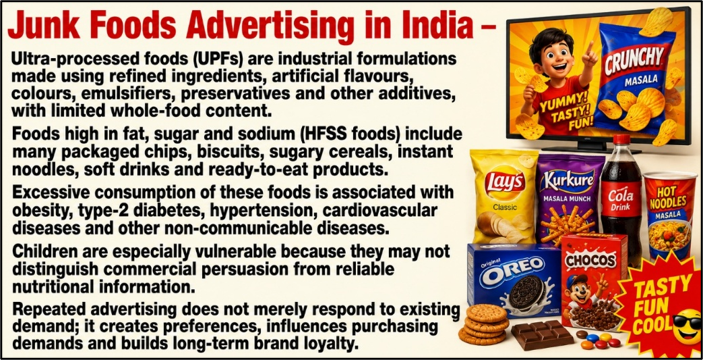
The rapid expansion of junk-food advertising across television, social media, digital games, cinemas and sporting events is shaping the dietary preferences of children and adolescents. Misleading health claims and celebrity endorsements often conceal the actual nutritional quality of products. Strong regulation is therefore necessary to protect public health and enable informed consumer choices.
Key Takeaways:
Explanation:
Existing Issues:
- Misleading Health Claims: Advertisements highlight terms such as “baked”, “natural”, “multigrain”, “12-grain”, “fortified” or “high-fibre”, while downplaying excessive sugar, fat, sodium, refined carbohydrates and additives. This creates a health-halo effect, making the entire product appear healthy.
- Celebrity Endorsements: Film stars, sportspersons and social-media influencers increase product credibility. Children may wrongly interpret such endorsements as proof that the product is nutritious or suitable for regular consumption.
- Child-Targeted Marketing: Cartoons, child actors, gifts, games, attractive packaging and emotional messages linking food with happiness, friendship or parental care exploit children’s limited understanding of advertising.
- Digital and Indirect Promotion: Marketing now occurs through social-media reels, influencer content, mobile applications, online games, sports sponsorships, cinema advertising and product placements. Television-only regulation is therefore inadequate.
- Public-Health Impact: Regular consumption of ultra-processed foods can displace fruits, vegetables, pulses and home-cooked meals, weakening overall diet quality and creating an unhealthy food environment.
- Limits of Nutrition Education: Teaching healthy eating is insufficient when children remain continuously exposed to persuasive marketing at home, during entertainment and in public spaces. Healthy choices require supportive surroundings, not merely individual willpower.
Existing Regulations and Policy Gaps:
- Policy Recognition: India’s public-health strategies have recognised the need to restrict advertising of foods high in fat, sugar and sodium.
- Regulatory Attention: Courts, parliamentary bodies and policy documents have supported clearer front-of-pack labelling, advertising restrictions and fiscal measures.
- Weak Enforcement: The existing framework remains fragmented and relies heavily on industry disclosures, advisories and voluntary self-regulation. Monitoring, penalties and digital-platform coverage remain inadequate.
Recommendations:
- Clear Warning Labels: Introduce prominent front-of-pack warnings for excessive fat, sugar and sodium, and prohibit deceptive health claims.
- Advertising Restrictions: Prohibit or tightly regulate child-targeted advertisements, celebrity endorsements, influencer promotions, sponsorships and product placements.
- Platform-Neutral Regulation: Apply uniform rules across television, social media, gaming platforms, cinemas, streaming services and sporting events.
- Healthy Food Environments: Restrict unhealthy-food promotion around schools and promote affordable, minimally processed, nutritious and locally produced foods.
- Stronger Legal Measures: Establish independent monitoring, deterrent penalties and appropriate taxation. Experiences of Chile, Mexico and Brazil indicate that mandatory controls are more effective than voluntary codes.
Conclusion:
Regulating junk-food advertising is not anti-business; it can redirect competition towards healthier products and responsible marketing. Consumer choice becomes meaningful only when information is transparent and children are protected from manipulation. Such regulation is therefore integral to the State’s responsibility to safeguard the right to health.
Source: (The Hindu)
La Excellence IAS Academy, the best IAS coaching in Hyderabad, known for delivering quality content and conceptual clarity for UPSC 2026 preparation.
FOLLOW US ON:
◉ YouTube : https://www.youtube.com/@CivilsPrepTeam
◉ Facebook: https://www.facebook.com/LaExcellenceIAS
◉ Instagram: https://www.instagram.com/laexcellenceiasacademy/
GET IN TOUCH:
Contact us at info@laex.in, https://laex.in/contact-us/
or Call us @ +91 9052 29 2929, +91 9052 99 2929, +91 9154 24 2140
OUR BRANCHES:
Head Office: H No: 1-10-225A, Beside AEVA Fertility Center, Ashok Nagar Extension, VV Giri Nagar, Ashok Nagar, Hyderabad, 500020
Madhapur: Flat no: 301, survey no 58-60, Guttala begumpet Madhapur metro pillar: 1524, Rangareddy Hyderabad, Telangana 500081
Bangalore: Plot No: 99, 2nd floor, 80 Feet Road, Beside Poorvika Mobiles, Chandra Layout, Attiguppe, Near Vijaya Nagara, Bengaluru, 560040