
Paper: GS – III, Subject: Environment, Ecology and Disaster Management, Topic: Biomes, Issue: Western Ghats ESA, Conservation and Development Debate.
Context:
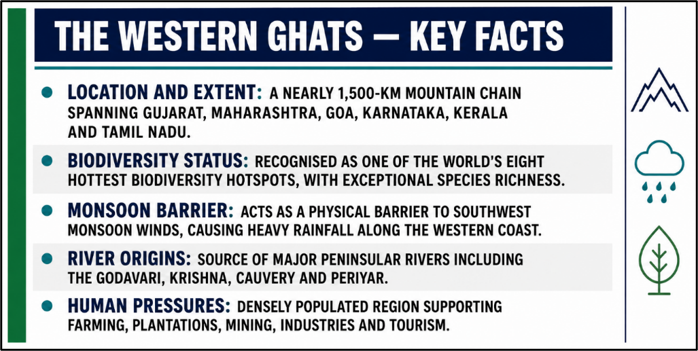
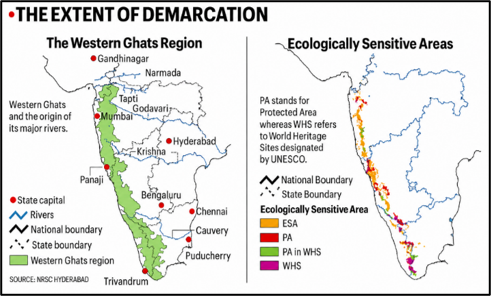
Indian government is finally moving to finalize the Ecologically Sensitive Area (ESA) notification for the Western Ghats across six states, imposing strict bans on mining, quarrying, and polluting industries in these fragile regions. The push for ecological conservation comes after a 12-year stalemate, with the government adopting a phased approach to resolve state-level disputes and local concerns.
Key Takeaways:
Explanation:
Meaning of ESA Status:
- An ESA is an environmentally fragile region where damaging activities are regulated.
- The proposal seeks to ban mining, quarrying, thermal power plants, highly polluting industries and large construction projects.
- Normal agriculture, plantations and existing settlements are not automatically banned.
Committee Recommendations:
- The Madhav Gadgil Committee (2010) categorized 64% of the Western Ghats into three graded Ecologically Sensitive Zones based on environmental vulnerability.
- It divided the landscape into Zone 1, Zone 2, and Zone 3 according to their ecological sensitivity and priority for conservation.
- The Kasturirangan Committee(2012) later divided the Western Ghats into:
- Cultural landscape (63%), including settlements, farms and plantations.
- Natural landscape (ESA – 37%), including forests and biodiversity-rich areas.
- The Kasturirangan report is widely considered a significant dilution of the Gadgil report because it reduced the protected Ecologically Sensitive Area from 64% to just 37% in order to prioritize economic development and agriculture.
Why the Notification Is Delayed:
- The Centre has proposed about 56,825 sq km as ESA through six draft notifications since 2014.
- States fear that restrictions may affect farming, mining, industries, construction and local development.
- Kerala seeks exclusion of plantation areas, Karnataka opposes the proposal, and Maharashtra wants several villages removed.
Recent Efforts:
- An expert committee formed in 2022 is checking village boundaries, satellite images and revenue records.
- The Centre may notify ESA boundaries State-wise instead of waiting for agreement from all six States.
- Financial incentives and payments for ecosystem services are also being considered.
Why the Ghats Need Protection?
- The region contains nearly 2,000 endemic plant species, 84 fish species, 87 amphibian species, 89 reptile species, 15 bird species and 12 mammal species found only there.
- It includes 61 protected areas, including national parks and wildlife sanctuaries.
- Its forests regulate rainfall, recharge groundwater, protect rivers and reduce soil erosion.
- Mining, quarrying, pollution and unplanned construction can increase deforestation, landslides and water insecurity.
Conclusion:
The Western Ghats are vital for biodiversity, rivers, rainfall and local livelihoods. Their protection cannot be delayed indefinitely. A scientific, consultative and financially supported ESA framework is necessary.
Source: (The Indian Express)
La Excellence IAS Academy, the best IAS coaching in Hyderabad, known for delivering quality content and conceptual clarity for UPSC 2026 preparation.
FOLLOW US ON:
◉ YouTube : https://www.youtube.com/@CivilsPrepTeam
◉ Facebook: https://www.facebook.com/LaExcellenceIAS
◉ Instagram: https://www.instagram.com/laexcellenceiasacademy/
GET IN TOUCH:
Contact us at info@laex.in, https://laex.in/contact-us/
or Call us @ +91 9052 29 2929, +91 9052 99 2929, +91 9154 24 2140
OUR BRANCHES:
Head Office: H No: 1-10-225A, Beside AEVA Fertility Center, Ashok Nagar Extension, VV Giri Nagar, Ashok Nagar, Hyderabad, 500020
Madhapur: Flat no: 301, survey no 58-60, Guttala begumpet Madhapur metro pillar: 1524, Rangareddy Hyderabad, Telangana 500081
Bangalore: Plot No: 99, 2nd floor, 80 Feet Road, Beside Poorvika Mobiles, Chandra Layout, Attiguppe, Near Vijaya Nagara, Bengaluru, 560040