
Paper: GS – III, Subject: Science & Technology, Topic: Medical Science and Health, Issue: Ban on Irrational Fixed-Dose Combination Drugs (Irrational FDCs).
Context:
Recently, the Union Health Ministry banned 16 Fixed-Dose Combination (FDC) drugs after experts found that they lacked medical justification and could harm patients. These include certain antibiotics, painkillers, antispasmodics and skin medicines. Drug authorities have been directed to stop their manufacture, distribution and sale.
Key Takeaways:
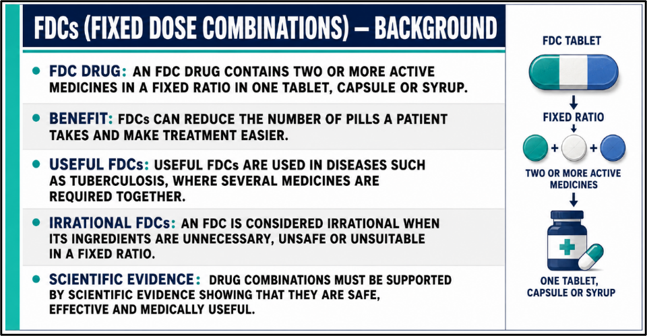
Explanation:
Benefits of Proper FDCs:
- They reduce the pill burden, especially during long-term treatment.
- They may help patients follow the full treatment schedule.
- Some medicines work better when combined in a scientifically tested ratio.
Problems with Irrational FDCs:
- Different patients may need different doses, but the fixed ratio cannot be changed separately.
- If a patient develops an allergy, it may be difficult to identify the responsible ingredient.
- A patient may not require every drug included in the combination.
- Unnecessary medicines can cause avoidable side effects without improving treatment.
Risk of Antibiotic Resistance:
- Irrational antibiotic combinations expose bacteria to unnecessary or unsuitable medicines.
- Some bacteria may survive and develop resistance.
- This contributes to antimicrobial resistance, in which antibiotics become less effective against infections.
- Antibiotic-based combinations formed a significant part of the large FDC ban announced in 2016.
Government Action:
- The recent ban was based on a scientific review of safety and therapeutic usefulness.
- State Drug Controllers and enforcement agencies must ensure compliance.
- Manufacturers, importers, distributors and pharmacies must stop stocking and selling the banned medicines.
Need for Better Monitoring:
- Earlier bans were not fully effective because some prohibited medicines remained available in pharmacies.
- Authorities must conduct regular inspections and market surveillance.
- Information about banned drugs must quickly reach every manufacturer, distributor and pharmacy.
- Digital tracking, strict penalties and public awareness can improve enforcement.
Conclusion:
Banning irrational FDCs protects patients and supports evidence-based medicine. However, notification alone is not enough. Strong monitoring is necessary to remove banned medicines from the market.
Source: (The Hindu)
La Excellence IAS Academy, the best IAS coaching in Hyderabad, known for delivering quality content and conceptual clarity for UPSC 2026 preparation.
FOLLOW US ON:
◉ YouTube : https://www.youtube.com/@CivilsPrepTeam
◉ Facebook: https://www.facebook.com/LaExcellenceIAS
◉ Instagram: https://www.instagram.com/laexcellenceiasacademy/
GET IN TOUCH:
Contact us at info@laex.in, https://laex.in/contact-us/
or Call us @ +91 9052 29 2929, +91 9052 99 2929, +91 9154 24 2140
OUR BRANCHES:
Head Office: H No: 1-10-225A, Beside AEVA Fertility Center, Ashok Nagar Extension, VV Giri Nagar, Ashok Nagar, Hyderabad, 500020
Madhapur: Flat no: 301, survey no 58-60, Guttala begumpet Madhapur metro pillar: 1524, Rangareddy Hyderabad, Telangana 500081
Bangalore: Plot No: 99, 2nd floor, 80 Feet Road, Beside Poorvika Mobiles, Chandra Layout, Attiguppe, Near Vijaya Nagara, Bengaluru, 560040