
Paper: GS – III, Subject: Environment, Ecology and Disaster Management, Topic: Disaster Management, Issue: Recurring Urban Fire Tragedies: A Crisis of Governance and Safety.
Context:
A recent fire in a three-storey building in Lucknow claimed at least 15 lives, exposing serious deficiencies in urban fire safety. The structure reportedly had a narrow staircase, inadequate ventilation and no proper emergency exits. The incident demonstrates how regulatory violations and administrative negligence can transform an emergency into a preventable tragedy.
Key Takeaways:
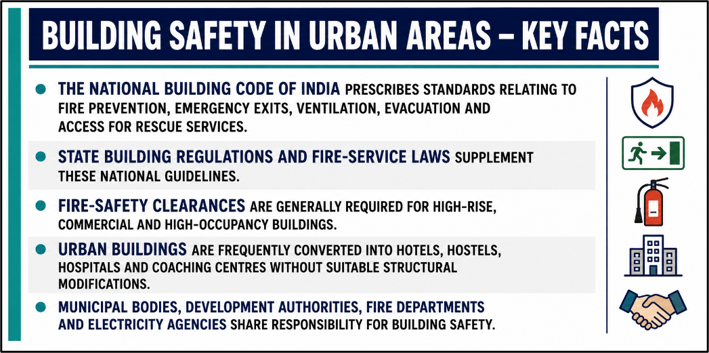
Explanation:
Factors Increasing the Loss of Life:
- A single narrow staircase can create congestion and prevent the rapid evacuation of occupants.
- The absence of emergency doors, fire-resistant exits and alternative escape routes can trap people inside buildings.
- Poor ventilation accelerates the accumulation of smoke and toxic gases, which often cause more deaths than flames.
- Congested construction and narrow approach roads may obstruct fire engines and delay rescue operations.
- Overcrowding and unauthorised commercial use increase both the probability and severity of fire incidents.
Regulatory and Governance Failures:
- Weak enforcement: Comprehensive fire-safety rules remain ineffective when inspections are irregular and violations are tolerated.
- Administrative negligence: Illegal construction, expired clearances and unauthorised changes in land use often continue without corrective action.
- Fragmented governance: Overlapping responsibilities allow departments to shift blame and delay action.
- Commercial pressures: Owners may avoid safety measures because they increase costs or reduce commercially usable space.
- Limited accountability: Responsibility is often confined to property owners, while negligent or complicit public officials escape meaningful punishment.
Required Reforms:
- Authorities must conduct regular, technology-enabled and third-party fire-safety audits.
- A unified digital database should integrate building approvals, occupancy certificates and fire clearances.
- Fire-safety certificates must be time-bound, publicly accessible and periodically renewed.
- Unsafe buildings should be closed until mandatory exits, ventilation and firefighting systems are installed.
- Governments must clearly assign institutional responsibility and penalise both violators and negligent officials.
- High-occupancy buildings should conduct evacuation drills, while urban planning must ensure access for emergency vehicles.
Conclusion:
Recurring urban fires reflect unsafe urbanisation, regulatory indifference and weak institutional accountability. Existing laws can protect lives only when they are consistently enforced. Urban development must place human safety above commercial convenience and administrative complacency.
Source: (The Indian Express)
La Excellence IAS Academy, the best IAS coaching in Hyderabad, known for delivering quality content and conceptual clarity for UPSC 2026 preparation.
FOLLOW US ON:
◉ YouTube : https://www.youtube.com/@CivilsPrepTeam
◉ Facebook: https://www.facebook.com/LaExcellenceIAS
◉ Instagram: https://www.instagram.com/laexcellenceiasacademy/
GET IN TOUCH:
Contact us at info@laex.in, https://laex.in/contact-us/
or Call us @ +91 9052 29 2929, +91 9052 99 2929, +91 9154 24 2140
OUR BRANCHES:
Head Office: H No: 1-10-225A, Beside AEVA Fertility Center, Ashok Nagar Extension, VV Giri Nagar, Ashok Nagar, Hyderabad, 500020
Madhapur: Flat no: 301, survey no 58-60, Guttala begumpet Madhapur metro pillar: 1524, Rangareddy Hyderabad, Telangana 500081
Bangalore: Plot No: 99, 2nd floor, 80 Feet Road, Beside Poorvika Mobiles, Chandra Layout, Attiguppe, Near Vijaya Nagara, Bengaluru, 560040