
Paper: GS – I, Subject: Geography, Topic: Climatology, Issue: Climate Extremes and the Need for Climate Resilience.
Context:
India is experiencing an uneven and relatively weak monsoon, with rainfall deficits across a large part of the country. At the same time, Europe is facing record-breaking heatwaves that have caused deaths, school closures, transport disruptions and pressure on electricity systems. Together, these developments show that the impact of a climatic hazard depends not only on its intensity but also on the preparedness and resilience of society.
Key Takeaways:
Explanation:
Weak Monsoon in India:
- By June 24, 537 of 740 districts had a rainfall deficit exceeding 20%, covering nearly 77% of India’s area.
- Seasonal rainfall was predicted at about 90% of the long-period average, but June rainfall remained much below normal.
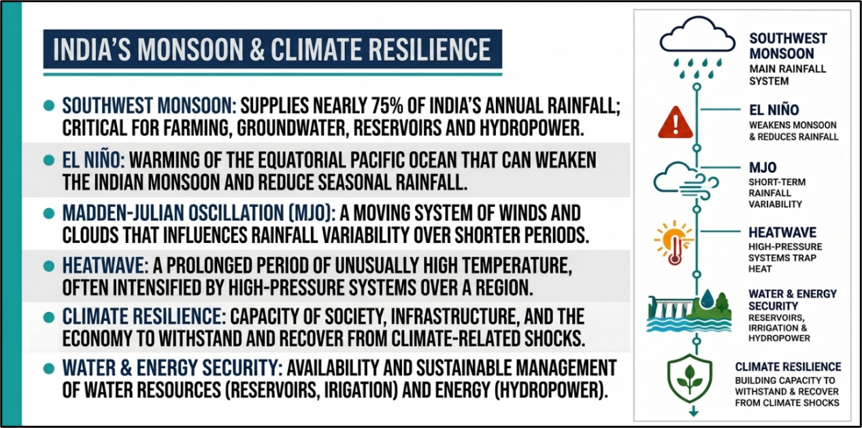
- The early deficit was mainly caused by weak monsoon currents, poorly developed low-pressure systems and an unfavourable MJO phase rather than El Niño.
- Poor rainfall can reduce crop output, farm income, rural demand, groundwater recharge and hydropower generation.
- India is relatively better prepared because of improved reservoir storage, expanded water-conservation infrastructure and greater use of solar and wind energy.
Europe’s Record Heatwave:
- Britain recorded 36.1°C, Paris reached 40.9°C, and France recorded temperatures of up to 44.3°C.
- A strong high-pressure pattern called an Omega Block or heat dome trapped hot air and prevented weather systems from moving normally.
- Climate change is intensifying such events, with Europe warming at nearly twice the global average.
- Urban heat islands further increase temperatures as concrete, roads and buildings absorb and retain heat.
Human and Infrastructure Impact:
- The heatwave caused deaths, school closures, transport delays and changes in the timings of major public and cultural sites.
- France reduced nuclear power generation because high temperatures limited access to cooling water.
- Europe’s ageing population, heat-retaining buildings and infrastructure designed for cooler climates increased vulnerability.
Required Response:
- India needs drought-resistant crops, efficient irrigation, groundwater recharge, reservoir management and better forecasts.
- Europe requires heat-resilient buildings, urban greenery, cooling centres, early warnings and stronger public-health plans.
- Climate policies must prepare simultaneously for rainfall shortages and extreme heat.
Conclusion:
The weak monsoon in India and Europe’s heatwave show that climate risks affect all regions. Stronger adaptation, resilient infrastructure and timely warnings are essential to reduce future losses.
Source: (The Indian Express)
La Excellence IAS Academy, the best IAS coaching in Hyderabad, known for delivering quality content and conceptual clarity for UPSC 2026 preparation.
FOLLOW US ON:
◉ YouTube : https://www.youtube.com/@CivilsPrepTeam
◉ Facebook: https://www.facebook.com/LaExcellenceIAS
◉ Instagram: https://www.instagram.com/laexcellenceiasacademy/
GET IN TOUCH:
Contact us at info@laex.in, https://laex.in/contact-us/
or Call us @ +91 9052 29 2929, +91 9052 99 2929, +91 9154 24 2140
OUR BRANCHES:
Head Office: H No: 1-10-225A, Beside AEVA Fertility Center, Ashok Nagar Extension, VV Giri Nagar, Ashok Nagar, Hyderabad, 500020
Madhapur: Flat no: 301, survey no 58-60, Guttala begumpet Madhapur metro pillar: 1524, Rangareddy Hyderabad, Telangana 500081
Bangalore: Plot No: 99, 2nd floor, 80 Feet Road, Beside Poorvika Mobiles, Chandra Layout, Attiguppe, Near Vijaya Nagara, Bengaluru, 560040