
Paper: GS Paper II, Subject: International Relations, Topic: Global Issues, Issue: U.S. Withdrawal from Iraq, Iraq War.
Context:
The United States withdrew its remaining troops from Iraq on September 30, 2026, more than 23 years after invading the country in 2003. The withdrawal comes amid a wider regional confrontation involving the U.S., Israel and Iran, highlighting both the long-term consequences of the Iraq War and the limits of sustained American military intervention in West Asia.
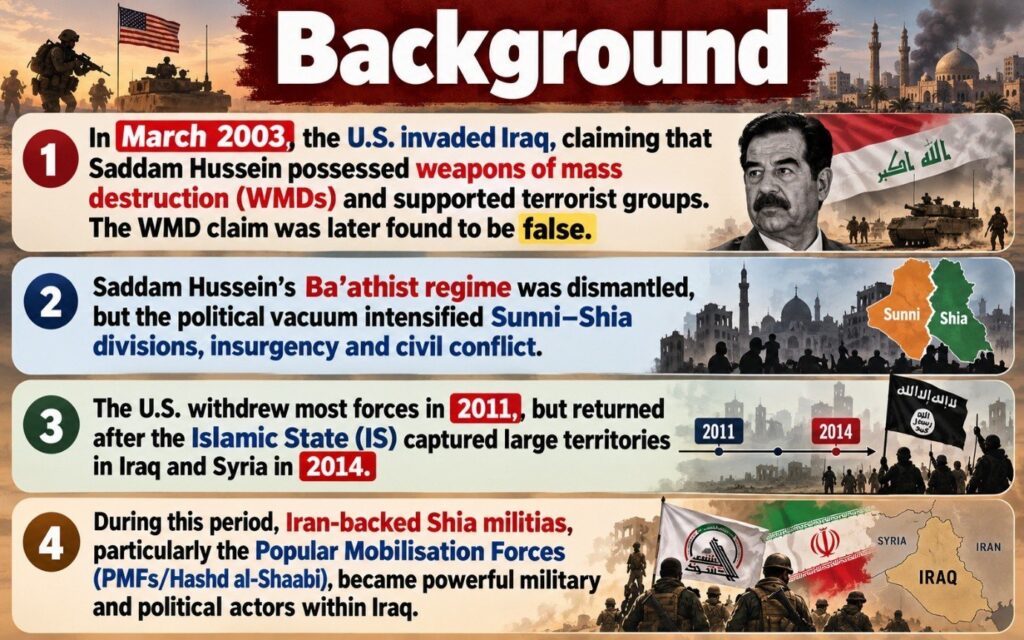
Why Did the Iraq Intervention Produce Unintended Consequences?
1. Collapse of the existing political order
- The overthrow of Saddam removed an authoritarian regime but also weakened the institutions that had held the Iraqi state together.
- The resulting instability created space for sectarian violence, armed militias and insurgent organisations.
2. Rise of jihadist organisations
- Post-war instability enabled Al-Qaeda in Iraq to establish one of its most violent branches. This organisation later evolved into the Islamic State, which emerged as a major regional security threat by 2014.
- Thus, the war produced security challenges that required renewed American intervention.
3. Expansion of Iranian influence
- Saddam’s Iraq had acted as an important barrier between Iran and the Arab Gulf monarchies. His removal altered this balance.
- Iran subsequently expanded its influence through Shia political parties and armed militias, while the PMFs developed considerable autonomy and influence within Iraq.
4. Iraq became part of the wider U.S.–Iran confrontation
- The situation became more difficult after the U.S. and Israel began bombing Iran on February 28, 2026.
- Hashd al-Shaabi groups joined the confrontation, while Iran and its allies reportedly carried out at least 600 attacks on U.S. military and diplomatic facilities in Iraq.
- Maintaining American forces consequently became increasingly risky and politically unsustainable.
Broader Significance
- The Iraq experience demonstrates the limitations of regime-change wars.
- Military superiority may overthrow a government, but it cannot automatically create political stability or functioning institutions.
- The war contributed to state weakness, sectarian conflict, jihadist mobilisation and the growth of powerful militias.
- The withdrawal also resembles the U.S. exit from Afghanistan: prolonged military intervention ended without fully achieving the political transformation originally envisioned.
Conclusion
The U.S. withdrawal may end its direct military presence in Iraq, but the consequences of the 2003 invasion remain. Iraq today illustrates how external intervention can unintentionally strengthen rival powers, weaken state institutions and generate new security threats.
Source: (The Hindu)
La Excellence IAS Academy, the best IAS coaching in Hyderabad, known for delivering quality content and conceptual clarity for UPSC 2026 preparation.
FOLLOW US ON:
◉ YouTube : https://www.youtube.com/@CivilsPrepTeam
◉ Facebook: https://www.facebook.com/LaExcellenceIAS
◉ Instagram: https://www.instagram.com/laexcellenceiasacademy/
GET IN TOUCH:
Contact us at info@laex.in, https://laex.in/contact-us/
or Call us @ +91 9052 29 2929, +91 9052 99 2929, +91 9154 24 2140
OUR BRANCHES:
Head Office: H No: 1-10-225A, Beside AEVA Fertility Center, Ashok Nagar Extension, VV Giri Nagar, Ashok Nagar, Hyderabad, 500020
Madhapur: Flat no: 301, survey no 58-60, Guttala begumpet Madhapur metro pillar: 1524, Rangareddy Hyderabad, Telangana 500081
Bangalore: Plot No: 99, 2nd floor, 80 Feet Road, Beside Poorvika Mobiles, Chandra Layout, Attiguppe, Near Vijaya Nagara, Bengaluru, 560040