
Paper: GS – II, Subject: International Relations, Topic: Regional and global groupings, Issue: United States Pacific Command (USPACOM).
Context:
The United States has recently restored the name United States Pacific Command (USPACOM), replacing United States Indo-Pacific Command (USINDOPACOM). It is not merely a naval command, but a joint military headquarters coordinating armed services across the Indian and Pacific Ocean region. Though seemingly administrative, the change coincides with shifts in American policy towards China, the Quad, West Asia and South Asia.
Key Takeaways:
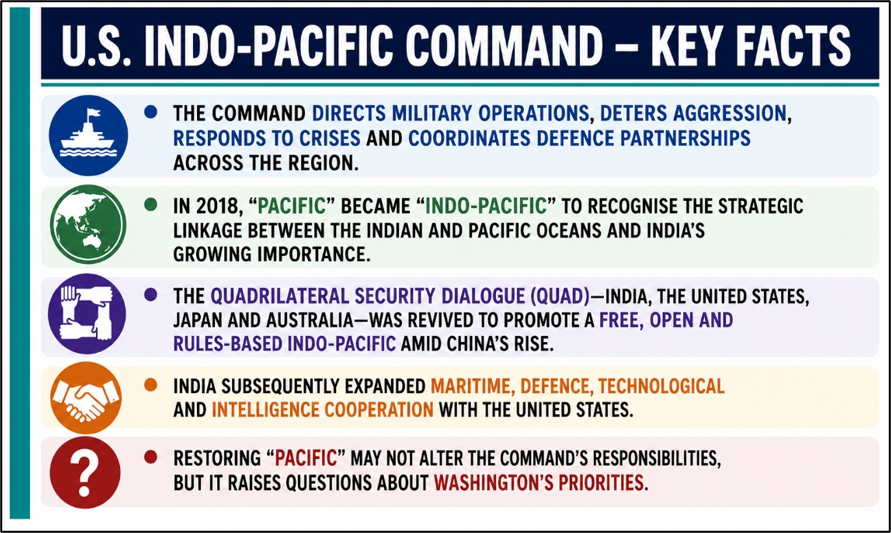
Explanation:
Recent Changes in United States Policy:
- China: Renewed engagement with Beijing suggests managed competition rather than complete confrontation. A possible informal “G2” or division of spheres of influence could reduce India’s strategic centrality.
- Quad: Its reduced visibility, delayed summit-level engagement and narrower focus on maritime security, technology, economic resilience and disaster response indicate weakening momentum.
- Technology: Restrictions on advanced technologies, including Artificial Intelligence, expose the limits and transactional nature of cooperation.
- West Asia: Possible accommodation with Iran, consultation over the Strait of Hormuz and reconstruction arrangements involving Gulf Cooperation Council states may reshape regional alignments.
- South Asia: Greater American engagement with Pakistan, Nepal, Bhutan, Bangladesh and Sri Lanka reflects an effort to compete with China and expand its regional role.
Implications for India:
- India cannot assume permanent American strategic support.
- Chabahar Port, energy interests, sanctions compliance and relations with Iran, Israel, Saudi Arabia and the United Arab Emirates require recalibration.
- Weak regional institutions, particularly SAARC and BIMSTEC, have created space for external powers.
What India Should Do:
- Preserve strategic autonomy and avoid dependence on any single partner.
- Strengthen indigenous defence, maritime and advanced-technology capabilities.
- Revive the Australia–India–Japan trilateral and develop issue-based coalitions.
- Rebuild neighbourhood trust, strengthen BIMSTEC and reconsider cooperation through SAARC.
Conclusion:
The renaming should be treated as a strategic signal, not conclusive proof of American disengagement. India must diversify partnerships, strengthen regional leadership and build domestic capabilities. National interest should remain the foundation of its foreign policy.
Source: (The Hindu)
La Excellence IAS Academy, the best IAS coaching in Hyderabad, known for delivering quality content and conceptual clarity for UPSC 2026 preparation.
FOLLOW US ON:
◉ YouTube : https://www.youtube.com/@CivilsPrepTeam
◉ Facebook: https://www.facebook.com/LaExcellenceIAS
◉ Instagram: https://www.instagram.com/laexcellenceiasacademy/
GET IN TOUCH:
Contact us at info@laex.in, https://laex.in/contact-us/
or Call us @ +91 9052 29 2929, +91 9052 99 2929, +91 9154 24 2140
OUR BRANCHES:
Head Office: H No: 1-10-225A, Beside AEVA Fertility Center, Ashok Nagar Extension, VV Giri Nagar, Ashok Nagar, Hyderabad, 500020
Madhapur: Flat no: 301, survey no 58-60, Guttala begumpet Madhapur metro pillar: 1524, Rangareddy Hyderabad, Telangana 500081
Bangalore: Plot No: 99, 2nd floor, 80 Feet Road, Beside Poorvika Mobiles, Chandra Layout, Attiguppe, Near Vijaya Nagara, Bengaluru, 560040