
Paper: GS – II, Subject: International Relations, Topic: Indian diaspora, Issue: Protecting Indian Seafarers on Sanctioned and High-Risk Ships.
Context:
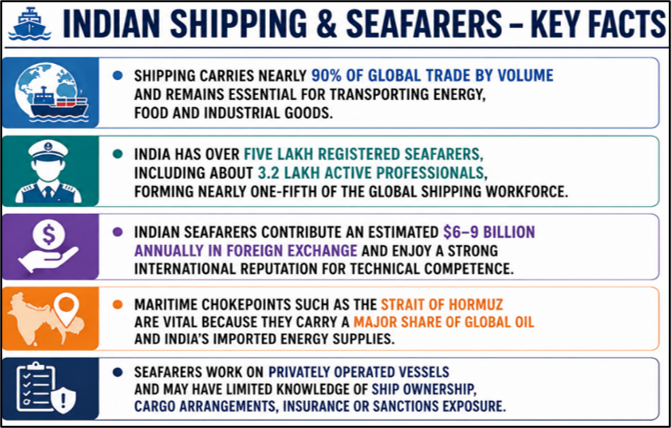
Indian seafarers increasingly face physical, legal and financial risks as maritime trade becomes entangled with armed conflicts, economic sanctions and deceptive shipping practices. Recent attacks on commercial vessels and detention of crew members have highlighted their vulnerability. India must protect seafarers without unnecessarily restricting employment, trade and energy security.
Key Takeaways:
Explanation:
Nature of Sanctions:
United Nations sanctions:
- Sanctions adopted by the United Nations Security Council under Chapter VII of the UN Charter are binding on member states.
- Indian authorities and citizens are legally required to comply with such measures.
Unilateral sanctions:
- Countries or regional groupings such as the United States, United Kingdom and European Union may independently sanction ships, companies or individuals.
- These restrictions are generally linked to their jurisdiction, but powerful countries may enforce them indirectly through ports, insurance, banking and payment systems.
- Therefore, India must distinguish between internationally binding sanctions and unilateral restrictions.
Sanctioned Ships and Dark Fleet Vessels:
- A sanctioned ship is formally listed under a sanction’s regime, but it may still possess valid registration, insurance and safety certification.
- A dark fleet vessel deliberately conceals its identity, ownership, cargo or movement.
- Warning signs include fraudulent registration, false insurance documents, frequent flag changes, ship-to-ship transfers and switching off the Automatic Identification System.
- Sanctioned and dark fleet vessels are therefore related but not identical categories.
Risks Faced by Indian Seafarers:
- Crew members may face missile attacks, piracy, detention, unpaid wages, abandonment and difficulties in repatriation.
- Captains may be held responsible for registration or administrative irregularities despite having limited control over corporate decisions.
- Seafarers may become innocent victims of sanctions disputes, especially when recruited without complete information.
- Poor certification, inadequate documentation and misleading recruitment practices further increase vulnerability.
Legal and Institutional Protection:
- Jurisdiction depends on whether an incident occurs in territorial waters, ports or on the high seas.
- Questions concerning warning, necessity, proportionality and protection of civilians may arise under international law.
- India should use UNCLOS, the International Maritime Organization and the International Labour Organization to secure seafarers’ rights and diplomatic protection.
Policy Approach for India:
- A blanket prohibition on employment aboard every sanctioned vessel may harm livelihoods, maritime connectivity and energy interests.
- The Directorate General of Shipping should maintain a dynamic list of sanctioned and high-risk vessels.
- Recruitment agencies must conduct due diligence and disclose ownership, insurance, flag and operational risks.
- Binding restrictions should apply to vessels involving fraudulent documentation or serious sanctions-evasion practices.
- India should ensure legal aid, emergency evacuation, wage protection and repatriation support.
Conclusion:
India should adopt a calibrated, risk-based approach rather than a universal ban. Strong regulation, transparent recruitment and international cooperation can protect seafarers while preserving employment and maritime trade. The State must intervene whenever commercial interests expose citizens to avoidable geopolitical and legal dangers.
Source: (The Hindu)
La Excellence IAS Academy, the best IAS coaching in Hyderabad, known for delivering quality content and conceptual clarity for UPSC 2026 preparation.
FOLLOW US ON:
◉ YouTube : https://www.youtube.com/@CivilsPrepTeam
◉ Facebook: https://www.facebook.com/LaExcellenceIAS
◉ Instagram: https://www.instagram.com/laexcellenceiasacademy/
GET IN TOUCH:
Contact us at info@laex.in, https://laex.in/contact-us/
or Call us @ +91 9052 29 2929, +91 9052 99 2929, +91 9154 24 2140
OUR BRANCHES:
Head Office: H No: 1-10-225A, Beside AEVA Fertility Center, Ashok Nagar Extension, VV Giri Nagar, Ashok Nagar, Hyderabad, 500020
Madhapur: Flat no: 301, survey no 58-60, Guttala begumpet Madhapur metro pillar: 1524, Rangareddy Hyderabad, Telangana 500081
Bangalore: Plot No: 99, 2nd floor, 80 Feet Road, Beside Poorvika Mobiles, Chandra Layout, Attiguppe, Near Vijaya Nagara, Bengaluru, 560040