
Paper: GS-II, Subject: Polity, Topic: Legal issues, Issue: VB-G RAM-G and the 60:40 Funding Dilemma.
Context
Recently, several States opposed the 60:40 funding formula under the Viksit Bharat–Guarantee for Rozgar and Ajeevika Mission (Gramin). They argue that it substantially increases their recurring financial burden.
Explanation
Importance of rural employment
- Guaranteed work supports rural households during agricultural off-seasons, droughts and periods when adequate private employment is unavailable.
- Public employment creates a wage floor by providing workers with an alternative to extremely low-paid private work.
- It strengthens the bargaining power of agricultural labourers, women and other vulnerable workers in the rural labour market.
- Such programmes can also create useful village assets, including roads, water-conservation structures and land-development works.
Implications of the funding change
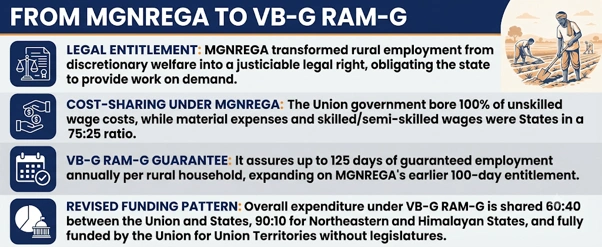
- The earlier arrangement protected State finances because the Union paid the entire cost of unskilled wages, the largest expenditure component.
- Under the new formula, States must bear 40% of total expenditure, including a much greater responsibility for wage costs.
- This obligation may reduce their fiscal space for health, education, pensions and State-specific welfare programmes.
- However, States cannot easily withdraw because rural households depend on guaranteed employment for livelihood and wage security.
Challenges
- Financially weaker States may release only part of their contribution, potentially delaying work allocation and wage payments.
- A uniform ratio may overlook differences in rural poverty, employment demand and the revenue capacity of individual States.
- The dispute also raises concerns about fiscal federalism, decentralised governance and State participation in centrally designed programmes.
Way forward
- Funding shares should reflect each State’s financial capacity, rural deprivation and actual demand for employment.
- Regular Union–State consultation should ensure predictable financing, timely employment and prompt wage payments.
- Transparent monitoring and independent social audits should improve accountability without weakening the role of Gram Panchayats.
Conclusion
Rural employment guarantees provide social protection while supporting fairer rural wages. India requires cooperative and flexible financing that protects workers without overburdening weaker States. Meaningful consultation can balance livelihood security with fiscal federalism.
Source: (The Indian Express)
La Excellence IAS Academy, the best IAS coaching in Hyderabad, known for delivering quality content and conceptual clarity for UPSC 2026 preparation.
FOLLOW US ON:
◉ YouTube : https://www.youtube.com/@CivilsPrepTeam
◉ Facebook: https://www.facebook.com/LaExcellenceIAS
◉ Instagram: https://www.instagram.com/laexcellenceiasacademy/
GET IN TOUCH:
Contact us at info@laex.in, https://laex.in/contact-us/
or Call us @ +91 9052 29 2929, +91 9052 99 2929, +91 9154 24 2140
OUR BRANCHES:
Head Office: H No: 1-10-225A, Beside AEVA Fertility Center, Ashok Nagar Extension, VV Giri Nagar, Ashok Nagar, Hyderabad, 500020
Madhapur: Flat no: 301, survey no 58-60, Guttala begumpet Madhapur metro pillar: 1524, Rangareddy Hyderabad, Telangana 500081
Bangalore: Plot No: 99, 2nd floor, 80 Feet Road, Beside Poorvika Mobiles, Chandra Layout, Attiguppe, Near Vijaya Nagara, Bengaluru, 560040