
Paper: GS-II, Subject: Social Justice, Topic: Welfare Schemes for Vulnerable Sections, Issue: Unconditional Cash Transfers and Their Fiscal Cost
Context
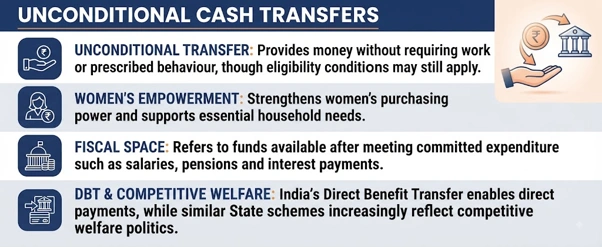
Recently, women-centred cash transfers have expanded across States, while the Economic Survey and the Sixteenth Finance Commission have flagged their fiscal burden. This has renewed debate over immediate welfare and long-term public investment.
Explanation
Importance and Implications
- Regular payments provide predictable relief and greater financial agency, especially where jobs and public services remain inadequate.
- However, monthly payments create recurring liabilities that governments must finance every year.
- Nearly 44% of State expenditure is already committed to salaries, pensions and interest payments, limiting funds for new priorities.
- Social-sector spending has stagnated within revenue expenditure and declined as a share of Gross Domestic Product since 2020–21.
- In some States, transfer spending exceeds half of education expenditure and even surpasses the entire health budget.
Challenges
- Beneficiary rationalisation in Maharashtra and Madhya Pradesh may remove ineligible recipients, but faulty verification can exclude deserving women.
- Documentation gaps, inactive bank accounts and database errors can also prevent eligible beneficiaries from receiving assistance.
- Cash helps families purchase services, but cannot replace hospitals, teachers, infrastructure or employment opportunities.
Way Forward
- States should disclose beneficiary numbers, fiscal costs and outcomes, while providing transparent eligibility checks and appeal mechanisms.
- Fiscal planning must protect education, health, jobs and productive investment.
- Growing demands for better services, accountability and a fair share of public resources must shape welfare priorities.
- Transfers should complement strong public services and structural development, rather than become their substitute.
Conclusion
Unconditional transfers can improve welfare and women’s agency, especially during hardship. However, unchecked expansion may weaken fiscal capacity and essential services. A balanced policy must combine targeted income support with accountable institutions, quality services and sustainable State finances.
Source: (The Indian Express)
La Excellence IAS Academy, the best IAS coaching in Hyderabad, known for delivering quality content and conceptual clarity for UPSC 2026 preparation.
FOLLOW US ON:
◉ YouTube : https://www.youtube.com/@CivilsPrepTeam
◉ Facebook: https://www.facebook.com/LaExcellenceIAS
◉ Instagram: https://www.instagram.com/laexcellenceiasacademy/
GET IN TOUCH:
Contact us at info@laex.in, https://laex.in/contact-us/
or Call us @ +91 9052 29 2929, +91 9052 99 2929, +91 9154 24 2140
OUR BRANCHES:
Head Office: H No: 1-10-225A, Beside AEVA Fertility Center, Ashok Nagar Extension, VV Giri Nagar, Ashok Nagar, Hyderabad, 500020
Madhapur: Flat no: 301, survey no 58-60, Guttala begumpet Madhapur metro pillar: 1524, Rangareddy Hyderabad, Telangana 500081
Bangalore: Plot No: 99, 2nd floor, 80 Feet Road, Beside Poorvika Mobiles, Chandra Layout, Attiguppe, Near Vijaya Nagara, Bengaluru, 560040