
Paper: GS – III, Subject: Economy, Topic: Infrastructure, Issue: Integrating Renewable Energy with Coal-Based Power.
Context:
Recently, a Centre for Science and Environment study recommended combining renewable energy with flexible coal generation. It also called for reforming thermal Power Purchase Agreements (PPAs) to maintain grid stability during India’s energy transition.
Key Takeaways:
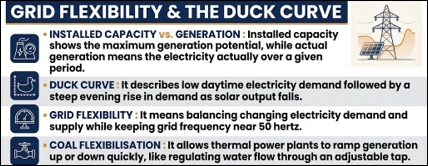
Explanation:
Meaning and working:
- Coal flexibilisation enables plants to reduce generation when renewable output is high and increase it when renewable supply falls.
- It requires lower minimum loads, faster ramping, improved controls, equipment upgrades and trained operators.
- It reduces the use of coal power instead of immediately closing coal plants. The plants remain available for backup, while renewable energy is used first.
Importance:
- Flexible operation reduces renewable curtailment, meaning deliberate non-use of available solar or wind electricity.
- It limits excess power injection and meets evening demand when solar generation falls.
- It offers balancing support while battery storage, pumped hydropower and gas capacity remain limited or costly.
- Reduced coal generation can lower fuel use and emissions, although coal remains polluting.
Challenges:
- Repeated heating and cooling causes thermal fatigue, or metal weakening through expansion and contraction.
- Low-load operation may reduce efficiency, increase maintenance and shorten plant life.
- Flexibilisation may add 27–46 paise per unit, depending on plant age and condition.
- Retrofitting old plants could prolong coal dependence and divert investment from cleaner alternatives.
Way forward:
- Baseline studies should identify suitable plants and estimate retrofit costs, emissions and remaining life.
- Thermal Power Purchase Agreements should compensate verified costs and reward balancing performance.
- Regulators should align tariffs, prioritise efficient units and retire plants with poor heat rates.
- India must expand batteries, pumped storage, transmission, renewable forecasting and demand response.
Conclusion:
Coal flexibilisation can bridge India’s coal-dependent present and renewable-dominant future. However, selective retrofitting must support balancing technologies and phased retirement of inefficient coal plants, rather than delay them.
Source: (Down to Earth)
La Excellence IAS Academy, the best IAS coaching in Hyderabad, known for delivering quality content and conceptual clarity for UPSC 2026 preparation.
FOLLOW US ON:
◉ YouTube : https://www.youtube.com/@CivilsPrepTeam
◉ Facebook: https://www.facebook.com/LaExcellenceIAS
◉ Instagram: https://www.instagram.com/laexcellenceiasacademy/
GET IN TOUCH:
Contact us at info@laex.in, https://laex.in/contact-us/
or Call us @ +91 9052 29 2929, +91 9052 99 2929, +91 9154 24 2140
OUR BRANCHES:
Head Office: H No: 1-10-225A, Beside AEVA Fertility Center, Ashok Nagar Extension, VV Giri Nagar, Ashok Nagar, Hyderabad, 500020
Madhapur: Flat no: 301, survey no 58-60, Guttala begumpet Madhapur metro pillar: 1524, Rangareddy Hyderabad, Telangana 500081
Bangalore: Plot No: 99, 2nd floor, 80 Feet Road, Beside Poorvika Mobiles, Chandra Layout, Attiguppe, Near Vijaya Nagara, Bengaluru, 560040