
Paper: GS – III, Subject: Economy, Topic: Unemployment, Issue: Educated Youth Employment Crisis, NEET and Household Distress.
Context:
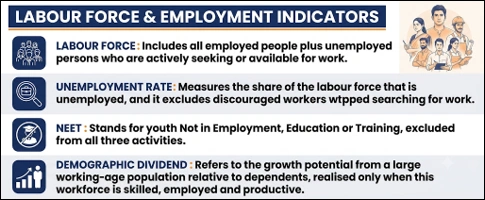
Recently, the Periodic Labour Force Survey (PLFS) 2025 highlighted persistent unemployment among educated youth. Wider evidence also shows poor-quality job creation, a large economically inactive youth population and growing financial pressure on families.
Key Takeaways:
Explanation:
Scale and Nature of the Problem:
- India’s overall unemployment rate was only 3.1% in 2025, but unemployment among people aged 18–29 was 14.8%.
- The rate increased to 29.4% among tertiary-educated youth, revealing a weak transition from higher education to suitable employment.
- Around 25% of Indian youth were NEET in March 2025, amounting to nearly 9.2 crore people.
- Women are frequently undercounted because caregiving duties, social restrictions and unavailable suitable jobs prevent active job searches.
Quantity versus Quality of Employment:
- India’s workforce increased from about 43.3 crore in 2017–18 to 61.6 crore in 2025.
- However, many new jobs emerged in agriculture, unpaid family work and low-earning self-employment, especially among women.
- Such workers are officially employed, although they may face low productivity, irregular earnings, underemployment or work below their qualifications.
Household Consequences:
- Families finance higher education, examinations, travel and living expenses during prolonged job searches.
- Households supporting unemployed educated youth spend about ₹1,087 less monthly, indicating reduced consumption and living standards.
- Nearly 58% of unemployed tertiary-educated youth searched for work beyond one year, while 28.9% remained unemployed beyond two years.
- Poorer families may therefore force young people to accept insecure or unsuitable jobs much earlier.
Way Forward:
- Employment assessment must combine the Unemployment Rate (UER) with NEET, earnings, working hours, job security and female labour-force participation.
- India must expand productive non-farm employment, improve education–industry links and reduce examination and recruitment delays.
Conclusion:
India’s employment challenge concerns not merely job numbers but also job quality, exclusion and household vulnerability. Timely recruitment and productive, secure employment are essential for converting educational progress into upward mobility and realising the demographic dividend.
Source: (The Indian Express, The Hindu)
La Excellence IAS Academy, the best IAS coaching in Hyderabad, known for delivering quality content and conceptual clarity for UPSC 2026 preparation.
FOLLOW US ON:
◉ YouTube : https://www.youtube.com/@CivilsPrepTeam
◉ Facebook: https://www.facebook.com/LaExcellenceIAS
◉ Instagram: https://www.instagram.com/laexcellenceiasacademy/
GET IN TOUCH:
Contact us at info@laex.in, https://laex.in/contact-us/
or Call us @ +91 9052 29 2929, +91 9052 99 2929, +91 9154 24 2140
OUR BRANCHES:
Head Office: H No: 1-10-225A, Beside AEVA Fertility Center, Ashok Nagar Extension, VV Giri Nagar, Ashok Nagar, Hyderabad, 500020
Madhapur: Flat no: 301, survey no 58-60, Guttala begumpet Madhapur metro pillar: 1524, Rangareddy Hyderabad, Telangana 500081
Bangalore: Plot No: 99, 2nd floor, 80 Feet Road, Beside Poorvika Mobiles, Chandra Layout, Attiguppe, Near Vijaya Nagara, Bengaluru, 560040