
Paper: GS II, Subject: Governance, Topic: Government Policies and Interventions, Issue: India’s system of Drug Price Regulation
Context
Recently, the Supreme Court questioned the wide gap between the Price to Retailer (PTR) and the Maximum Retail Price (MRP) of some medicines, including a cancer drug reportedly supplied to retailers for about ₹2,700 while carrying an MRP of nearly ₹27,000. The proceedings have brought India’s system of drug-price regulation and pharmaceutical trade margins under scrutiny.
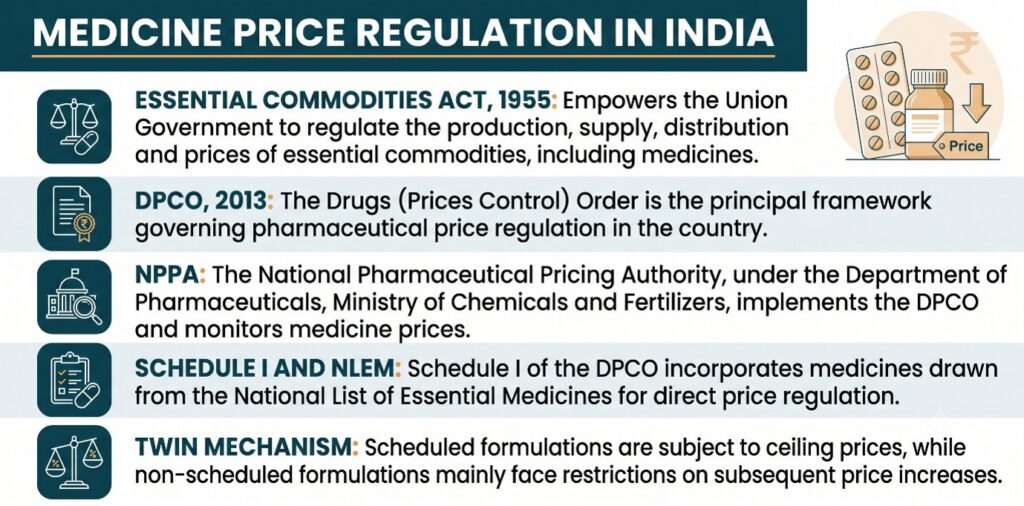
Explanation
How India’s Twin Drug-Pricing Mechanism Works
| Scheduled Medicines | Non-Scheduled Medicines | |
| Meaning | Medicines under Schedule I of DPCO, 2013, largely based on NLEM | Medicines outside Schedule I |
| Price control | Direct price control | No general ceiling price |
| Regulator | NPPA fixes ceiling price | Manufacturer generally fixes initial MRP; NPPA monitors increases |
| Restriction | Cannot ordinarily exceed notified ceiling price + applicable taxes | MRP generally cannot rise by more than 10% in 12 months |
| Approach | Ceiling price broadly based on prevailing market prices + permitted retailer margin | Controls subsequent increases, not the initial launch price |
Core regulatory gap: For non-scheduled medicines, the DPCO restricts only subsequent price increases, not the initial launch price. Therefore, a manufacturer can set a very high initial MRP and still comply with the rule limiting later increases to 10% in 12 months.
Why the Framework Is Under Scrutiny
- High initial MRPs: Since there is no general ceiling on the launch price of non-scheduled medicines, an already high price can remain legally permissible even when later increases are controlled.
- Large trade margins: Significant PTR–MRP gaps may raise patient costs.
- Information asymmetry: Patients have limited ability to compare prices and alternatives.
- Hospital dependence: Patients may have little choice but to buy from hospital pharmacies.
- Affordability: High medicine prices increase out-of-pocket expenditure and may restrict access.
Regulatory Balance
- Stronger regulation can improve affordability and curb excessive margins.
- Overly rigid controls may affect availability, manufacturing viability and innovation.
- Policy must balance affordability, accessibility, availability and innovation.
Way Forward
- Scrutinise abnormally high launch prices of non-scheduled medicines.
- Examine PTR–MRP gaps and excessive trade margins.
- Improve supply-chain price transparency.
- Strengthen NPPA’s data, monitoring and enforcement capacity.
- Promote quality-assured generics and generic prescribing.
- Prevent price controls from causing shortages or weakening innovation.
Conclusion
India’s framework must address not only annual price increases but also high launch prices, excessive trade margins and information asymmetry. Combining ceiling-price regulation, trade-margin rationalisation and stronger market oversight can improve affordability while maintaining supply and innovation.
Source: (The Indian Express)
La Excellence IAS Academy, the best IAS coaching in Hyderabad, known for delivering quality content and conceptual clarity for UPSC 2026 preparation.
FOLLOW US ON:
◉ YouTube : https://www.youtube.com/@CivilsPrepTeam
◉ Facebook: https://www.facebook.com/LaExcellenceIAS
◉ Instagram: https://www.instagram.com/laexcellenceiasacademy/
GET IN TOUCH:
Contact us at info@laex.in, https://laex.in/contact-us/
or Call us @ +91 9052 29 2929, +91 9052 99 2929, +91 9154 24 2140
OUR BRANCHES:
Head Office: H No: 1-10-225A, Beside AEVA Fertility Center, Ashok Nagar Extension, VV Giri Nagar, Ashok Nagar, Hyderabad, 500020
Madhapur: Flat no: 301, survey no 58-60, Guttala begumpet Madhapur metro pillar: 1524, Rangareddy Hyderabad, Telangana 500081
Bangalore: Plot No: 99, 2nd floor, 80 Feet Road, Beside Poorvika Mobiles, Chandra Layout, Attiguppe, Near Vijaya Nagara, Bengaluru, 560040