
Paper: GS-III, Subject: Economy, Topic: Inflation and Food Security, Issue: Rising Edible Oil Prices and the Food–Fuel Dilemma
Context
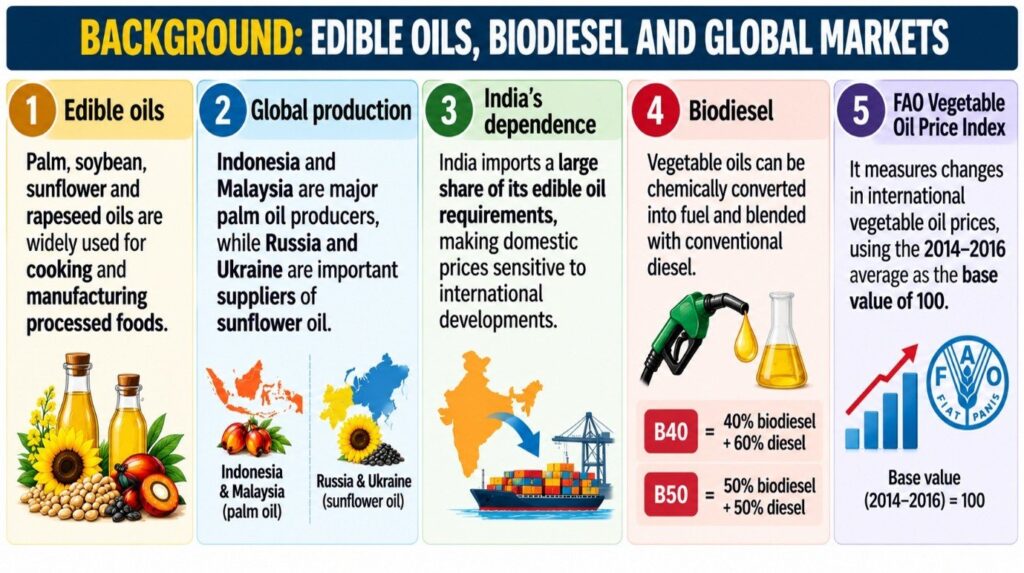
Recently, the FAO Vegetable Oil Price Index reached 198.6 in September 2026, compared with 136 for the overall Food Price Index. Rising biofuel demand, El Niño-related weather risks and the Russia-Ukraine war are putting renewed pressure on global edible oil prices.
Explanation
Why Are Global Edible Oil Prices Rising?
1. Increasing diversion of edible oils towards biofuels
- Countries are promoting biodiesel to reduce dependence on petroleum. However, this increases competition between using vegetable oils for food and fuel.
- Indonesia, the world’s largest palm oil producer, is moving from B40 to B50 biodiesel blending. Consequently, more palm oil will be consumed domestically, leaving less for exports.
- Similarly, the United States uses soybean oil and the European Union uses rapeseed oil for biofuel production.
This creates a food-versus-fuel dilemma, where increasing demand for transport fuel reduces the availability of vegetable oils for food markets.
2. Weather-related production risks
- El Niño can reduce rainfall in Indonesia, affecting oil palm plantations.
- Water shortages can reduce fruit production after several months, potentially lowering palm oil output in 2027.
- Thus, rising biodiesel demand may coincide with declining palm oil production, further reducing export availability.
3. Russia–Ukraine war and trade disruptions
- Russia and Ukraine are major sunflower oil suppliers. Despite expectations of better sunflower harvests, disruptions to ports and shipping routes restrict exports.
- Shortages of one vegetable oil also increase demand for alternatives, pushing up their prices.
Implications for India
- Food inflation: Rising edible oil prices increase household cooking expenses and processed food costs, affecting food security, particularly among low-income households.
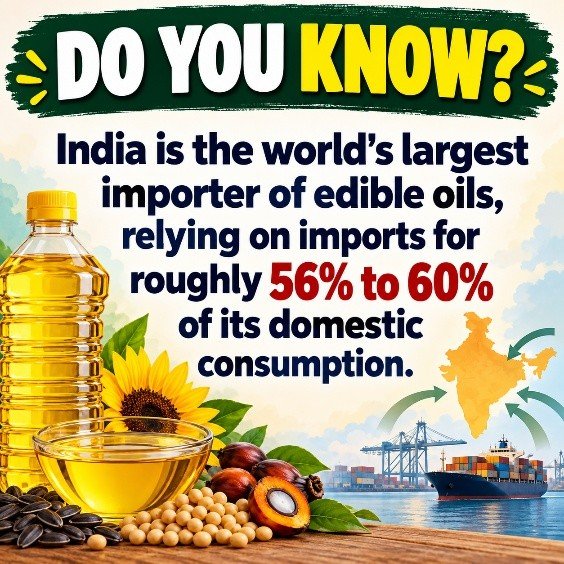
- Higher import bill: India’s projected imports of 17.2 million tonnes in 2026–27 increase its exposure to rising global prices.
- Supply vulnerability: Heavy import dependence exposes India to foreign biofuel policies, climate shocks and geopolitical conflicts.
Way Forward
- Increase domestic production: Improve oilseed productivity through better seeds, irrigation and initiatives such as the National Mission on Edible Oils–Oilseeds (NMEO-Oilseeds) to reduce import dependence.
- Diversify import sources: Expand edible oil imports from different countries to reduce vulnerability to geopolitical conflicts, climate shocks and export restrictions.
- Promote sustainable biofuels: Encourage biofuels made from used cooking oil, agricultural waste and non-edible feedstocks to minimise the food-versus-fuel dilemma.
Conclusion
Edible oil inflation increasingly reflects the interaction of energy policies, climate risks and geopolitical conflicts. India must strengthen domestic oilseed production, diversify imports and promote biofuels that minimise competition with food supplies.
Source: (The Indian Express)
La Excellence IAS Academy, the best IAS coaching in Hyderabad, known for delivering quality content and conceptual clarity for UPSC 2026 preparation.
FOLLOW US ON:
◉ YouTube : https://www.youtube.com/@CivilsPrepTeam
◉ Facebook: https://www.facebook.com/LaExcellenceIAS
◉ Instagram: https://www.instagram.com/laexcellenceiasacademy/
GET IN TOUCH:
Contact us at info@laex.in, https://laex.in/contact-us/
or Call us @ +91 9052 29 2929, +91 9052 99 2929, +91 9154 24 2140
OUR BRANCHES:
Head Office: H No: 1-10-225A, Beside AEVA Fertility Center, Ashok Nagar Extension, VV Giri Nagar, Ashok Nagar, Hyderabad, 500020
Madhapur: Flat no: 301, survey no 58-60, Guttala begumpet Madhapur metro pillar: 1524, Rangareddy Hyderabad, Telangana 500081
Bangalore: Plot No: 99, 2nd floor, 80 Feet Road, Beside Poorvika Mobiles, Chandra Layout, Attiguppe, Near Vijaya Nagara, Bengaluru, 560040