
Paper: GS-III, Subject: Environment, Topic: Biodiversity Conservation, Issue: Global Wildlife Population Decline and Ecosystem Degradation
Context
Recently, the Living Planet Report 2026, released by the World Wide Fund for Nature (WWF), revealed a 73% average decline in monitored wildlife population sizes between 1970 and 2022. It highlights severe biodiversity loss while emphasising that effective conservation can help nature recover.
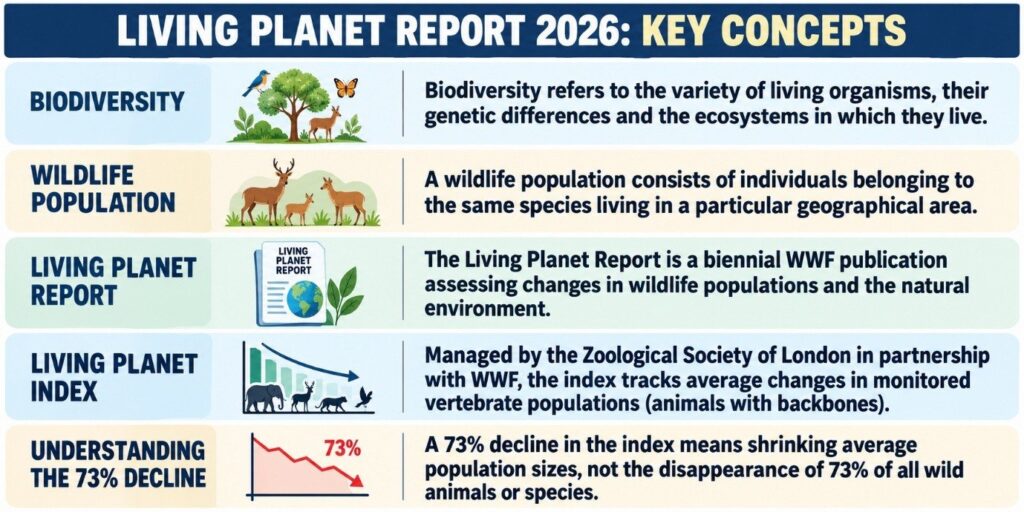
Explanation
Key Findings of the Report
- Scale of decline: The assessment covered 35,803 populations across 5,790 vertebrate species, including mammals, birds, fishes, reptiles and amphibians.
- Ecosystem-wise decline: Freshwater ecosystems experienced the highest decline (85%), followed by terrestrial (69%) and marine (59%) ecosystems.
- Regional differences: Latin America and the Caribbean recorded the steepest decline (95%), followed by Africa (80%) and Asia-Pacific (49%).
Major Drivers of Biodiversity Loss
- Habitat destruction, excessive exploitation of natural resources, climate change, invasive alien species, pollution and diseases threaten wildlife survival.
- Unsustainable food production and consumption are the largest drivers of biodiversity loss through deforestation, excessive water use, overfishing and greenhouse gas emissions.
Implications of Biodiversity Loss
- Declining biodiversity weakens essential ecosystem services, including pollination, water purification, soil fertility and climate regulation.
- Degradation of these natural services threatens food security, agricultural productivity, livelihoods and long-term economic development.
Conservation and Pathways to Recovery
- Targeted conservation has supported the recovery of green turtles, bluefin tuna, elephants and tigers. Global wild tiger numbers increased from approximately 3,200 in 2010 to 5,700 in 2025.
- Positive tipping points occur when initial improvements trigger wider beneficial changes in food production, clean energy and environmentally responsible finance.
- The Kunming–Montreal Global Biodiversity Framework (2022), adopted under the Convention on Biological Diversity (CBD), includes the 30×30 target to conserve at least 30% of land, inland waters and marine areas by 2030.
Conclusion
Biodiversity loss threatens ecological stability, food security and human well-being. Transforming food and energy systems, strengthening conservation and fulfilling global biodiversity commitments are essential to reversing wildlife decline and ensuring sustainable development.
Source: (The Indian Express)
La Excellence IAS Academy, the best IAS coaching in Hyderabad, known for delivering quality content and conceptual clarity for UPSC 2026 preparation.
FOLLOW US ON:
◉ YouTube : https://www.youtube.com/@CivilsPrepTeam
◉ Facebook: https://www.facebook.com/LaExcellenceIAS
◉ Instagram: https://www.instagram.com/laexcellenceiasacademy/
GET IN TOUCH:
Contact us at info@laex.in, https://laex.in/contact-us/
or Call us @ +91 9052 29 2929, +91 9052 99 2929, +91 9154 24 2140
OUR BRANCHES:
Head Office: H No: 1-10-225A, Beside AEVA Fertility Center, Ashok Nagar Extension, VV Giri Nagar, Ashok Nagar, Hyderabad, 500020
Madhapur: Flat no: 301, survey no 58-60, Guttala begumpet Madhapur metro pillar: 1524, Rangareddy Hyderabad, Telangana 500081
Bangalore: Plot No: 99, 2nd floor, 80 Feet Road, Beside Poorvika Mobiles, Chandra Layout, Attiguppe, Near Vijaya Nagara, Bengaluru, 560040