
Paper: GS-III | Subject: Environment and Ecology | Topic: Environmental Pollution and Degradation | Issue: PFAS Contamination and Drinking-Water Safety
Context
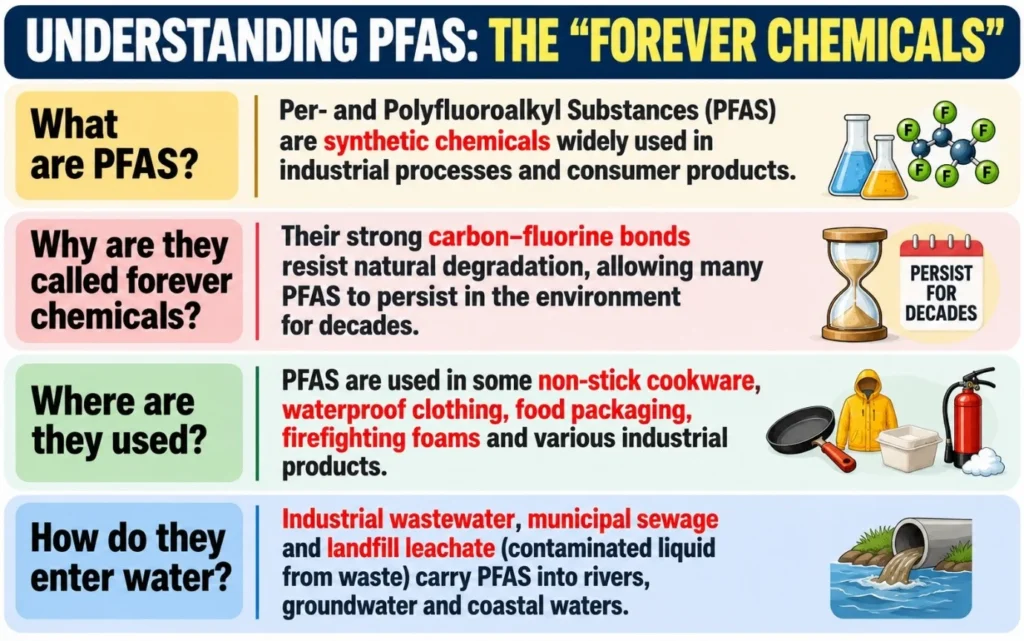
Recently, studies detected Per- and Polyfluoroalkyl Substances (PFAS), commonly called forever chemicals, in water sources across India. Their persistence, inadequate removal by conventional treatment plants and absence of specific drinking-water limits have raised public health concerns.
Explanation
PFAS Contamination and Treatment Challenges
- Studies in Chennai and Visakhapatnam have detected PFAS in groundwater, sewage and coastal waters.
- Ordinary water treatment plants remove suspended impurities and microorganisms but cannot effectively remove many dissolved PFAS.
- Some chemicals, called precursors, can transform into measurable PFAS during treatment, potentially increasing their detected concentrations.
- Chennai study: Concentrations of eight monitored PFAS increased by 5–103% after treatment, possibly due to precursor transformation.
- Advanced treatment: Activated carbon, reverse osmosis and ion exchange can remove many PFAS, but involve additional costs and waste disposal challenges.
Health Concerns and Regulatory Gaps
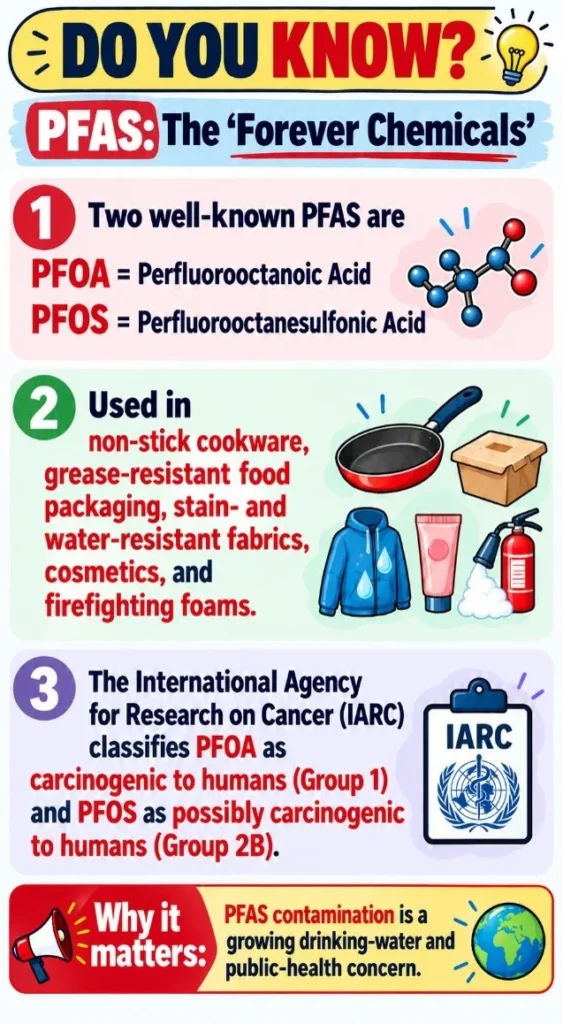
- Long-term exposure to certain PFAS may cause adverse health effects, depending on the chemical, exposure level and duration.
- India lacks nationwide PFAS monitoring, while existing laboratory tests may overlook several compounds and their precursors.
- Regulatory gaps: India’s drinking-water standard, IS 10500:2012, does not specify PFAS limits, and no general prohibition exists on PFAS manufacturing.
Government Initiatives
- The Bureau of Indian Standards (BIS) has established a working group to examine PFAS limits and testing methods.
- CSIR–Indian Institute of Toxicology Research (CSIR-IITR) is developing PFAS monitoring capabilities through a United Nations Environment Programme (UNEP)-supported initiative.
Way Forward
- Nationwide Monitoring: India needs standardised testing methods to identify contamination hotspots and assess the extent of PFAS pollution.
- Regulatory Measures: Precautionary drinking-water limits and stricter industrial discharge controls are necessary to prevent PFAS contamination at its source.
- Treatment Improvements: Advanced purification technologies and safe disposal systems should be adopted to reduce PFAS contamination in drinking water.
Conclusion
PFAS contamination highlights the growing challenge of persistent chemical pollution in India. Stronger regulations, comprehensive monitoring and improved water treatment systems are essential to protect drinking-water safety and public health.
Source: (The Hindu)
La Excellence IAS Academy, the best IAS coaching in Hyderabad, known for delivering quality content and conceptual clarity for UPSC 2026 preparation.
FOLLOW US ON:
◉ YouTube : https://www.youtube.com/@CivilsPrepTeam
◉ Facebook: https://www.facebook.com/LaExcellenceIAS
◉ Instagram: https://www.instagram.com/laexcellenceiasacademy/
GET IN TOUCH:
Contact us at info@laex.in, https://laex.in/contact-us/
or Call us @ +91 9052 29 2929, +91 9052 99 2929, +91 9154 24 2140
OUR BRANCHES:
Head Office: H No: 1-10-225A, Beside AEVA Fertility Center, Ashok Nagar Extension, VV Giri Nagar, Ashok Nagar, Hyderabad, 500020
Madhapur: Flat no: 301, survey no 58-60, Guttala begumpet Madhapur metro pillar: 1524, Rangareddy Hyderabad, Telangana 500081
Bangalore: Plot No: 99, 2nd floor, 80 Feet Road, Beside Poorvika Mobiles, Chandra Layout, Attiguppe, Near Vijaya Nagara, Bengaluru, 560040