
What is GDP?
GDP is the total market value of all final goods and services produced within a country’s borders in a given period — usually a year. It is released in India by MoSPI.
Three words matter here: final, within borders, and produced.
- Final — It counts the final products, Intermediate goods are not counted.
- Within borders(Domestic) — A Japanese company’s factory in India. Its output is counted in India’s GDP not in Japan’s GDP. This is where GDP differs from GNP, which we’ll get to know later.
- Produced — GDP is about production, not transactions. Buying an old house doesn’t add to GDP. Building a new one does.
UPSC tests whether you’ve genuinely understood the concept or just memorised the definition.
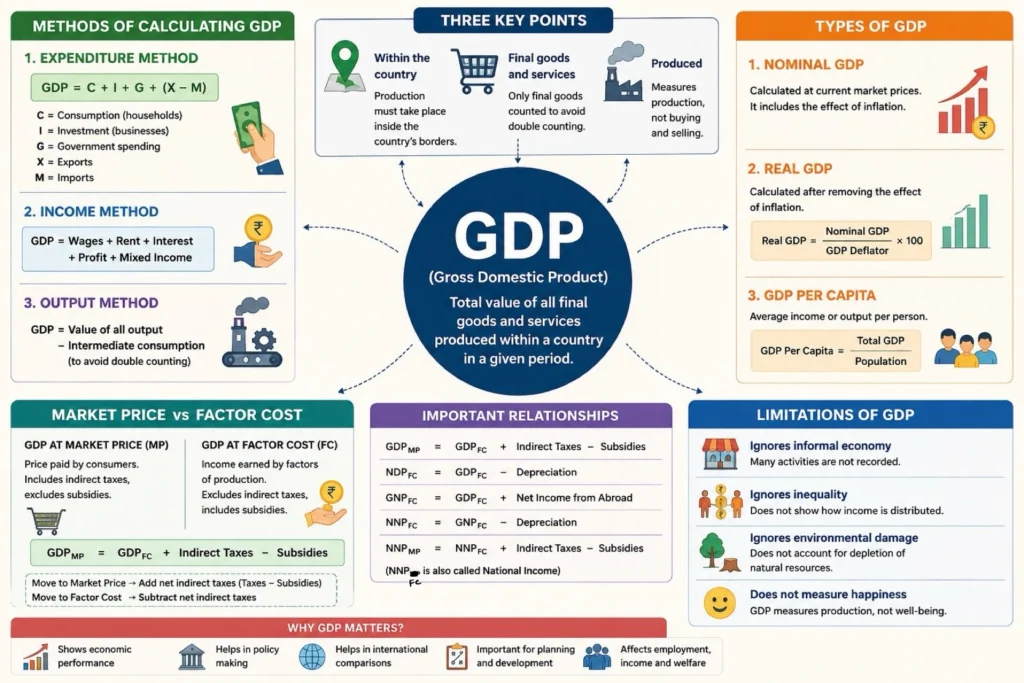
What are the Three Methods of Calculating GDP?
GDP is calculated in three ways, and all three should give the same number (in theory). Here’s how to remember them:
1. Expenditure Method — Who spent money on what?
GDP = C + I + G + (X − M)
- C = Private consumption (households)
- I = Investment (businesses buying equipment, buildings)
- G = Government spending (not transfers like subsidies — actual spending on goods and services)
- X − M = Net exports (exports minus imports)
This is the most commonly asked formula. Also know that transfer payments (pensions, subsidies & Remittances) are NOT counted here .
2. Income Method — What did everyone earn?
GDP = Wages + Rent + Interest + Profit
This counts income earned by factors of production — labour and capital. The key formula for the exam:
GDP at Factor Cost = GDP at Market Price − Indirect Taxes + Subsidies
3. Production/Output Method — What was produced?
Value of all goods and services produced, minus the intermediate consumption (to avoid double counting).
Real GDP = Nominal GDP ÷ Price Deflator
Exam tip: You don’t need to master the calculation behind each method. You need to know what each method measures, what it excludes, and which formula belongs to which method. Prelims MCQs often give you a statement mixing up these methods and ask if it’s correct.
How not to Confuse With The Formulae?
This is where most students lose marks. There are eight national income concepts and each has a formula that looks almost identical to the next. Let’s organise this so it actually sticks.
Think of it as two axes:
- Gross vs Net: Gross minus depreciation is Net; Depreciation refers to wear and tear of machines.
Example: Gross profit includes wear and tear of machines, while net profit is calculated after deducting it.
- Domestic vs National: Domestic means income generated within a country’s borders; National means income earned by a country’s citizens, including income from abroad, that is what we call it as Gross National Product (GNP).
Example: Income earned by an Indian company in Dubai is part of India’s national income, but not its domestic income.
And two price adjustments:
- Market Price: Includes indirect taxes, excludes subsidies.
- Factor Cost: Excludes indirect taxes, includes subsidies.
Once you know these four toggles, every formula becomes logical rather than memorised:
| Concept | Formula |
| GDP at Market Price | GDP at Factor Cost + Indirect Taxes − Subsidies |
| GDP at Factor Cost | GDP at Market Price − Indirect Taxes + Subsidies |
| NDP at Factor Cost | GDP at Factor Cost − Depreciation |
| GNP at Factor Cost | GDP at Factor Cost + Net Income from Abroad |
| NNP at Factor Cost | GNP at Factor Cost − Depreciation |
| NNP at Market Price | NNP at Factor Cost + Indirect Taxes − Subsidies |
NNP at Factor Cost = National Income
One trick to remember Market Price vs Factor Cost:
Market Price = Factor Cost + Net Indirect Taxes (Taxes − Subsidies)
So if you’re moving to market price, you add net indirect taxes. If you’re moving to factor cost, you subtract them. That’s it.
WHY?
Because market price is the price paid by consumers in the market, and this price includes taxes imposed by the government.
So:
- To move from Factor Cost → Market Price, you add indirect taxes because taxes increase the final selling price.
- You also subtract subsidies because subsidies reduce the price consumers pay.
That is why:
GDP(MP)=GDP(FC)+Indirect Taxes−Subsidies
In short:
- Taxes raise market prices
- Subsidies lower market prices
Nominal vs Real GDP: The Distinction That Keeps Showing Up
Nominal GDP is calculated at current prices. Real GDP is adjusted for inflation using the GDP deflator.
Why does this matter? Because if the price of everything doubles but production stays the same, Nominal GDP doubles — but nothing real has changed. Real GDP corrects for this.
Real GDP = (Nominal GDP / Price Deflator) × 100
GDP Deflator = (Nominal GDP / Real GDP) × 100
This is different from CPI (Consumer Price Index). The deflator covers all goods and services in the economy; CPI covers only a basket of consumer goods. UPSC has tested this distinction.
Per Capita GDP = Total GDP ÷ Population. It reflects the average standard of living, economic productivity, and development level of a country.
The 2015 Methodology Change:
In 2015, India shifted its GDP calculation method. This has been asked directly in UPSC Mains 2021. Here’s what you need:
| Criteria | Pre-2015 | Post-2015 |
| Base Year | 2004–05 | 2011–12 |
| Manufacturing Data Source | IIP & ASI | MCA-21 database (wider coverage) |
| Metric Used | GDP at factor cost | GDP at market price & GVA at basic price |
| Subsidies/Taxes | Excluded | Included |
| Labour Input | Treated equally | Weighted “effective labour input” |
| Financial Sector | Narrow coverage | Broader coverage incl. SEBI, IRDA, etc. |
| Agriculture | Farm produce only | Includes livestock, etc. |
The shift from factor cost to market price as the headline number is the most important change. GVA (Gross Value Added) at basic price replaced GDP at factor cost for sectoral estimates.
GVA + Taxes on products − Subsidies on products = GDP
Knowing this relationship between GVA and GDP is essential for Mains answers.
Tax-to-GDP Ratio:
India’s tax-to-GDP ratio is around 11.7% (2024-25). Developed economies typically clock 25–35%. UPSC uses this gap to ask analytical questions.
Why is India’s ratio low? Know at least four reasons:
- Large informal sector → widespread tax evasion
- Agricultural exemptions → 15 out of 25 crore households pay no tax
- High poverty and low per capita income → narrow tax base
- Tax disputes between authorities and taxpayers → low recovery
Why does this matter for governance? A low ratio means less money for public services — infrastructure, health, education — which feeds back into slower growth. This is the kind of analysis Mains rewards.
GDP’s Limitations:
UPSC Mains loves asking you to evaluate GDP rather than just explain it. The 2019 Mains question — “Do you agree that steady GDP growth and low inflation have left the Indian economy in good shape?” — is a perfect example. This question is asking you to critique GDP as a measure of well-being.
Here are the limitations, organised for impact:
1. It ignores what it can’t measure: Household work, volunteer activity, the informal economy — none of it shows up in GDP. In a country like India where a massive informal sector exists, this is a serious blind spot.
2. It treats all spending as equal. Money spent building schools and money spent on crime prevention both count the same in GDP. Cleaning up an oil spill increases GDP, even though the spill itself was a disaster.
3. It says nothing about distribution. A country can have high GDP while most citizens remain poor if income is concentrated at the top. GDP per capita tells you the average but not the spread.
4. It ignores environmental costs Cutting down forests boosts GDP (timber is produced) but destroys the natural capital that sustains future production. This is why Green GDP is increasingly discussed — it adjusts for environmental degradation.
5. It doesn’t measure happiness or quality of life. This is why indices like HDI (Human Development Index), GNH (Gross National Happiness, Bhutan’s contribution), and the Multidimensional Poverty Index exist alongside GDP.
Potential GDP:
Potential GDP is the maximum output an economy can produce without causing inflation. It’s tied to:
- Size and quality of the labour force
- Capital stock (machinery, infrastructure)
- Technology
- Natural Unemployment Rate (NAIRU)
When actual GDP is below potential, the economy has slack — unemployment is high, capacity is underused. When it’s above potential, the economy is overheating — inflation builds up and the central bank raises rates.
This concept links GDP to monetary policy, which makes it relevant for questions on RBI and economic management. A one-liner on potential GDP in a Mains answer on fiscal stimulus or inflation control immediately signals conceptual depth.
What to Actually Revise Before the Exam?
If you’re short on time, here’s the priority order:
- All formulae — especially the Market Price ↔ Factor Cost conversion and the Expenditure method components. These are easy marks if you’ve drilled them.
- Pre vs Post-2015 methodology — two to three points each, well understood, not just listed.
- Limitations of GDP — with one example each. This comes up in Mains in multiple forms.
- Tax-to-GDP ratio — India’s number, why it’s low, why it matters.
- Potential GDP and its link to inflation/monetary policy — one paragraph understanding is enough.
- GVA vs GDP relationship — post-2015, this is the foundation of India’s sectoral data.
https://www.pib.gov.in/PressNoteDetails.aspx?NoteId=155121&ModuleId=3®=3&lang=2
https://online.hbs.edu/blog/post/why-is-gdp-important
For more such preparation strategies, you can read here: https://laex.in/category/preparation-strategy/
La Excellence IAS Academy, the best IAS coaching in Hyderabad, known for delivering quality content and conceptual clarity for UPSC 2025 preparation.
FOLLOW US ON:
◉ Youtube : https://www.youtube.com/@CivilsPrepTeam
◉ Facebook: https://www.facebook.com/LaExcellenceIAS
◉ Instagram: https://www.instagram.com/laexcellenceiasacademy/
GET IN TOUCH:
Contact us at info@laex.in, https://laex.in/contact-us/
or Call us @ +91 9052 29 2929, +91 9052 99 2929, +91 9154 24 2140
OUR BRANCHES:
Head Office: H No: 1-10-225A, Beside AEVA Fertility Center, Ashok Nagar Extension, VV Giri Nagar, Ashok Nagar, Hyderabad, 500020
Madhapur: Flat no: 301, survey no 58-60, Guttala begumpet Madhapur metro pillar : 1524, Rangareddy Hyderabad, Telangana 500081
Bangalore: Plot No: 99, 2nd floor, 80 Feet Road, Beside Poorvika Mobiles, Chandra Layout, Attiguppe, Near Vijaya Nagara, Bengaluru, 560040.