
Context
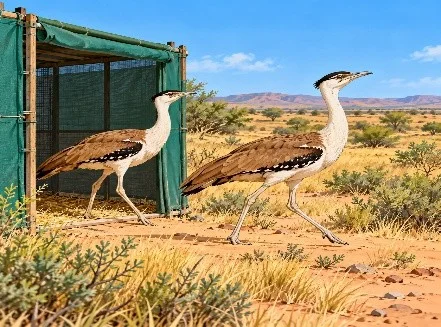
For the first time, captive-bred Great Indian Bustard (GIB) chicks are set to be released into enclosures in Desert National Park, Rajasthan. The move marks a major step in India’s conservation-breeding and rewilding programme for this critically endangered bird.
Explanation
- The Great Indian Bustard (Ardeotis nigriceps) is one of India’s most threatened grassland birds.
- It is listed as Critically Endangered on the IUCN Red List and is protected under Schedule I of the Wildlife (Protection) Act, 1972.
- Its remaining population is concentrated mainly in Rajasthan, especially around Desert National Park, Jaisalmer.
- Major threats include habitat loss, grassland degradation, power-line collisions, predation and disturbance.
- The species is a ground-nesting bird with a slow reproductive rate, usually laying only one egg.
- India runs a conservation-breeding programme involving captive hatching and rearing of chicks.
- Rewilding requires gradual acclimatisation, predator protection, adequate insect/grassland food and long-term monitoring.
- GIB conservation highlights the ecological importance of arid and semi-arid grassland ecosystems.
La Excellence IAS Academy, the best IAS coaching in Hyderabad, known for delivering quality content and conceptual clarity for UPSC 2026 preparation.
FOLLOW US ON:
◉ YouTube : https://www.youtube.com/@CivilsPrepTeam
◉ Facebook: https://www.facebook.com/LaExcellenceIAS
◉ Instagram: https://www.instagram.com/laexcellenceiasacademy/
GET IN TOUCH:
Contact us at info@laex.in, https://laex.in/contact-us/
or Call us @ +91 9052 29 2929, +91 9052 99 2929, +91 9154 24 2140
OUR BRANCHES:
Head Office: H No: 1-10-225A, Beside AEVA Fertility Center, Ashok Nagar Extension, VV Giri Nagar, Ashok Nagar, Hyderabad, 500020
Madhapur: Flat no: 301, survey no 58-60, Guttala begumpet Madhapur metro pillar: 1524, Rangareddy Hyderabad, Telangana 500081
Bangalore: Plot No: 99, 2nd floor, 80 Feet Road, Beside Poorvika Mobiles, Chandra Layout, Attiguppe, Near Vijaya Nagara, Bengaluru, 560040